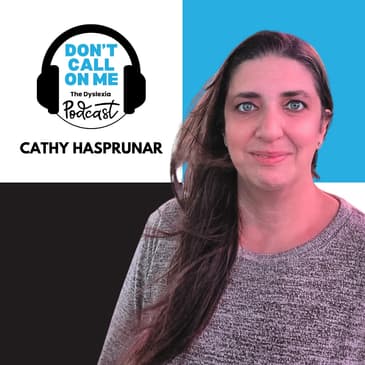
In this episode, we follow Cathy, a determined mother of twin daughters who struggle to learn to read. When the school fails to provide clear answers or data on their progress, Cathy takes matters into her own hands. Frustrated and overwhelmed, her relentless advocacy journey even lands her in the hospital. But Cathy doesn't give up. Through perseverance and networking, she finds an outside expert who uncovers the unexpected diagnoses of dyslexia and dysgraphia. Listen as Cathy shares the challenges, heartbreak, and victories of navigating the school system to get her daughters the support they need.
-
Book a consultation with Megan to discuss CALT therapy.
-
Book a consultation with Eryn to discuss advocacy services.
With Love and Gratitude,
Megan, Eryn & The Don't Call On Me Team
[00:00:00] What is your advice to other parents?
[00:00:02] Obviously don't be scared to advocate for your child. If you've got the resources to understand and fight for yourself, don't back down.
[00:00:11] I recognize that I'm very fortunate and I say all the time, what do the parents do who don't know what I know, right?
[00:00:17] So if you're not understanding or not capable of understanding, not anything against them, but you don't have the background, get yourself an advocate.
[00:00:27] You have to understand it and if you're not able to, get somebody who can help you understand. Amen.
[00:00:35] This is Megan, owner of Dyslexia On Demand.
[00:00:39] And I'm Erin, owner of Advocate to Educate.
[00:00:43] And we are the Dont Call On Me Podcast.
[00:00:46] We are here to talk about dyslexia, to remove the stigma, to hear what families really go through, and to share their stories.
[00:00:54] In both of our businesses and personal experiences, on a daily basis, we listen to people telling their stories.
[00:01:03] Many have heartbreak, many have struggle, but most all have a silver lining. Even eventually.
[00:01:09] It's all about the stories. The more we share, the more we realize we aren't alone and we are a community.
[00:01:18] No, a tribe standing together.
[00:01:24] Today's episode is sponsored by Advocate to Educate.
[00:01:27] We help parents navigate through the confusing maze of special education in public schools in California.
[00:01:34] We support families starting as early as preschool through 12th grade, creating individual education plans to support the specific needs of your unique and amazing child.
[00:01:46] To learn more, go to our website, advocate2educate.com.
[00:01:51] Today's episode is sponsored by Dyslexia On Demand.
[00:01:56] Dyslexia On Demand uses only the highest trained dyslexia therapists, and it's all one-on-one and individualized to your child's needs.
[00:02:05] The best part is that it doesn't matter where you're located, because it's all virtual.
[00:02:10] Visit us at dyslexiaondemand.com to learn more.
[00:02:16] Welcome back today.
[00:02:18] Today we are fortunate enough to have Kathy Hassprner.
[00:02:23] Did I say that right?
[00:02:24] You did.
[00:02:25] Okay.
[00:02:26] You did.
[00:02:27] I went over it a couple times in my head just to make sure.
[00:02:30] You got it.
[00:02:31] Anyway, join us today to tell her dyslexia story.
[00:02:35] So I am going to turn it over really quickly to her to give us a little bit of background, who she is, how she got here, that kind of thing.
[00:02:47] Okay.
[00:02:47] So I am first a mom of twins.
[00:02:50] I am also a speech language pathologist.
[00:02:54] Ooh.
[00:02:54] That being said, I knew nothing about dyslexia until my daughter started to struggle.
[00:03:00] Very interesting how I found out in hindsight, how much I actually knew, but that's kind of how the story unfolds.
[00:03:08] Well, it's all language continuum.
[00:03:10] So I work, I work with the birth to three population.
[00:03:14] Everything I know about birth to three is play, play, play, play is going to give them the foundation and language that they need.
[00:03:21] We have some very ambitious parents that we work with, where they're really anxious about the alphabet and reading and numbers and all of those academic skills.
[00:03:32] But actually early intervention, when you're talking about little kids that young, you really need the language before you need the academics.
[00:03:39] Yeah.
[00:03:39] So that was my mindset for my girls.
[00:03:41] I looked really hard for a preschool that was not academic.
[00:03:46] They went one day a week starting when they were two and a half.
[00:03:50] Just because I didn't, I did not want the academics.
[00:03:53] I knew that they, if they were home with me doing lots of activities, getting the social language, that was the best I could do.
[00:03:59] Fast forward, we get to kindergarten.
[00:04:01] They came to kindergarten, not knowing their alphabet, not knowing their letter sounds.
[00:04:06] None of it, none of it was shocking to me.
[00:04:08] I intentionally did not give them the background.
[00:04:10] I thought that I was doing the best at the time.
[00:04:13] Had I known what I know now, absolutely would have changed.
[00:04:17] However, that's, that's where I was at the time.
[00:04:19] So they struggled.
[00:04:21] They struggled in kindergarten.
[00:04:22] I wasn't surprised what I knew about reading at the time.
[00:04:25] Everybody is different.
[00:04:27] They're going to learn it.
[00:04:28] Reading develops between five and seven is some of the things that, that I had known.
[00:04:33] So when, when the school was concerned, I really wasn't.
[00:04:39] I knew that I was doing the best I could by giving them the foundational language skills, play-based skills.
[00:04:45] They wanted them in a pull out what they call the boot camp class five days a week.
[00:04:51] They're now in kindergarten.
[00:04:52] They're missing class.
[00:04:54] I said, okay, but tell me more about this program.
[00:04:56] What's the curriculum?
[00:04:57] Is it, is it evidence-based?
[00:04:59] What, what progress monitoring?
[00:05:01] So they had no idea.
[00:05:02] So you know all the right questions asked.
[00:05:04] I, so, so fortunately as an SLP, I do understand diagnostic testing, right?
[00:05:09] So, so I was trying to evaluate in my own mind, the cost benefit of pulling them kindergarteners out of class five days a week.
[00:05:17] So.
[00:05:18] Can I, can I interrupt?
[00:05:20] Cause I'm, I'm, I going back to making sure that I understood something that you said, and I can't, I'm fixated on it.
[00:05:28] Did you say that you weren't worried when they were, or you were worried when they were?
[00:05:34] I was not worried because the knowledge that I had at the time was that reading develops between five and seven.
[00:05:41] Got it.
[00:05:41] Um, and I was in my mind focused on this play language based sort of background.
[00:05:47] So we worked really hard to develop the language part of the reading rope, which I did not know about at the time, but I just.
[00:05:55] Okay.
[00:05:55] Now know that I ignored the other strand.
[00:05:58] And anyhow, so then I did not do, I did not do the, the bootcamp as they called it.
[00:06:04] It was pull out.
[00:06:06] It was not during their reading time.
[00:06:08] It was not evidence-based.
[00:06:11] They had no data as far as baseline or ongoing progress monitoring or any of that.
[00:06:16] So I just kind of told them, I don't see any benefit in, in the program at this time.
[00:06:21] They didn't like to hear that.
[00:06:22] We went back and forth a lot.
[00:06:25] In the end, the compromise was that they would do a push in during reading, which made sense to me.
[00:06:32] That was probably like, I don't know, March, April.
[00:06:35] So in the end they came in, they got two different times of pull-in and that was it.
[00:06:40] They were in the same kindergarten class.
[00:06:41] So, so essentially nothing.
[00:06:43] However, the school continued to tell me that they were concerned.
[00:06:47] So I said, okay, so you're concerned.
[00:06:49] Let's get some real data here.
[00:06:50] Our school also does not have a real MTSS, RTI, whatever you want to call it.
[00:06:56] They, they do not do in my district.
[00:06:59] So I requested a child study team evaluation because I had nothing else to go on.
[00:07:04] They, and that, and a child study team evaluation on the East coast, I'm assuming is an SST meeting on the West coast, which is a student study team meeting.
[00:07:14] So it's pre it's pre IEP.
[00:07:16] And this is just for the listeners to understand because you're a professional in the field.
[00:07:21] We'll, we'll just pop in and add those little nuggets of, okay, that's what this is so that parents can follow, follow this train.
[00:07:31] So you're in a position where the school is saying, and just to kind of summarize that they are concerned.
[00:07:38] You are more about, you know, okay, let's watch it.
[00:07:42] Let's monitor it.
[00:07:43] Not so concerned because they weren't offering you an evidence-based practice anyways.
[00:07:49] So you're just going to put them in this bootcamp that is doing probably more of the same that isn't working originally.
[00:07:56] But that at that time, it wasn't so obvious to you in that moment that they need something.
[00:08:04] And this, and also the reason why I'm summarizing this is because this is a very unique perspective that I don't, as an advocate, been doing this for almost 10 years.
[00:08:14] I don't hear that a lot where a parent isn't concerned, but the school, I hear that on like behavior management more because the parents are like, yeah, I deal with this behavior every day.
[00:08:29] Like, so just deal with it type thing.
[00:08:32] Right.
[00:08:32] It's not as bad as you're making it out to be.
[00:08:35] Whereas this is something where you're a professional.
[00:08:38] Yes.
[00:08:38] You worked with small children, so like babies, basically zero to three.
[00:08:42] You're not there yet in that mindset of when they have to start doing this memorization of the alphabet.
[00:08:50] When you moved into this SST process or you called it, what did you call it?
[00:08:55] Child study.
[00:08:56] Yeah.
[00:08:57] Yeah.
[00:08:58] Were they very, I'm just curious, like how their demeanor was.
[00:09:02] Were they very serious?
[00:09:03] And you were like, this isn't a big deal guys.
[00:09:06] Like, how did it go?
[00:09:07] No, they're, our district is very cookie cutter.
[00:09:10] So the reason they were concerned was because of the, how they, both of my daughters were scoring on the star testing.
[00:09:18] The star testing, they do three times a year.
[00:09:20] This bootcamp, they automatically send whatever it is, the bottom 15%, let's call it.
[00:09:26] But whatever their number is, their number is, they were below that marker and that was the end of it.
[00:09:31] I didn't really have any other good information, which was part of why I was in the position of give me something to show that if you're, if you're concerned, you're concerned.
[00:09:43] And I'm not scared of any intervention by any means.
[00:09:46] I mean, that's what I do.
[00:09:47] So I just needed something to, to show me that, that it was a struggle.
[00:09:52] Again, again, knowing that at the time I was thought I had taught, was taught that rating develops between five and seven.
[00:10:00] I'm now talking about my five and six year olds.
[00:10:03] I didn't see a reason to be concerned unless I had it.
[00:10:06] So I requested this evaluation.
[00:10:09] They resisted me at the time because their protocol said, but, but you do the bootcamp and that's the end of it.
[00:10:18] Mind you, no RTI.
[00:10:20] So if they don't do well in bootcamp, they're just kind of in it indefinitely.
[00:10:24] So we wound up going to mediation.
[00:10:26] I did not get an advocate.
[00:10:27] I felt like I knew the law well enough to, to represent myself.
[00:10:31] So we went to mediation just because they refused to evaluate, which I guess in other states, you can't refuse.
[00:10:40] New Jersey, you're allowed to refuse to evaluate.
[00:10:43] Yeah.
[00:10:44] It's kind of different in every different state, like for the most part, in terms of how that works.
[00:10:49] If it's consent, non-consent, all that kind of stuff.
[00:10:52] Right.
[00:10:53] So we went to mediation.
[00:10:55] I, I kind of got what I needed out of mediation.
[00:10:58] They, they did agree to evaluate after mediation.
[00:11:01] I was prepared to take it further.
[00:11:02] I didn't have to, they evaluated, included in the valuation was a dyslexia screening.
[00:11:08] They got average across the board.
[00:11:10] They were not flagged on the dyslexia screening.
[00:11:13] So I said, okay, so, so everything I'm doing is right.
[00:11:17] We don't, we don't need any intervention.
[00:11:19] We're good to go.
[00:11:20] So I'm going to interrupt really quickly.
[00:11:23] So at this point, how old were the kids?
[00:11:26] I mean, at kinder, had this process taken a while?
[00:11:30] I mean.
[00:11:30] This was the summer.
[00:11:32] They were tested the summer in between kindergarten and first.
[00:11:36] Okay.
[00:11:36] So were they seven yet?
[00:11:38] Six.
[00:11:39] No.
[00:11:39] Okay.
[00:11:40] Gotcha.
[00:11:40] So we move into first grade.
[00:11:42] They're still struggling academically.
[00:11:44] I'm a little bit more worried now because of the age, you know, they're, they're approaching
[00:11:48] seven.
[00:11:49] But I also knew that they didn't really have a ton of the background.
[00:11:53] So Kaylee, one of my daughters, her teacher was more concerned with her, with her writing,
[00:12:00] her letter formation.
[00:12:02] And then she, she wound up saying, but when she's cutting, it's a little bit more difficult.
[00:12:07] They were playing some kind of game.
[00:12:08] I remember the teacher had told me and the other kids couldn't read what she was writing
[00:12:12] on the paper, which was part of the game.
[00:12:15] And it was disruptive to the game.
[00:12:17] But again, no, no real recommendation other than this boot camp, which, which I was still
[00:12:23] refusing at the time for the same exact reasons.
[00:12:26] But what she was saying to me sounded like a lot of fine motor.
[00:12:29] Again, still did not know really what dyslexia dysgraphia was.
[00:12:34] I had you asked me at the time, I would have told you dyslexia is when they make all the
[00:12:38] reversals.
[00:12:39] That's not my children.
[00:12:40] And that's, that's kind of where I was, but I don't know, maybe there, there's an OT
[00:12:44] concern.
[00:12:44] So I had requested the school for, for an OT eval.
[00:12:48] Again, I was told them.
[00:12:50] So again, I went to mediation, represented myself.
[00:12:53] This is about midway through first grade.
[00:12:58] Mediation, we could not come to an agreement.
[00:13:00] So I said, I'm filing due process.
[00:13:04] The next day I reached out to my director of special ed and I said, I'm moving forward
[00:13:10] with the due process.
[00:13:11] I really feel like it's in everybody's benefit.
[00:13:13] If we could just figure this out between us, what do you say?
[00:13:17] And he agreed.
[00:13:18] He agreed.
[00:13:19] So he and I met alone.
[00:13:21] He pulled out his whiteboard and his marker.
[00:13:24] And he said, what do you need?
[00:13:25] I said, I just need her evaluated for OT.
[00:13:30] I mean, again, different states, different, different laws in New Jersey.
[00:13:34] You can't do just OT.
[00:13:36] You've got to do the full psychoeducational evaluation.
[00:13:39] They didn't have the data to warrant that evaluation, which is why they were refusing it.
[00:13:43] So he tells me, you get me a diagnosis and I'll give you $300 towards a private eval.
[00:13:51] And if that person recommends OT, then sure, I'll get you a 504 with OT.
[00:13:57] I said, okay.
[00:13:58] Oh, and then he had said, we'll do the educational testing, but not the psychological.
[00:14:02] I said, okay.
[00:14:04] So I get all of that.
[00:14:05] But I wound up going to vision therapy just because of a conference I had taken myself professionally.
[00:14:12] And I just, Kaylee's twin, Ashley, has a diagnosis of ADHD.
[00:14:17] And a lot of that was cropping up in second grade.
[00:14:20] We are now in second grade.
[00:14:22] Okay.
[00:14:23] So I said, let me just see about this vision therapy.
[00:14:27] So it turns out Kaylee got a diagnosis of convergence insufficiency.
[00:14:32] It's a diagnosis.
[00:14:33] The OT absolutely recommended therapy.
[00:14:36] So then they put Kaylee on a 504 and she was getting OT twice a week, which is great.
[00:14:42] So second grade for us was also the year of COVID.
[00:14:46] At the time, Ashley was struggling academically.
[00:14:49] It was more than just reading.
[00:14:51] She was having trouble paying attention in the classroom, hence the ADHD diagnosis and whatnot.
[00:14:59] So trying to collect my thoughts.
[00:15:01] I was like, here comes Kathy again, asking for testing.
[00:15:05] Well, I mean, this is where their stories were very much the same until about second grade.
[00:15:11] Ashley was having struggles in the classroom that looked really, really different than Kaylee.
[00:15:16] Kaylee just seemed to be all focused around this OT.
[00:15:20] People became less concerned with her reading.
[00:15:23] The star testing that they do three times a year.
[00:15:26] Sometimes she'd score fine.
[00:15:27] Sometimes she scored as high as the 50th percentile.
[00:15:30] Sometimes she'd be lower.
[00:15:31] So it really wasn't consistent.
[00:15:33] It also wasn't a test that I really considered all that valid.
[00:15:37] So I wasn't really monitoring it.
[00:15:39] Academically, they both have always done well.
[00:15:42] I don't think they've ever gotten anything below a B.
[00:15:45] But regardless, the teacher was concerned with Ashley's performance in the classroom, despite
[00:15:51] what the grade said.
[00:15:52] There were just individual homework assignments, her grasp concept, things like that.
[00:15:56] It was looking like we were gearing up towards another child study team of L.
[00:16:01] This time I had her support, except for then COVID hit us.
[00:16:04] So everything stops.
[00:16:05] Kaylee gets her OT.
[00:16:07] Our schools were closed through most of third grade.
[00:16:11] They went back to school like April of third grade.
[00:16:16] So, I mean, I just I don't blame anybody for that period.
[00:16:20] Everybody did the best that they could.
[00:16:22] It was what it was.
[00:16:24] At this point, were they noticing like what signs were showing up at this third grade mark
[00:16:31] after COVID?
[00:16:32] Or were they not even noticing because it's COVID?
[00:16:35] Exactly.
[00:16:35] It was COVID.
[00:16:36] So nobody, myself included, knew anything.
[00:16:40] Okay.
[00:16:41] They weren't monitored.
[00:16:42] Kaylee was getting her OT.
[00:16:44] I was happy with the therapy that it was getting at the time.
[00:16:46] They were still struggling with their reading, but also it's now COVID and they had struggles
[00:16:52] with reading before.
[00:16:53] So who's going to be shocked about this?
[00:16:55] There were no supports available to us because of what was happening in the world.
[00:17:00] And that's the time where so many parents started to see for themselves how bad the situation really
[00:17:08] was when they started to get the homework, especially for the kids with writing struggles,
[00:17:14] because now they had to communicate via chat to their teachers or classmates or whatever.
[00:17:19] If that was the platform of getting any sort of education at that time, that's when most
[00:17:25] parents were like, this is actually a worse problem than I thought.
[00:17:29] But it took them the whole experience of COVID to get there.
[00:17:32] Yeah.
[00:17:33] I hear that from parent after parent after parent.
[00:17:35] I have too.
[00:17:37] I've listened to Solda Story.
[00:17:38] I've read other things where parents say the same.
[00:17:41] I was working during COVID.
[00:17:43] I was doing my own virtual sessions.
[00:17:45] Both of my daughters are really independent.
[00:17:48] They like school.
[00:17:49] They liked virtual school.
[00:17:51] So I was fortunate in that sense.
[00:17:53] And they were doing what was expected.
[00:17:56] And nobody was really monitoring.
[00:17:58] I do read with them both every single night.
[00:18:01] I have forever.
[00:18:03] Ashley prefers that I read to her.
[00:18:05] I wasn't listening to her read as much.
[00:18:07] Kaylee, I knew she was struggling on words.
[00:18:09] But I mean, again, that was not any new news.
[00:18:12] Until we hit fourth grade.
[00:18:14] And I think what happened in fourth grade is that we were just back in regular school again,
[00:18:20] typical setting.
[00:18:21] And that's when alarms started going off in my head.
[00:18:24] I talked to Kaylee's teacher early on, not Ashley's.
[00:18:29] Again, Ashley's struggles continued.
[00:18:32] But it seemed more like ADHD type struggles.
[00:18:36] Organization, executive functioning was kind of where my focus was with Ashley.
[00:18:41] Kaylee, I talked to the teacher.
[00:18:43] And I said, she's not reading.
[00:18:44] She's guessing at words.
[00:18:46] The teacher comes back and says, no, no, no, she's fine.
[00:18:48] I should say that we still use Readers and Writers Workshop.
[00:18:52] We also use F&P.
[00:18:54] So he's giving me the F&P data.
[00:18:56] And sure, she's a little bit behind.
[00:18:58] But she's doing great because of ABCD.
[00:19:01] And I think she's just going to get this.
[00:19:03] And she's going to fly and whatnot.
[00:19:06] But mind you, I'm reading with her every night.
[00:19:08] And I'm like, she's guessing.
[00:19:09] And it's not even making sense is what kind of alarmed me with her guesses.
[00:19:15] It was very classic.
[00:19:16] You look at the first letter and let's just pick any word that it could be.
[00:19:19] And none of the other letters.
[00:19:20] But a really good friend of mine in Connecticut is a school psychologist.
[00:19:25] So I had been talking to him about this more and more and more.
[00:19:29] And finally, I guess about halfway through fourth grade, he says, you know what?
[00:19:34] This is great literacy specialist.
[00:19:36] She's out a certified reading specialist.
[00:19:38] This is great literacy specialist.
[00:19:39] She just retired.
[00:19:41] She's phenomenal.
[00:19:42] I'm going to see if she'll do you a favor for me.
[00:19:45] Now, prior to this, what was happening in the school was the same debate as far as progress
[00:19:50] monitoring.
[00:19:51] The school was looking for me to do intervention again.
[00:19:54] I kept asking for data.
[00:19:57] I remember one conversation clearly with my principal.
[00:20:02] So what would happen is I could not get what I needed from the teacher.
[00:20:06] I would go to the principal, to the director of special ed, even though nobody was classified,
[00:20:13] to anybody I could as far as the administrative level.
[00:20:16] So the principal had told me at one point, I said, but she's not reading.
[00:20:22] And he's like, yeah, but the FNP says she needs to work on character development and cause
[00:20:27] and effect is what he told me.
[00:20:29] And I'm like, he tried as best as he could to help me.
[00:20:34] I think, again, you don't know what you don't know.
[00:20:37] He and I clashed a lot.
[00:20:39] I just don't think he knew how to help me.
[00:20:42] But I wasn't going to accept that.
[00:20:44] So I escalated it to whoever I could.
[00:20:47] I mean, I wrote several emails to my superintendent.
[00:20:50] So anybody who I could, I would write to.
[00:20:54] At the same time that all this is happening, my friend's telling me, let me speak to my friend.
[00:21:00] She's a wonderful woman.
[00:21:02] It was great advice.
[00:21:04] I spoke to her five minutes on the phone.
[00:21:06] And she's like, I think Kaylee's dyslexic.
[00:21:09] And I mean, again, we weren't even watching Ashley at the time.
[00:21:11] And I was shocked.
[00:21:13] But I mean, it was explained to me.
[00:21:14] And I mean, again, I'm always really open for the intervention and the help and the support.
[00:21:19] I just, I mean, don't know what you don't know.
[00:21:23] And Kathy, do you mind me asking really quickly in that five minutes, like what is it that made her
[00:21:29] or do you remember her telling you what made her assume or think that it was dyslexia?
[00:21:35] I remember really focusing at the time on the fact that she was guessing at words.
[00:21:42] And she did not know all of her letter sounds properly.
[00:21:45] I mean, I think the basic one she probably knew at the time.
[00:21:47] But certainly vowels or vowel combinations.
[00:21:50] I would just get really bizarre answers from her, especially from a fourth grader.
[00:21:55] I think that's what got her there.
[00:21:58] I mean, that was February when I first reached out to her throughout the rest of the school year.
[00:22:02] She did testing.
[00:22:04] It was all done virtually.
[00:22:04] It wasn't perfect because she was based in Connecticut.
[00:22:08] She didn't offer a final formal diagnosis.
[00:22:11] But I mean, she wrote a report.
[00:22:13] She called it dyslexia dysgraphia, in fact.
[00:22:15] And so the OT struggles, I now knew what that was.
[00:22:18] I didn't even, I had never even heard of dysgraphia prior to her doing her testing.
[00:22:23] I brought it all back to the school, requested another child study team, a vowel for Kaylee.
[00:22:30] Finally, they qualified her based on, so New Jersey uses the discrepancy model.
[00:22:36] I don't know if New Jersey or my district does.
[00:22:38] Somebody uses the discrepancy model.
[00:22:40] I didn't really care what they used.
[00:22:42] At the time, I just wanted the IEP.
[00:22:44] Right.
[00:22:45] They were giving it to me.
[00:22:47] I didn't care why.
[00:22:48] So she was classified SLD the end of fourth grade.
[00:22:51] Now, Ashley had started that spring of fourth grade with the child study team testing.
[00:22:59] They found her eligible.
[00:23:01] However, average scores across the board.
[00:23:05] So they qualified her under OHI because she had the ADHD diagnosis.
[00:23:10] I mean, again, data is just so important to me.
[00:23:13] So I'm looking, I'm looking at her valid.
[00:23:15] I said, but, but she's average across the board.
[00:23:18] And I know that she's struggling and the teacher knows that she's struggling,
[00:23:22] but you're not giving me the information.
[00:23:24] And if I don't have the information, how am I going to get a good IEP with good goals?
[00:23:29] Right.
[00:23:30] I asked them for a neuropsych.
[00:23:31] They told me no.
[00:23:32] I took her anyway to the neuropsych.
[00:23:35] Neuropsych diagnosed her with dyslexia.
[00:23:38] Neuropsych also said she didn't think it was ADHD.
[00:23:40] She thought it was slow processing.
[00:23:42] I don't even know if that's relevant, but for what it's worth, that's, that's where we're at.
[00:23:46] So Ashley, I was totally surprised.
[00:23:48] Ashley did not have those classic signs that Kaylee did.
[00:23:51] It was more of the overall academic struggle.
[00:23:55] Her, her writing was below the first percentile.
[00:23:59] Mind you, she was getting A's and B's in her LA class.
[00:24:04] Yeah, but you know, that's the case across the board.
[00:24:07] Yeah, I do.
[00:24:07] I do.
[00:24:08] I do.
[00:24:09] You know that, which is what is so incredibly frustrating because you're, as a parent, that's, that's your measure.
[00:24:16] And well, yeah, my, my child's doing great.
[00:24:18] And then, and then you get that she's below the first percentile in writing and you're like, what, what is not adding up here?
[00:24:25] Yeah.
[00:24:26] Yep.
[00:24:27] It's the worst.
[00:24:28] It's, it's the worst because it, it really, it's like smoke and mirrors and it makes most parents question the entire school system.
[00:24:38] Grades are so incredibly subjective.
[00:24:41] Like we all remember that teacher that loved us or during the pandemic.
[00:24:48] I can't tell you in IEP meetings, how many teachers I heard say out loud on the recording.
[00:24:54] Oh, well, it was during the pandemic.
[00:24:56] Like we felt bad for them.
[00:24:57] So we gave them good grades to boost their morale.
[00:25:00] Totally.
[00:25:00] Okay.
[00:25:01] I was going to say the same thing, Erin.
[00:25:02] They, it is so incredibly subjective.
[00:25:05] And then you also have to remember that the teachers feel like those grades are also a reflection of themselves.
[00:25:12] So like there's a million different reasons why our kids do, they've got great grades.
[00:25:19] And then what kills me is when parents are like, oh my gosh, there's something wrong.
[00:25:25] And then, you know, they go to the school, but then admin won't do anything because they're like, they've got great grades.
[00:25:33] Well, guess what?
[00:25:33] So do all of them.
[00:25:35] They're really bright kids.
[00:25:38] But, you know, one thing I see far too often is how they will use grades when it's in their favor.
[00:25:46] Oh, sure.
[00:25:47] They will not use grades when it's not in their favor.
[00:25:51] So it's just another magic trick that they think we don't know how to do.
[00:25:56] I mean, for me and my experience, I don't think anybody in my district is meaning to do harm.
[00:26:04] I don't think people in most districts are.
[00:26:06] But I mean, specifically for my district, they don't know what good data means.
[00:26:11] So it is just something to grasp on to, right?
[00:26:13] So now you have a confirmation bias where if you're proving or if you're looking to argue that everything's fine, well, look, the grades are fine.
[00:26:20] And then if you're trying to explain to a parent that your child needs support, but yeah, they're feeling mad.
[00:26:26] They need support.
[00:26:27] Again, it just goes back to that lack of understanding of how to measure progress and good data, really.
[00:26:36] Totally.
[00:26:36] And you don't know what you don't know.
[00:26:38] And unfortunately, we put so much assumption that they do know.
[00:26:44] Everyone has the best interest of your child, but they are fighting without the right toolbox of information to be able to apply.
[00:26:53] And they also have pressures that are that's higher up that are telling them not to test, not to, you know.
[00:26:59] The same principle.
[00:27:01] He finally tells me I've reached out to a colleague of mine who's an expert in reading because she has all these credentials.
[00:27:09] I don't remember who she was.
[00:27:11] And if what you're saying is true, she says your daughter is dyslexic, still would not help me for the child study team of ours.
[00:27:18] I knew at the time that that my literacy expert report was coming like a month away and I knew what it was showing.
[00:27:28] So I kept my mouth shut at the time because I also knew I didn't have the data to support the child study team of ours.
[00:27:35] But I mean, I just I can't believe that you would be told that.
[00:27:41] Tell it to a parent in writing.
[00:27:43] I mean, his colleague was right.
[00:27:45] I guess sadly he didn't he didn't listen.
[00:27:49] And then the other thing that you were saying before with with the good grades hurting a child.
[00:27:54] Absolutely.
[00:27:55] The other thing that that really affected me is that I'm the crazy.
[00:27:59] Right.
[00:27:59] Like my friends, most of my family don't listen to her.
[00:28:03] She's crazy.
[00:28:04] You know, nothing nothing's going to be good enough for her.
[00:28:08] My daughter, Ashley, I mean, she's got quite a personality.
[00:28:11] She tells me all the time, Mom, you're just a Karen.
[00:28:15] And how old is she now?
[00:28:18] They're both 12.
[00:28:19] Oh, OK.
[00:28:20] That sounds about par for the course.
[00:28:22] I mean, she's been telling me that probably, I mean, at least a year.
[00:28:27] Yeah.
[00:28:29] I'm not ashamed of it at all.
[00:28:32] When they were getting tested for what they were getting tested for, they knew why they were being tested.
[00:28:37] But I mean, they knew that they also know they make great grades.
[00:28:41] They hear people talking.
[00:28:43] And I mean, so fine.
[00:28:44] If I've got to be a Karen, I've got to be a Karen.
[00:28:46] But you know what's so ridiculous about this is.
[00:28:49] And yes, it's like funny because it's cute because they're 12 and this and that.
[00:28:53] But if this was like a medical situation, like they were diabetic and they needed insulin and, you know, they were passing out at school.
[00:29:02] Like you wouldn't be thinking of yourself as a Karen.
[00:29:07] It's so sad that that's kind of what we end up feeling to get what our kids rightfully deserve.
[00:29:15] We're not asking for an extracurricular.
[00:29:18] We are asking for what our kids need.
[00:29:21] We just need to be able to read so we can collect information around us and writing so that we can do daily skills and chores and things, just anything around.
[00:29:34] Right.
[00:29:34] I want to catch us up to so there's clearly you are not afraid to ask for what your kids need.
[00:29:41] You're not afraid to get, you know, psychologists involved, neuropsychs involved.
[00:29:47] You're not afraid to go into your own pocket and pay for things regardless of whether you're getting reimbursed or not.
[00:29:53] So as it stands right now, where are the twins?
[00:29:57] What services do they currently have?
[00:30:01] And how do you feel about where you're settled right now?
[00:30:05] I mean, I'm going to be as brief as I can.
[00:30:06] I think a really important piece of that story is I was hospitalized for six months.
[00:30:12] Sixth grade, I was hospitalized.
[00:30:13] I got a rare autoimmune disease.
[00:30:16] I was completely paralyzed.
[00:30:17] Nobody knows what caused it.
[00:30:18] I'm doing much better now.
[00:30:20] I'm almost fully recovered.
[00:30:22] I'm positive that the stress of the advocating is what would put me there.
[00:30:27] So we kind of had a huge setback at this point.
[00:30:32] Kaylee is getting tutored twice a week all summer.
[00:30:35] Fifth grade, sixth grade, they were both in a resource room.
[00:30:38] They had once a week pull out, once pushed in from the reading specialist.
[00:30:41] Our district does IMSE, which is part of the Orton-Gillingham program.
[00:30:47] So they've had that.
[00:30:48] They've had that for two years.
[00:30:49] The school district had that available all along.
[00:30:54] The entire time.
[00:30:55] They did?
[00:30:56] Shut the front door.
[00:30:58] But they also passed their dyslexia screening.
[00:31:01] Right.
[00:31:01] That's true.
[00:31:02] Yeah.
[00:31:03] But the dyslexia screenings, I swear I'm convinced they are to not find out that your child's
[00:31:09] dyslexic, like I swear you're going to learn about the child that is so impacted that they're
[00:31:16] in fourth grade and still don't know their letters like that to me.
[00:31:20] And again, if there was some control or better control around what the screening was, and I'm
[00:31:26] not saying this is how it is for everybody, but the screener I know in my district that they're
[00:31:33] using, my son passed with flying colors.
[00:31:36] Well, doesn't mean he's not dyslexic.
[00:31:38] It's really scary that that's the measure that they use.
[00:31:43] And the reason why I bring up that they had IMSC the whole time is you got ill because of
[00:31:53] the stress of advocating for your children.
[00:31:55] That is absurd.
[00:31:57] That is unfortunately far too typical.
[00:32:01] I had another client that was having panic attacks.
[00:32:04] Yeah.
[00:32:04] So bad.
[00:32:05] She was in the ER before IEP meetings and it became a habit, not a habit, a pattern.
[00:32:12] And she also has an autoimmune condition as well.
[00:32:16] It's like, are you kidding?
[00:32:19] Offer like, God forbid you offer the child something, you know, my guess is, even though
[00:32:24] they passed, it wasn't like they were at grade level reading eloquently and writing.
[00:32:31] No, they weren't because they wanted them in boot camp.
[00:32:34] Right.
[00:32:35] Why isn't that it, that they can, they're not individualizing or like really and truly accepting
[00:32:42] like profile case by case by case basis.
[00:32:45] Because if they have IMSC, first of all, that's a great approach to teaching gen ed at the younger
[00:32:53] grades.
[00:32:54] Right.
[00:32:54] So if they had even just gotten it there, sometimes I just don't understand why districts throw
[00:33:00] up so many barriers and walls and then look where it got everybody.
[00:33:05] I had a one-on-one meeting with my superintendent at one point and I handed him the research about
[00:33:11] Lucy Calkins reading and writing workshop.
[00:33:13] So, so the answer is, is why don't they do it?
[00:33:16] Well, because we have Lucy Calkins in district, right?
[00:33:18] So I literally handed him a stack of research and then he told me how wonderful she is and
[00:33:25] how he still uses teachers college to do.
[00:33:29] I forgot.
[00:33:29] Did he say foreign services a year for the middle school teachers?
[00:33:32] And, and what a great program it was.
[00:33:34] And this teacher likes her because of this and this teacher likes her because of that.
[00:33:38] Right.
[00:33:38] So if that's where your administration's coming from, and that's the mentality that he's giving
[00:33:43] the teachers.
[00:33:43] Sure.
[00:33:44] IMSC though, that's, that's just for the special ed kids, but we've got this wonderful
[00:33:48] curriculum for everybody else.
[00:33:50] And I mean, that's, I mean, it wasn't really spelled out to me that way, but that's kind
[00:33:53] of what I'm hearing.
[00:33:54] Meanwhile, I had people telling me, well, why are you putting your kids in a resource room?
[00:33:59] And I kind of agreed with them.
[00:34:02] Only way for them to get orange.
[00:34:03] So I literally put my two kids in a resource room only to get orange.
[00:34:09] It's not abnormal.
[00:34:11] My, my prayer for the future in 20 years is that we just have science of reading based
[00:34:18] education for literacy in the gen ed class.
[00:34:21] They can help all kids.
[00:34:23] Why not just use that methodology?
[00:34:24] And then the ones that need it more intensely.
[00:34:27] Let's slow down a little bit.
[00:34:29] Like the amount of money the districts could save in providing training.
[00:34:34] It's infuriating when we are in, we're in a, we're in a national crisis already.
[00:34:41] So if you're going to do training on some kind of useless training that they do like all
[00:34:49] the time, which is just, you know, I think that the other piece too, is that there, there
[00:34:54] are still a crew of people that believe this is a, it's a fad and it's going to pass.
[00:35:01] And that when it passes, we'll all go back to balanced literacy.
[00:35:06] We're at a place now where I feel that with districts, even the superintendent, you'd assume
[00:35:14] that their end goal would be to bring up their literacy for everyone.
[00:35:20] But, you know, they don't, they don't think about their district as 20% of these kids need
[00:35:26] this.
[00:35:27] And it's such a basic concept that it's almost like mind boggling to wonder how they're still
[00:35:34] questioning it.
[00:35:35] It doesn't.
[00:35:36] Yeah.
[00:35:36] And I mean, my experience, like I keep saying, you say broken record, but it just, I mean,
[00:35:40] the amount of times that I say progress monitoring in a day, I, I know that people in my district
[00:35:46] do not understand simple data, how to, how to monitor progress, the reading specialist
[00:35:51] from this past year.
[00:35:53] So I ask for data on everything now, of course.
[00:35:55] And, and the reading specialist who is trained in IMC told me, I just don't understand numbers.
[00:36:02] None of it makes sense to me.
[00:36:03] So I just throw in what I need when I see it.
[00:36:07] And I'm like, it feels very balanced literacy.
[00:36:09] Well, and, and I like how asinine that she even opened her mouth and said that, like, do
[00:36:15] you, does she recognize how ridiculous and uneducated that sounds?
[00:36:19] Because data drives instruction.
[00:36:22] That's what it's supposed to be.
[00:36:23] But I promise you as someone with, with training and background in a lot of this kind of stuff,
[00:36:30] they're not training on how to analyze the data.
[00:36:33] They're, they're training on like how to deliver, but guess what?
[00:36:37] Like it doesn't work for every single child.
[00:36:41] Like every description, I mean, every profile is a little bit different.
[00:36:44] And I don't even necessarily just mean kids with dyslexia, just children in general.
[00:36:49] It's so sad.
[00:36:52] It's so sad.
[00:36:53] Yeah.
[00:36:54] It's so sad.
[00:36:55] Again, if you just, if you just look at the data, it's, it's clear.
[00:36:58] Like I, I was so angry at the end of fourth grade.
[00:37:02] I'm still a little bit angry, but I, I, I handed my district the data on a silver platter
[00:37:08] and it was, it was still more or less ignored.
[00:37:12] So let's get to today again, just so I want to make sure that I heard you correctly.
[00:37:16] So today, where, where, where are they?
[00:37:18] What's happening?
[00:37:19] I guess the West coast, you guys don't have those dyslexia centers.
[00:37:23] Um, we have the, y'all have children's dyslexia centers.
[00:37:27] Is that what you're referring to?
[00:37:28] I'm referring to.
[00:37:30] Yeah.
[00:37:30] They're mostly East coast.
[00:37:31] Yeah.
[00:37:32] So that's, that's kind of what I thought.
[00:37:33] So, so fifth grade, I was promised a spot for both of them.
[00:37:38] I had to turn down the spot.
[00:37:40] People wait for years.
[00:37:41] I had to turn it down because I was in the hospital.
[00:37:43] My poor husband was like barely keeping his head about above water after all that.
[00:37:49] Mm hmm.
[00:37:49] Mm hmm.
[00:37:50] Um, I'm sorry.
[00:37:51] You know what?
[00:37:52] I, that was sixth grade.
[00:37:53] It was offered to me.
[00:37:54] So, so the good news is, is that I've been told in uncertain terms.
[00:37:59] I think they're both slighted to start the dyslexia center a year later in September.
[00:38:04] They know my story.
[00:38:06] So they've kind of held it for me this past year.
[00:38:10] Ashley did phenomenal in, in the resource.
[00:38:13] I mean, again, bad data.
[00:38:15] So, so I was told she's doing better than all of the other resource kids.
[00:38:20] We want her out of the resource room.
[00:38:22] I didn't see any reason to keep her in the resource room anymore.
[00:38:26] So I agreed.
[00:38:27] So, so we've been told since like November that she'll start seventh grade in a gen ed
[00:38:33] classroom.
[00:38:33] Everybody's on the same page with this.
[00:38:35] She's still getting next week.
[00:38:36] She's going to get twice a week individual IMSE.
[00:38:39] So great.
[00:38:41] Kaylee still struggles.
[00:38:43] Nobody ever told me orthographic dyslexia, but that's what it would be called.
[00:38:48] Um, just, just very, very classic.
[00:38:50] Also very bright.
[00:38:51] So, I mean, she, she's just so textbook with all, all of that stuff.
[00:38:55] So I decided to put her in tutoring this summer.
[00:38:59] Also, if you look at the data, they, they don't have any for this past year.
[00:39:04] I've been looking at fluency.
[00:39:06] They don't measure fluency.
[00:39:07] She's kind of stagnated this year.
[00:39:09] What are they doing?
[00:39:10] I mean, it's not evidence-based, right?
[00:39:12] So it, or it's not, it's not, um, called to fidelity.
[00:39:16] Yeah.
[00:39:16] You know, I, I had asked the teacher at one point, where are their levels?
[00:39:20] How are they doing on the IMSE charts?
[00:39:22] She gave me the same exact numbers for both girls, which is just insane.
[00:39:27] Yeah.
[00:39:28] Because it's individualized, obviously, and all of that, but you're also telling me that
[00:39:32] Ashley's thriving and you want her out of the resource room, but yet Kaylee's still
[00:39:36] struggling.
[00:39:37] How, how can they possibly be doing the same things?
[00:39:40] So, I mean, it just tells me that it's not truly IMSE.
[00:39:45] So, I mean, again, that's, that's why I have her in tutoring.
[00:39:47] And then, I mean, they'll be in the dyslexia center come September, fingers crossed.
[00:39:52] Everybody says they're going to be, I mean, even the tutor says, well, now that she's here,
[00:39:55] she'll be just fine.
[00:39:57] But I mean, again, my, my own time and my own resources.
[00:40:00] And do they do take flight there at the, at the dyslexia center?
[00:40:05] What do you know what programming they're using?
[00:40:07] It's all Orton based.
[00:40:09] It's the take flight, all the cult stuff.
[00:40:12] Cause I've looked into it myself.
[00:40:13] It's not used on the East coast.
[00:40:15] Nobody knows what a cult is.
[00:40:16] It's not, it's, it's not, I know.
[00:40:19] I have to do a lot of education as to what, who a cult is.
[00:40:24] And take flight isn't exclusive to cults.
[00:40:26] It's just one of the programs, but I know that some of the dyslexia or I am under the
[00:40:31] impression, if I remember correctly, a lot of those centers do take flight, but that's
[00:40:36] why I was just curious.
[00:40:37] Yes.
[00:40:38] No, they just call it Orton.
[00:40:41] Okay.
[00:40:42] Yeah.
[00:40:42] So your journey is far from done in a nutshell.
[00:40:45] Yeah.
[00:40:46] Far from done.
[00:40:47] I've also learned, I mean, I've, I've like thrown myself into the research and learning
[00:40:52] all about this.
[00:40:53] I found this new passion myself.
[00:40:54] I want to go get my own certification, which is how I know what a cult is.
[00:40:58] Totally.
[00:40:59] Yeah.
[00:41:00] Looking to help other kids like Mike, like nobody, nobody should have to struggle like
[00:41:03] this.
[00:41:03] Right.
[00:41:04] No, no, no.
[00:41:06] And you know, you are pretty much the profile of so many parents who become a cult.
[00:41:11] And I will also tell you that that marriage of your SLP background with a cult is like
[00:41:19] the absolute gold, gold.
[00:41:20] Like when I get a resume that has both of them, I'm like, salt.
[00:41:24] I don't even know.
[00:41:24] I need to talk to that lady.
[00:41:26] But nobody knows, nobody knows what it is on the East coast.
[00:41:30] So I'm so torn.
[00:41:31] Do I want to go for cult or do I want to go for OG certification?
[00:41:35] So we have, yeah.
[00:41:36] Go for cult.
[00:41:37] Go for cult.
[00:41:37] I would go for cult.
[00:41:38] But I personally would, but that's a whole nother side conversation.
[00:41:43] We are popping up more on the East coast just so that, you know, there are more chapters
[00:41:48] that are starting of Alta, that kind of thing.
[00:41:50] But it's just a beautiful combination because now you have all of the spots in the language
[00:41:57] continuum.
[00:41:57] You have that really intense understanding and it's just they're coupled and married
[00:42:03] so beautifully.
[00:42:04] So I would totally recommend that.
[00:42:06] I want to circle around to the more emotional side of things.
[00:42:10] Sure.
[00:42:10] I want to know how the twins emotionally have or have not been affected by this.
[00:42:18] I don't, I don't necessarily think that there's any trauma.
[00:42:22] I know, I know that that's not the norm.
[00:42:25] I look for it.
[00:42:26] I worry about it.
[00:42:28] I mean, Ashley has got quite the ego.
[00:42:31] You know, you talk to Ashley, nothing's wrong.
[00:42:33] Everything's great.
[00:42:34] I'm, I'm a wonderful.
[00:42:35] This dyslexia stuff is made up with her.
[00:42:38] It's the constant fight and it's a very fine line.
[00:42:41] I love that you have such a great self-image and I don't want to deflate that.
[00:42:46] But at the same time, you've got a very real disability and you have to recognize your
[00:42:52] strengths and your weaknesses if you're ever going to advocate for yourself.
[00:42:56] So I don't think it's affected Ashley at all.
[00:42:58] And if anything, it's me trying to convince her.
[00:43:01] Maybe you should recognize this just a bit, but you know, I tread, tread lightly.
[00:43:07] Kaylee has known from the beginning, Kaylee accepted.
[00:43:09] She embraces that she's a fabulous self-advocate.
[00:43:12] She knows her accommodations.
[00:43:14] She will come home from school and she will tell me that the teacher didn't let me have
[00:43:19] my computer today.
[00:43:20] So, I mean, she, she's great.
[00:43:22] She's embraced everything.
[00:43:23] I do think that she hasn't verbalized it.
[00:43:27] I do think that it affects her confidence and her self-esteem a bit.
[00:43:31] It's just my, my gut.
[00:43:33] Kaylee and I have a lot of conversations about, you know, this is not fair.
[00:43:37] You know, it's not your fault.
[00:43:39] You know, if the school did things differently, this might look very different for you, especially
[00:43:46] in the summer.
[00:43:47] She's, she's spending her summer going to tutoring and she's giving up part of what would be fun
[00:43:55] because she has to go to tutoring.
[00:43:56] So I, it's the reminder, not your fault.
[00:44:00] It is what it is.
[00:44:01] And kind of thinks, can you describe a strength that the twins have that the more you learned
[00:44:10] about dyslexia, the more you saw how they're not maybe strong in the literacy aspect, but
[00:44:18] Oh my gosh, like look at the strength that they do have that sets them apart from maybe
[00:44:23] a traditional learner.
[00:44:24] I call, I tell the kids, those are your dyslexia superpowers.
[00:44:28] I had read it somewhere, you know, Ashley, before we knew anything, she, she had had
[00:44:33] speech therapy and the speech therapist told me early on, she's an old soul.
[00:44:38] Her out of the box thinking her, her logic, her reasoning surprises all of us.
[00:44:44] Sometimes even during the neuropsych, the way that she had answered one of the questions,
[00:44:49] the neuropsych had said to me, I I'm floored with how she answered this particular question.
[00:44:55] And she took this route instead of the other route.
[00:44:58] It, it shows thinking well beyond her years.
[00:45:01] So that would be Ashley's superpower.
[00:45:04] Kaylee is phenomenal with putting things together.
[00:45:08] That, that visual imagery for, for her birthday, she got a brand new room, all new furniture
[00:45:13] or whatnot.
[00:45:14] My poor husband's putting furniture together times too.
[00:45:18] She, she, she put together her own dresser all by her.
[00:45:23] There you go.
[00:45:24] Yeah.
[00:45:24] And she had just turned 12.
[00:45:26] I mean, I don't think I could do that as an adult.
[00:45:28] Yeah.
[00:45:30] Well, all of the, like the Legos, we cannot find a set that's hard enough for her.
[00:45:34] Her uncle bought her.
[00:45:36] Um, and, and she, it was like the hardest one we could find.
[00:45:39] And she's like, I did it in three days.
[00:45:42] Um, I love it.
[00:45:43] I love it.
[00:45:44] Oh my gosh.
[00:45:46] And it's funny.
[00:45:47] That's like such a random dyslexia strength in terms of like the visualization for the
[00:45:52] Ikea furniture.
[00:45:53] Um, I do want to ask really quickly, are they fraternal twins or are they identical?
[00:45:59] I figured because, uh, first of all, interestingly, this, you are the second mom of twins we've
[00:46:06] had this season, but amazingly all of the identical reports that I've read are literally like carbon
[00:46:14] copies of each other, like neuropsychs.
[00:46:16] It's so amazing.
[00:46:18] And I don't know if that's the case across the board, but it seems like it should be.
[00:46:21] So that's what one, cause there are differences in their dyslexia.
[00:46:24] I was curious.
[00:46:25] Oh, they're so different.
[00:46:26] Sure.
[00:46:26] Yeah.
[00:46:27] Last and final question is what advice would you give another parent?
[00:46:33] Now, I feel like you are from the moment you started talking.
[00:46:39] You're very strong as, as an individual and not all parents are like you, right?
[00:46:46] So what, what is, what is your advice to other parents?
[00:46:50] Obviously don't be scared to advocate for your child.
[00:46:52] Um, if you've, if you've got the resources to understand and fight for yourself, don't,
[00:46:58] don't back down.
[00:46:59] I recognize that I'm very fortunate.
[00:47:01] I say all the time, what, what do the parents do who, who don't know what I know?
[00:47:05] Right.
[00:47:06] So, so if you're not understanding or not capable of understanding, not, not anything
[00:47:13] against them, but you don't have the background, get yourself an advocate.
[00:47:16] You have to understand it.
[00:47:17] And if you're not able to get somebody who, who can help you understand.
[00:47:22] Amen.
[00:47:24] Thank you for tuning in to don't call on me.
[00:47:26] If you enjoyed today's episode, please follow us on social media channels and YouTube to
[00:47:32] stay connected and help us spread awareness.
[00:47:35] Join us by sharing your own stories at don't call on me.com.
[00:47:38] Your voice can make a difference.
[00:47:40] Join us in building a supportive community.
[00:47:43] One story at a time.
[00:47:45] See you next episode.