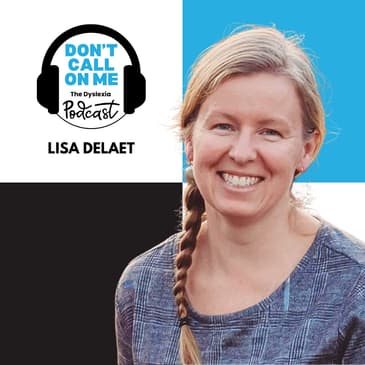
In this powerful episode of the Don't Call on Me Podcast, Megan and Eryn welcome Lisa Jensen DeLaet, a mother of two children with dyslexia, who has become a fierce advocate for early intervention and the science of reading. She shares her journey of discovering her 9-year-old son's dyslexia in kindergarten and the uphill battle she waged to secure evaluations, accommodations, and an IEP—all while learning how to navigate a system that often overlooks early signs of learning differences.
Lisa also shares the story of her 16-year-old daughter, a straight-A student whose dyslexia went unnoticed for years due to her incredible memory and compensatory skills. Through this dual perspective, Lisa emphasizes the importance of proper screening and evidence-based interventions in ensuring every child gets the support they need.
This mother's advocacy extends beyond her family: she has presented at a national health equity summit and spoken to her local school district on "Dyslexia: A Parent's Perspective." She also shares the heartwarming story of her son's newfound confidence as a 3rd grader who reads aloud in class and runs for kids with dyslexia at a suicide awareness event.
Tune in for a conversation about dyslexia where perseverance, hope, and the life-changing impact of embracing an intentional journey is sure to inspire.
-
Book a consultation with Megan to discuss CALT therapy.
-
Book a consultation with Eryn to discuss advocacy services.
With Love and Gratitude,
Megan, Eryn & The Don't Call On Me Team
[00:00:00] Your Kid Needs to Be Seen and Heard, you know, and Felt because there's nothing like going through something and feeling like nobody else is recognizing it. Nobody else is mentioning it. So, yeah, it's not a good feeling. It could be lifelong results for that early intervention.
[00:00:20] This is Megan, owner of Dyslexia On Demand.
[00:00:24] And I'm Erin, owner of Advocate to Educate.
[00:00:27] And we are the Don't Call On Me Podcast.
[00:00:31] We are here to talk about dyslexia, to remove the stigma, to hear what families really go through, and to share their stories.
[00:00:39] In both of our businesses and personal experiences on a daily basis, we listen to people telling their stories.
[00:00:47] Many have heartbreak, many have struggle, but most all have a silver lining, even eventually.
[00:00:54] It's all about the stories. The more we share, the more we realize we aren't alone and we are a community. Know, a tribe standing together.
[00:01:08] Today's episode is sponsored by Advocate to Educate.
[00:01:12] We help parents navigate through the confusing maze of special education in public schools in California.
[00:01:19] We support families starting as early as preschool through 12th grade, creating individual education plans to support the specific needs of your unique and amazing child.
[00:01:30] To learn more, go to our website, advocate2educate.com.
[00:01:37] Today's episode is sponsored by Dyslexia On Demand.
[00:01:41] Dyslexia On Demand uses only the highest trained dyslexia therapists, and it's all one-on-one and individualized to your child's needs.
[00:01:50] The best part is that it doesn't matter where you're located because it's all virtual.
[00:01:55] Visit us at dyslexiaondemand.com to learn more.
[00:02:00] Thanks everybody for joining us today.
[00:02:03] We are so excited today to hear from Lisa DeLatt, who I think it's super cool that she's in Alaska,
[00:02:10] because there are very few people, it seems in my head, that even live in Alaska.
[00:02:16] And I know that you have done a lot of work in just kind of the dyslexia world or just lots of advocacy and efforts,
[00:02:24] and we are so excited to hear from you today.
[00:02:27] So thanks for joining us, and why don't you just kind of give everybody a little bit of a brief introduction about yourself?
[00:02:33] Thank you, Megan, and thank you, Erin, for having me.
[00:02:36] So yes, Lisa DeLatt, and I currently live in Ketchikan, Alaska.
[00:02:42] My family and I have moved for the past 20 years being in the Coast Guard, and I work in the behavioral health field,
[00:02:50] and I have a husband who has dyslexia and a son who has dyslexia.
[00:02:57] And I would guess, but she hasn't been tested, a teenage daughter who also has dyslexia.
[00:03:02] So, party, party in your house.
[00:03:05] Right?
[00:03:06] We're the fun ones, I have to say.
[00:03:09] Like, we're the ones cracking the jokes, being silly, and, you know, saying things that are so just maybe not the right words.
[00:03:17] And they're looking at us like, is that really what you meant?
[00:03:21] But yeah, so I'm sure it's quite entertaining to be in your house.
[00:03:25] Yes, very much so. Yes, they're all full of personality and lots of laughs.
[00:03:31] And they're just, yeah, they're all bright and intelligent and creative.
[00:03:35] It is, it's a lot of fun. My life would be boring if I shouldn't have it.
[00:03:38] I mean, I'm not saying that, but you know, I kind of am.
[00:03:42] If you could just start out by telling us a little bit about your dyslexia journey.
[00:03:48] I know it's not yours individually, but obviously it's like we were talking about, it's a family affair.
[00:03:54] So.
[00:03:55] Yes. Yes.
[00:03:56] So when I met my husband, I knew that he had like undiagnosed dyslexia from his story of being held back twice in elementary and then still not graduating on time.
[00:04:08] And like, we'd write cards together and I'd always have to correct his your, you know, and things like that.
[00:04:15] And so it was joking and he always just said, I'm probably dyslexic.
[00:04:18] And so when we had children, I didn't really notice it with my daughter because her memorization, her memory, her other, her other skills played a factor.
[00:04:29] So I kind of call her that stealth dyslexic.
[00:04:30] And then we also moved her after kindergarten, before first grade from Alaska to Illinois.
[00:04:37] And so standards and expectations are different.
[00:04:40] So then when she was behind there.
[00:04:42] So those kinds of things.
[00:04:44] So it got away, it got away from us.
[00:04:46] But then when my son was around preschool age, I noticed some things that were different than Morgan or my daughter when she was, when she was little and that preschool age.
[00:04:58] Things like having difficulty with colors, shapes, numbers and letters, even just singing the alphabet.
[00:05:06] And so then I was like, oh, OK, maybe I'm not the best teacher for him.
[00:05:11] You know, he is a second born.
[00:05:12] He is a boy like he's got these other interests and things.
[00:05:16] So I kind of let that take over a little bit.
[00:05:19] And then when he started kindergarten, we got to that first parent teacher conference and he really hadn't made any progress.
[00:05:27] I then then I became concerned.
[00:05:29] OK, it's not me.
[00:05:31] You know, like it's like this is school.
[00:05:34] This is kindergarten.
[00:05:35] And the school really wouldn't say the the D word.
[00:05:40] I just kind of had thought about it.
[00:05:42] So I went into that full mama bird type thing and just did my my research.
[00:05:47] And so thankful nowadays for Internet, for Facebook groups, all of that of like and just books at the library and such that I quickly learned that that is most definitely what we're probably looking at.
[00:06:02] I went to the school and the school said, no, wait and see.
[00:06:07] Yeah, they all say that always.
[00:06:10] Even. Yes.
[00:06:11] Yep. I hear it over and over now that I work with other families since then.
[00:06:15] It's it's it is the typical, the same stuff.
[00:06:17] But, yeah, we'll wait and see.
[00:06:19] No, we'll start with a few accommodations.
[00:06:21] No, we have to do RTI first and then he has to fail that these things.
[00:06:25] And I said, you know, like, no, that's not acceptable.
[00:06:30] I am so thankful for those Facebook groups and other groups of like, this is what you do.
[00:06:34] You write a written evaluate request for evaluation.
[00:06:38] So I went that route and I knew that was going to take a long, long time.
[00:06:43] So I went the pediatrician route as well at the same time.
[00:06:47] And I'm so thankful that our traveler doctor, the pediatrician in Cordova, Alaska, was had just been to a reading right Alaska, a conference where they spoke about.
[00:07:00] Wow, that's awesome.
[00:07:01] That is luck. And I hear a lot about the pediatricians, unfortunately, telling me that, you know, they're like, we're not trained in this yet.
[00:07:13] Parents come to us all the time asking us questions and we feel like we have to say something in the sense of like they don't even know they don't even know what to say.
[00:07:25] And so I've been thinking about how can we like triage with them, because really it would be so great if they could say, you know, let me step out and call somebody and get back to you.
[00:07:36] That's a big area of misinformation being funneled from pediatricians, unfortunately.
[00:07:43] Absolutely. And there are actually still several, a handful of states where dyslexia is considered a medical diagnosis.
[00:07:50] So they are going to the pediatricians and they find the exact same situation, right?
[00:07:56] That in 2024, there's such little information or knowledge in the hands of the people where it needs to be, you know?
[00:08:04] So even though this is not a medical diagnosis, regardless of how some states classify it, that is an individual who you do turn to for support and guidance.
[00:08:16] And they need to know, the educators need to know.
[00:08:19] We do try to get in front of as many pediatricians as possible.
[00:08:22] But I mean, think about how many pediatricians are out there.
[00:08:25] And the stories that I read about and was warned, they were like, this is what you're going to hear.
[00:08:31] You're going to hear it. This is not a medical thing.
[00:08:33] You need to talk to the school because the school says, no, we can't handle this.
[00:08:38] You need to talk to the pediatrician.
[00:08:40] And so then the families are just bounced around.
[00:08:42] So it's an unbelievable, you know, amount of luck that I had a pediatrician traveling, you know, that just conference, just learn this information.
[00:08:52] So not only know what to say, but what to ask.
[00:08:55] Like, and he did, and I've had others to say, you know more than I do about this.
[00:08:59] Like, just let me write you a referral.
[00:09:01] You know, so doing that research, he was like, yep, this is what it sounds like.
[00:09:05] So I was just so thankful that those two paralleled.
[00:09:09] The individual evaluation and the school evaluation as well.
[00:09:15] And they both turned up, you know, that's probably what we're looking at.
[00:09:18] Of course, the school wouldn't use the word dyslexia.
[00:09:21] But that he did meet criteria for an IEP.
[00:09:26] What grade was this?
[00:09:28] Kindergarten.
[00:09:29] Still kinder.
[00:09:30] Okay.
[00:09:30] Yep.
[00:09:30] So that's why, like, knowing this was going to take some time.
[00:09:34] I started this at the first conferences in kindergarten.
[00:09:37] And we signed the IEP the very last day of school that year.
[00:09:42] And that's why I'm always like, if you even, you know, to others, if you even think that this is what it is, get the process started now.
[00:09:49] Because it's going to take nine months, you know.
[00:09:53] So basically, you're a tiger mom in the best way.
[00:09:57] I just, I feel like in a very gentle way.
[00:10:00] But I mean.
[00:10:00] Well, of course.
[00:10:01] I just mean it in the best way.
[00:10:03] Because, I mean, how many people, like, you jumped on it.
[00:10:07] You educated yourself and you pushed for that.
[00:10:09] And, I mean, it is not, most parents, they do wait and see.
[00:10:16] Or they wait for the guidance of the school.
[00:10:19] You just knew you had that, I always call it mama gut, that you knew to chase it.
[00:10:23] So you should, like, be very proud of yourself for that.
[00:10:29] It's just a lot about who you are.
[00:10:31] Getting the identification early and the intervention early is something that not a lot of parents can get on their own.
[00:10:40] So more kudos to you.
[00:10:42] Because just because you see dyslexia doesn't necessarily mean they're going to get an IEP either.
[00:10:47] No.
[00:10:48] That early intervention completely changes everything.
[00:10:53] I cannot imagine where he would be if we started this in third or fourth grade like most end up doing.
[00:11:00] Right.
[00:11:00] I can't even imagine.
[00:11:02] My wish in the world is that the term early intervention can be opened up for other spaces other than autism.
[00:11:12] Early intervention for kids who are dyslexic will make or break their future.
[00:11:17] And I don't mean that strictly from being able to read, write, and spell.
[00:11:23] It will enable them, hopefully, to bypass this inner voice in our heads that start telling us how stupid we are when we are not equal to what the person next to us is capable of doing.
[00:11:39] And I'm sure, Megan, that was a big motivator for you with your business to grow and grow so you can start getting these kids in earlier than later.
[00:11:49] But anyways, I digress.
[00:11:51] I always say you can turn a speedboat around really quickly, but a tugboat takes a lot longer.
[00:11:56] So when we can turn that speedboat around really early, a lot of times it is before they have that self-awareness of the, you know, don't call on me or I'm dumb compared to everyone else where we all know that is not the case.
[00:12:13] And one last little bit, whoever did the autism marketing also needs to do the dyslexia, just like you're saying.
[00:12:21] They got insurance coverage.
[00:12:23] I mean, what they've done is insane.
[00:12:26] And knowing how many steps that had to take is amazing.
[00:12:32] So, Lisa, I'm so sorry that we are big interrupters today.
[00:12:38] No.
[00:12:38] We really don't want to hear.
[00:12:41] This is a natural conversation.
[00:12:43] Okay.
[00:12:43] And that's connection.
[00:12:45] That shows connection right there.
[00:12:46] And that, you know, so many stories are so similar and the path forward is known.
[00:12:51] Like we know, we know we need the marketing.
[00:12:53] We know we need the kindergarten screeners.
[00:12:55] Like, you know, all of those things.
[00:12:57] So that is one thing that you all touched on was like, you know, that early intervention in Alaska.
[00:13:02] I know we're not the last state, but I think we're one of the few left that just started the mandatory screeners in kindergarten.
[00:13:10] And if you're flagged for the discrete dyslexia screener, then you get the dyslexia screener.
[00:13:15] So that's a huge step.
[00:13:17] And I feel like, you know, all the moms and dads and professionals before me that led to this to finally come into place this year.
[00:13:25] And yes, it was tough on the schools and, you know, funding and all of that.
[00:13:29] But it's absolutely necessary if we want to improve the lives of these kiddos.
[00:13:34] 100%.
[00:13:35] And like, sadly, California is one.
[00:13:37] It was lumped in with you guys.
[00:13:39] So like, I think there's eight states left.
[00:13:41] Let's go back to, okay, so your son's in kindergarten.
[00:13:46] You get this IEP the last day of school, which is always fun because nothing ever gets done after that because then you have to wait.
[00:13:54] So what happened from there?
[00:13:55] That was my thing.
[00:13:56] And so, you know how you called me a little bit of a, you know, a mama tiger.
[00:14:00] And, you know, I was, I made a dyslexia video that was shown for a health equity summit for the state of Alaska and then throughout the nation.
[00:14:08] And I talk about in there of listening to your intuition as a parent, not waiting for the school.
[00:14:15] I share in there about, you know, initially I may have come across rude when I was talking to the school, you know, just like trying to talk about something I didn't really know much about and that I expected them to know a lot about.
[00:14:27] Yeah.
[00:14:28] I got a letter in the mail at the, after the end of the school year.
[00:14:32] So during the summer from the SPED director and I have it here so I should remember, but it's just really quick.
[00:14:38] It just says, Lisa, I admire your support for your children.
[00:14:41] You are a beautiful family.
[00:14:44] And I just, it like chokes me up because like, I, I, I didn't feel so great in those meetings.
[00:14:49] Right.
[00:14:49] You know, but my, my kiddo got what he needed.
[00:14:52] If I would have done anything less, it wouldn't have happened.
[00:14:55] And you have an onus to your children, not to the school.
[00:14:59] And I know it's really hard because I am a parent who has also had to advocate for her children.
[00:15:04] So we can all cry.
[00:15:06] Right.
[00:15:06] Yes.
[00:15:07] Thanks for giving me the space to do that.
[00:15:09] But I just feel like it is important that, you know, your children need you.
[00:15:13] Like they, they're the ones, you know, like you're the one you have to listen to the intuition.
[00:15:17] You see it, you hear it, you feel it.
[00:15:19] You got to go with it and just do everything that you can for it.
[00:15:22] So, yeah.
[00:15:23] But yeah, school services have been very minimal until this year.
[00:15:27] And he, he just completed third grade.
[00:15:31] And so he's been with a private company in Alaska.
[00:15:34] There's only two that I'm aware of for the whole state.
[00:15:36] And so this year he finally made enough gains to be more than what his peers have done in a school year.
[00:15:45] So, you know, the, all the time in his interventions in school, out of class, and then his tutoring three days a week outside of school.
[00:15:56] Like he's the one doing all of this work.
[00:15:58] And I'm just so thankful that he's finally making those gains, that he's, he's making more gains than the average kiddo in school year.
[00:16:06] And that takes a lot of work.
[00:16:07] And that's not me.
[00:16:09] That's, that's him.
[00:16:10] Well, totally, totally.
[00:16:12] And he has something to, to, to feel like he's showing for all of that extra investment that he's having to make, like away from his personal time.
[00:16:24] So I bet you that's just another reason that it's just so much more meaningful to him.
[00:16:29] It, it is.
[00:16:30] And then I think it was you, Aaron, that mentioned it of like, he raises his hand and reads out loud, you know, aloud when they're reading a classroom book.
[00:16:41] Like he's the one raising his hand.
[00:16:42] He knows he's behind.
[00:16:44] He knows there's a difference between the other readers, but his self-esteem and his confidence are so intact that he's like, it's okay.
[00:16:52] And he knows that there's probably, you know, two, three, four others in his class that are in a similar situation as him.
[00:17:00] So just that early intervention to save that confidence, that self-esteem.
[00:17:05] Priceless.
[00:17:05] I can think to so many moments where I was just, even as an adult thinking about, oh my gosh, like we're reading something as a group.
[00:17:16] Like, don't please, like, I'm going to go to the bathroom or I don't have my glasses.
[00:17:20] I don't have reading glasses.
[00:17:21] Like, I don't, I don't even have them.
[00:17:23] So, right.
[00:17:24] So I'm like, what can I make up?
[00:17:27] It's really, it's the early intervention piece.
[00:17:30] I, I really hope, I hope we see through all these interviews that that really does make a big impact because it, it makes a lot of sense to me.
[00:17:38] And I would hope it does for the, the other kids that are getting that.
[00:17:43] So volunteering to read out loud.
[00:17:46] And you're probably like, what?
[00:17:48] And that's why I mentioned it because most kids are just sweating bullets.
[00:17:52] And we read the book fish in a tree.
[00:17:55] You know, she does anything like you're saying anything to get out of, you know, reading, writing, all of that, not wanting to go to school, things like that.
[00:18:04] So I just, I, I just, that to me was like absolutely amazing.
[00:18:08] And when the teacher sent me a video of it, like just tears.
[00:18:12] Oh, you're so, yeah, of course.
[00:18:13] You're so, no, kids are willing to go to the principal's office, man.
[00:18:18] They're willing to do anything.
[00:18:20] Make a fool of themselves.
[00:18:22] Act like a class clown.
[00:18:23] Get like suspended.
[00:18:25] And it's, it's all to save face.
[00:18:28] The word embarrassed is what came up.
[00:18:32] I think with every single person with dyslexia that we've interviewed thus far, embarrassed.
[00:18:37] That is the word that shows up over and over again, which is so sad to me because our schools are not even designed to teach them properly.
[00:18:46] Right.
[00:18:47] That, that is.
[00:18:50] So tell us a little bit about your daughter and that piece of the journey, because you were saying that she has been identified with dyslexia.
[00:19:00] Correct.
[00:19:01] I mean, just, just through me and my research.
[00:19:03] Okay.
[00:19:04] Yes.
[00:19:04] Okay.
[00:19:04] That's fine.
[00:19:05] That's fine.
[00:19:05] But as you said that she's a stealth dyslexic, which 100%, we see those all the time.
[00:19:10] You know, just that ability to memorize because as we, anyone listening to this probably all know that the majority of children with dyslexia or individuals are average to above average intelligence.
[00:19:24] So they have this amazing brain strength, but how did you see it?
[00:19:31] Do you see how it manifests itself?
[00:19:34] Any of that kind of stuff?
[00:19:35] Sure.
[00:19:36] Yeah.
[00:19:36] Thanks for asking about her.
[00:19:38] And she just recently, she'll now crack jokes.
[00:19:41] She'll, she'll mispronounce words.
[00:19:44] She will kind of create a word that's not real.
[00:19:49] She'll use sounds like words, like totally different definitions, but they sound like the same.
[00:19:55] She's 16.
[00:19:57] She's going into her junior year and she is a 4.0.
[00:20:03] Smart as a whip, you know, like, I don't know.
[00:20:06] She's going on calculus or something like she's, she's unbelievably smart, intelligent, I guess, like steel trap in that brain.
[00:20:14] She will memorize things.
[00:20:16] And looking back, I think that's what she did with words is that she memorized.
[00:20:21] I don't remember the number of like the average words that, that we all memorize, but she's definitely over that.
[00:20:28] So that, that memory, that steel trap has really helped her.
[00:20:32] And so now she kind of laughs about it.
[00:20:34] She's starting to accept it, I think a little bit, and she doesn't want to get a diagnosis or any, you know, she's just not ready for that level yet because she's used her other resources in, in her brain.
[00:20:45] I am not in your daughter's brain, but from everything I understand, she is having to work like 600 times harder than her neurotypical reading peers.
[00:20:57] And so have you seen that fallout or is it just that, what the other thing that I say is like, she doesn't know any different because that's the only way she's ever known that.
[00:21:06] But did you ever like, as she was growing up, see any just kind of emotional distress about just like how hard she had to work or not really?
[00:21:17] So there was the time where we moved, um, when she finished kindergarten here and feeling like she's advanced and then moving to the new state, um, of Illinois.
[00:21:27] And then her teacher had mentioned like social emotional and like this, this kid is actually like really social and has friends and, you know, a little bit shy, but just like, I didn't see those problems.
[00:21:42] The teacher was seeing the social emotional, but not identifying the reading part, the reading and writing spelling part.
[00:21:50] And unbelievably thankful for her second grade teacher there in Illinois.
[00:21:55] She has since went on to get like a master's in reading and a reading specialist and things.
[00:22:00] And I do like to think that maybe Morgan was, was part of her story, but she connected with Morgan and she, I think without knowing it, I mean, maybe her education gave her the heads up to help Morgan.
[00:22:12] And then Morgan not only got on grade level, but went above like, you know, flew past her peers in that very short, uh, second grade year.
[00:22:22] So then I was like, Oh, okay, we're, we're good.
[00:22:24] And she's amazing at math and she, she does, she holds her pencil grip.
[00:22:29] She's got the two fingers over.
[00:22:31] She's got some of those, those signs, um, outside, you know, the, the other signs.
[00:22:36] I don't know if she's ever going to need or want extra supports.
[00:22:42] I don't know.
[00:22:43] I don't know if college will be a challenge for her or not.
[00:22:47] I don't know.
[00:22:48] She's like, yeah, she's in the advanced English and math and she plays volleyball and dances and things.
[00:22:54] And, um, so I don't know.
[00:22:56] And I, I've read a little bit about dyslexia kind of on a spectrum.
[00:23:00] Um, so I'm just maybe worse.
[00:23:03] Yeah.
[00:23:04] Yeah.
[00:23:04] Yeah.
[00:23:05] Yeah.
[00:23:05] Yeah.
[00:23:06] Yeah.
[00:23:06] So maybe he is on that, you know, that, that, that lower level of her dyslexia is not the same as my husband's or her brothers.
[00:23:14] And so maybe that also is a factor in it that she's.
[00:23:18] And, you know, there's not a need to fix something that's not broken and devastating.
[00:23:25] And, and so I look at it like she could just have traits and she could have just those traits and that's it.
[00:23:32] When I talk to parents who are looking for therapy for their child, who is more of an adult child or, you know, or pushing that limit, uh, you know, about to go into college or someone who is in college, et cetera.
[00:23:48] A lot of times it's not, I kind of dissuade them or I'm very transparent.
[00:23:53] And I say, look, the number, the time it's going to take is going to be much longer.
[00:23:58] The repetition number is going to be much higher.
[00:24:01] And at the end of the day, you've made it this far.
[00:24:04] So you have to ask yourself, are you willing to commit to what it's going to take to get you there?
[00:24:11] And that gain is not going to be like it would be if you were seven years old, unfortunately.
[00:24:18] And I bet you've become really, really great at your assistive technology, regardless of whether or not you've had an official accommodation there.
[00:24:26] That's just something we all use.
[00:24:28] We're all using assistive technology every day for everything.
[00:24:31] Right.
[00:24:32] So if that is enough for you, and there's a handful that do want to commit to it because they see the struggle that they're having on a regular basis.
[00:24:40] And we do still see great progress and gains at that age because they're working with somebody who's like a highly, highly trained professional who kind of understands how to make those adaptations.
[00:24:51] But what I say is if you're not willing at your age to commit to this, you know, if they don't have an identification, I will say, go ahead and get tested.
[00:25:03] Even if it's just for shits and giggles so we can have that accommodation potential ready for you in college to have that 504 to get those accommodations.
[00:25:14] So obviously it's everyone's personal decision as to what they want to do.
[00:25:19] But sometimes I say, get that label on paper just so you have that in your back pocket.
[00:25:24] So that would be the only thing, right?
[00:25:26] There's no like window in which we can't identify dyslexia anymore.
[00:25:30] Right.
[00:25:31] Right.
[00:25:31] Right.
[00:25:31] I read stories of people in their 50s, 60s.
[00:25:34] Yeah, I agree.
[00:25:36] Thank you for that.
[00:25:37] I think I do want to cover just a little bit of the advocacy.
[00:25:40] Yes, because I was going to ask you about that next, but I wanted to make sure you were finished sharing about your kids.
[00:25:45] Oh, sorry.
[00:25:45] Yes, I think so.
[00:25:46] Yeah.
[00:25:48] Through advocacy.
[00:25:49] I mean, I feel like I started advocating just right away for my own child.
[00:25:53] And then it was just quickly like I realized how needed I was for others.
[00:25:57] The video that I did, I end with, you know, like not only does your own kid need you, but there's other kids that need you and your voice as well.
[00:26:07] So I started speaking at like school board meetings.
[00:26:10] One of the, that I love that I got to do a year ago was the preschool year.
[00:26:16] So that there was two days of training.
[00:26:18] Our school district did a trauma informed conference for all of the school district staff.
[00:26:23] And when they asked people if they wanted, you know, what they wanted, if they wanted to present what they wanted to, I was, I was expecting a no.
[00:26:30] When I said, I would love to do a presentation on dyslexia, a parent's perspective.
[00:26:36] And they said, yes.
[00:26:38] And so, you know, I started the little bit of training of like, I'm not here to lecture anybody.
[00:26:45] You know, I'm here because, you know, when I first dove into this, into dyslexia, the research, I pulled up some YouTube videos that are, that are aged.
[00:26:56] But they're grown men and women, CEOs, you know, highly intelligent individuals, highly successful individuals who break down and cry when they talk about their dyslexia.
[00:27:11] When they talk about their school years, when they talk about feeling lazy, dumb, stupid, all of those things.
[00:27:17] And so then I'm like, okay, this belongs at a trauma informed conference for a school district.
[00:27:22] Because, you know, I don't think they do it intentionally.
[00:27:25] You know, they just don't, they just don't know.
[00:27:28] Right.
[00:27:28] You know, they don't learn it in college.
[00:27:30] They have like one day on dyslexia or learning disabilities or.
[00:27:33] Or none.
[00:27:35] Or none.
[00:27:36] So, yeah, it wasn't there to lecture them, but just to let them know that there's this opportunity for them to recognize a kid who's struggling.
[00:27:43] To reckon, you know, what are the signs, those kinds of things.
[00:27:46] And so I just felt, I just, it just felt amazing.
[00:27:50] And I, I, I presented on two different times.
[00:27:53] The first time there was like seven people in the room.
[00:27:55] I'm like, oh, kind of, kind of bummed, but I will take, I'll take even one person.
[00:27:59] And the afternoon one was, the room was packed.
[00:28:02] Like 50 some people in this little classroom, you know?
[00:28:06] And so I, yeah, I, I just, I felt like that piece for me was really eyeopening of like how hungry they were for, for the information.
[00:28:16] First of all, hats off to your district.
[00:28:19] I'm very impressed that they held this like trauma informed opera, like something.
[00:28:25] It just feels so progressive.
[00:28:27] It's not, but for a school, I'm just blown away by that.
[00:28:33] But you did make a huge impact that day.
[00:28:37] Thank you.
[00:28:38] That's amazing.
[00:28:38] And that video that you were referring to that you made, is that out on YouTube for parents?
[00:28:45] It is.
[00:28:45] I think I threw it up there, got a couple of views.
[00:28:48] And then I like, I had it on Facebook or whatever, but I would gladly like email it to you all or, you know, the link or whatever.
[00:28:55] I was very thankful for that because that was a health equity summit.
[00:28:58] And someone had asked me like, oh, you're, you get to do one of these on dyslexia.
[00:29:04] And I'm like, well, your education is part of your health.
[00:29:08] You know, it's a social determinant of health.
[00:29:11] Like, yeah, it absolutely fits in there.
[00:29:13] And we talk about, you know, mental health, behavioral health.
[00:29:18] My son and I, so through my workplace, we do a suicide prevention awareness and prevention run every year.
[00:29:24] And on the back of the shirt, it says, I run for, and you just fill in the blank line.
[00:29:28] And my son wrote kids with dyslexia, you know, and so many people were like, oh, yeah.
[00:29:35] And then I talked about like, you know, mental health and suicide rates and such and, you know, prison and things like that.
[00:29:42] And so making that tie and that connection really opens the eyes to a lot of people.
[00:29:47] I have chills.
[00:29:49] We all just need to, anyone who is even remotely impacted needs to just be a voice, just like what you're doing today, Lisa.
[00:29:59] Just what we're doing.
[00:30:00] Because we can't just assume and wait for the schools to do that.
[00:30:06] I mean, all legislative change has been led by parents.
[00:30:10] It's just by those voices.
[00:30:12] And I always say, like, even if you don't think you're doing something huge, right, you're adding a bean in.
[00:30:20] And next thing we know, we have bean soup.
[00:30:22] So it's a huge, you know, the more that we hear that word, you know, I'm also amazed every day.
[00:30:31] Like, knowing, I mean, I'm obviously knee deep in this world.
[00:30:35] But just of what every parent's experience is the same story minus a few.
[00:30:44] You have great, great insight and knowledge.
[00:30:48] And I want to know, other than, because I heard you very loud and clear when you were discussing your video, that listening to your gut as a parent was like, you know, number one.
[00:31:00] I want, what other advice would you give parents?
[00:31:05] And what would you want to tell those children that aren't your own?
[00:31:09] Because clearly you're very well educated in this area.
[00:31:12] You're in the mental health field.
[00:31:15] So I think your kids are pretty well supported.
[00:31:19] So what would you tell other kids?
[00:31:21] And what advice would you give parents?
[00:31:23] Thank you.
[00:31:24] I do, I think, listening to that gut feeling, that intuition is number one.
[00:31:29] Your kid needs to be seen and heard, you know, and felt.
[00:31:34] Because there's nothing like going through something and feeling like nobody else is recognizing it.
[00:31:40] Nobody else is mentioning it.
[00:31:42] So, yeah, it's not a good feeling.
[00:31:46] And it can be lifelong results for that early intervention.
[00:31:49] I do recommend going both the IEE and the IUP route if you can.
[00:31:56] I know that insurance is a tricky thing.
[00:31:58] Even with mine, it was a tricky thing.
[00:32:01] But we make it work.
[00:32:03] And relying on those, or not relying on your children's strengths, but playing to your children's strengths.
[00:32:10] There's so many fun ways to learn to read, to learn to spell, and that to remember how, like, exhausted their brain is.
[00:32:20] That they're working twice as hard.
[00:32:22] So if they're able to accomplish something that their peers are, you know, kudos to them.
[00:32:27] Because they worked twice as hard as their classmate.
[00:32:30] And I think that early recognition, that, you know, appropriate interventions, just, you know, science of reading, evidence-based programs.
[00:32:39] There's so much out there.
[00:32:41] If you went to go Google it, you would just be overwhelmed with the options.
[00:32:45] So, you know, talking with others and figuring out what programs are appropriate for dyslexia.
[00:32:51] There's a lot out there that is not appropriate for dyslexia.
[00:32:55] Yeah, strengths, like sometimes it could be vocabulary, problem-solving, storytelling.
[00:33:01] The thing that I'm learning right now is that, you know, despite our best efforts since the end of kindergarten,
[00:33:08] that assistive technology may still be in my son's future.
[00:33:12] And that's okay.
[00:33:13] That's a big one for me because I'm like, I did what I was supposed to do.
[00:33:17] I caught it young, you know, all of that.
[00:33:19] But this is long and slow progress, you know?
[00:33:25] So it's okay if, if assisted technology is still something that is necessary.
[00:33:31] I think that that's really great advice, Lisa, to hear that from a parent's mouth, not, you know, a therapist's mouth.
[00:33:38] Or, and also to hear it from you too, Erin.
[00:33:40] But accommodations are really, really important throughout the life of a child or an individual with dyslexia.
[00:33:49] So, yeah.
[00:33:50] And I would just like to add, I mean, I've shared on social media before about like, you know, MIT and other colleges that see dyslexia as, as a skill, as a benefit.
[00:34:02] And they actually seek out that information.
[00:34:07] Even, what's the job finding one that added a dyslexia?
[00:34:11] Yeah, LinkedIn.
[00:34:12] Hashtag dyslexic strength.
[00:34:14] Yeah.
[00:34:15] I'm so sorry.
[00:34:15] Hashtag dyslexic thinking.
[00:34:16] I'm so sorry.
[00:34:19] Yeah.
[00:34:20] You know, like that, it's, you know, it can be a strength, you know?
[00:34:23] Like using the other side of your brain more in that creativity and all those other skills that are on the other side of your brain.
[00:34:31] You know, like those are amazing.
[00:34:33] I have mentioned to my family before of like, I kind of wish I had your guys' brains sometimes when I'm at work.
[00:34:39] I'm like, I just, that critical thinking, that creative thinking.
[00:34:42] I'm like, I just can't tap in there.
[00:34:45] And so, there's, yeah, many, many strengths that come with it.
[00:34:49] So.
[00:34:50] Well, so I know we've kept you for a long time today.
[00:34:53] But we so appreciate hearing from you, getting your such, you have such a valuable perspective as a mom of two with dyslexia who have really like fought that fight.
[00:35:05] So, thank you so much for taking the time today to throw your bean into that bean soup.
[00:35:11] I know you've thrown a lot, a lot of beans in though.
[00:35:13] Thank you.
[00:35:14] Thank you very much for taking the time and for doing this kind of work.
[00:35:17] Because like you both said, there's so much more work to do.
[00:35:21] So many of us are individually fighting this fight.
[00:35:24] And I think when we come together and share our stories that we can create that awareness and that change that's needed.
[00:35:31] Thank you for listening to today's episode of Don't Call On Me.
[00:35:35] If you felt a connection to the stories we shared, we encourage you to engage with us online through our social media platforms and YouTube.
[00:35:44] Contribute your own experiences at Don't Call On Me.
[00:35:48] And help us spread the word about dyslexia.
[00:35:51] Your involvement is critical as we build and support our community.
[00:35:56] Tune in next time for more empowering stories.