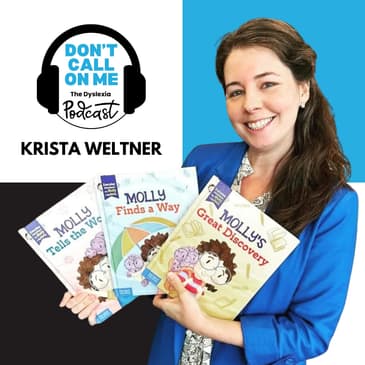
In this heartfelt episode, hosts Megan and Eryn sit down with Krista Weltner, an inspiring filmmaker and dyslexia advocate, to hear her powerful story. Krista opens up about her personal journey with dyslexia, sharing how her early struggles with reading shaped her identity and fueled her passion for creative expression. Discover how those experiences led her to create a unique stop-motion film that sheds light on the dyslexic experience in a way words alone can't. Whether you're a parent, educator, or someone with dyslexia, this conversation offers insight, hope, and the reminder that challenges can spark the most extraordinary creativity. Tune in for an uplifting conversation about resilience, storytelling, and the power of embracing differences!
- Book a consultation with Megan to discuss CALT therapy.
- Book a consultation with Eryn to discuss advocacy services.
With Love and Gratitude,
Megan, Eryn & The Don't Call On Me Team
[00:00:00] Gosh, my favorite thing about the picture book series is that I've done some school visits and just my favorite thing in the world is doing these school visits and at some point in their presentation there will be a kid that raises their hand and just says, I'm dyslexic too. They just want to interrupt me and tell me that they're dyslexic, you know? And it's like, that's something I never would have done as a kid.
[00:00:20] Love that.
[00:00:22] Yeah.
[00:00:22] This is Megan, owner of Dyslexia On Demand.
[00:00:26] And I'm Erin, owner of Advocate to Educate.
[00:00:29] And we are the Don't Call On Me Podcast.
[00:00:33] We are here to talk about dyslexia, to remove the stigma, to hear what families really go through and to share their stories.
[00:00:41] In both of our businesses and personal experiences on a daily basis, we listen to people telling their stories.
[00:00:49] Many of heartbreak, many of struggle, but most all have a silver lining, even eventually.
[00:00:56] It's all about the stories.
[00:00:58] The more we share, the more we realize we aren't alone and we are a community.
[00:01:04] No, a tribe standing together.
[00:01:10] Today's episode is sponsored by Dyslexia On Demand.
[00:01:14] Dyslexia On Demand uses only the highest trained dyslexia therapists, and it's all one-on-one and individualized to your child's needs.
[00:01:23] The best part is that it doesn't matter where you're located, because it's all virtual.
[00:01:28] Visit us at dyslexiaondemand.com to learn more.
[00:01:33] Today's episode is sponsored by Advocate to Educate.
[00:01:36] We help parents navigate through the confusing maze of special education in public schools in California.
[00:01:43] We support families starting as early as preschool through 12th grade, creating individual education plans to support the specific needs of your unique and amazing child.
[00:01:55] To learn more, go to our website, advocate2educate.com.
[00:02:01] All right, good morning, listeners.
[00:02:03] Today, we have our friend Krista here, who's going to share with us some wonderful things she has done with her dyslexia experience.
[00:02:13] But first, let's welcome you to the Don't Call On Me podcast.
[00:02:18] Tell us about yourself.
[00:02:19] Where do you live?
[00:02:21] Who do you live with?
[00:02:22] Where are you located?
[00:02:23] Yeah, thank you.
[00:02:24] I'm down in Orlando, Florida right now.
[00:02:26] I'm an artist, and I've kind of lived all over.
[00:02:29] And right now, I live with my boyfriend and my dog.
[00:02:33] Actually, we have two dogs.
[00:02:34] We just got a new one a couple months ago.
[00:02:37] And yeah, thank you for having me.
[00:02:40] I'm dyslexic, and I've been dyslexic since I was seven.
[00:02:43] But I guess probably before that, too.
[00:02:47] Probably.
[00:02:48] Most likely.
[00:02:49] Yes, exactly.
[00:02:50] Exactly.
[00:02:51] So, well, thank you so much for being here today.
[00:02:54] It doesn't just happen at a door.
[00:02:55] No, it doesn't.
[00:02:57] It doesn't.
[00:02:57] So let's start with your first memory.
[00:03:02] And you mentioned being seven.
[00:03:04] I was six, seven second grade-ish as well when I found out that I was dyslexic.
[00:03:10] So why don't you tell us a little bit about what led up to finding that out and how that
[00:03:16] beginning time of life was for you?
[00:03:20] Sure.
[00:03:21] You know, I don't remember too many indistinct struggles before getting diagnosed.
[00:03:27] I was diagnosed in second grade.
[00:03:28] I'm sure that I was struggling or not making the progress like my peers were.
[00:03:32] But to me, I was just going to school.
[00:03:35] And I think it was definitely my second grade teacher who noticed it.
[00:03:39] And I think, you know, I'm very fortunate that I was in a really good school district and
[00:03:43] I was getting a diagnosis even, you know, especially it was 1997.
[00:03:47] My mom's also a teacher.
[00:03:49] She's an art teacher.
[00:03:50] And so I think I had a lot of people looking out for me, I guess, is what I'm saying.
[00:03:53] And I remember getting the diagnosis.
[00:03:55] And I remember it was actually so much fun being like taken out of class to do these tests.
[00:04:00] Like I think we did it over the course of a couple of weeks.
[00:04:02] You know, like there's all these like little puzzles and little like time.
[00:04:05] I love that you're saying that because I've never heard anybody say that.
[00:04:11] And for so many parents are terrified of having their kids get tested.
[00:04:17] So many.
[00:04:18] They're like, what is it going to be like this and that?
[00:04:21] And I'm like, it's and I try to explain to them.
[00:04:23] It's not like the kind of test that you get that you're anxious about.
[00:04:27] It's like it is.
[00:04:28] It's puzzles and things like that.
[00:04:29] But I'm so glad that you said that because more parents need to hear that you loved it.
[00:04:34] Yeah, I know.
[00:04:36] That's funny.
[00:04:36] I've never really talked about this, but I remember I was like in a session having
[00:04:41] the test done at one point and I was working with the counselor and whoever was with me.
[00:04:46] And the recess bell rang.
[00:04:48] The teacher didn't didn't realize that the recess bell rang that I needed to go to recess.
[00:04:52] And I also didn't even though I knew it, I didn't tell her because I was like having
[00:04:57] fun doing the puzzles.
[00:04:59] But that's awesome.
[00:05:00] Yeah.
[00:05:01] But yeah, I definitely I would say my elementary school years were definitely defined by my
[00:05:05] struggles with dyslexia.
[00:05:06] You know, it did it did snowball from there and it was a big you know, there was a lot
[00:05:11] of hurdles for me to get over during that time.
[00:05:14] But yeah, getting diagnosed was OK.
[00:05:17] I know that you're in Florida right now.
[00:05:19] Where were you then?
[00:05:21] Dayton, Ohio.
[00:05:22] I'm from a town called Oakwood.
[00:05:25] It's like a suburb.
[00:05:26] Well, yeah, it's close to Dayton.
[00:05:27] Well, I got an IEP and I think that I think my mom got that like I think it's called Hooked
[00:05:34] on Phonics, that program that people were doing at that time.
[00:05:37] And she worked with me a lot outside of school.
[00:05:39] And I think at different periods, I remember being tutored after school, like working with
[00:05:43] a specialist.
[00:05:44] And at other times, I remember being taken out of class and actually like in a separate
[00:05:49] classroom for a couple hours or at least, you know, an hour a day maybe.
[00:05:52] Or well, I can't really remember the exact time, but I was in that class with like two
[00:05:56] other boys.
[00:05:58] And like, it's funny because I always talk.
[00:05:59] Oh, here's my dog.
[00:06:00] I always talk about how this is Nellie.
[00:06:04] I don't really like I don't remember knowing other kids who were dyslexic.
[00:06:08] But looking back, I think those two boys were my my separate like reading class were probably
[00:06:12] also dyslexic.
[00:06:13] Yeah.
[00:06:14] And I had I remember a big part of my IEP was that I wasn't responsible for knowing as
[00:06:18] many spelling words like as the rest of the class.
[00:06:21] So like everyone would know would have to know 20 and I would be responsible for learning
[00:06:25] 10.
[00:06:25] But if I could learn more, that was like a bonus, which I think really helped with like
[00:06:29] stress levels and whatnot.
[00:06:30] But at that time, I developed a lot of anxiety and and feelings of like isolation.
[00:06:36] And I felt really ashamed, you know?
[00:06:38] Yeah.
[00:06:39] When you're telling your experience, I was thinking I was going to say, well, so did you
[00:06:43] have any negative feelings like tied to getting pulled out and all that?
[00:06:47] Because the way that you frame it, it almost sounded not positive.
[00:06:50] But just kind of like it was what it was.
[00:06:53] But that feeling of anxiety and isolation is like obviously very common.
[00:06:59] So tell us a little bit more about that.
[00:07:02] And like maybe I think a lot of times you can parlay that into who you are as an adult.
[00:07:07] Right.
[00:07:07] So yeah, that's kind of why I'm asking a little bit more about that.
[00:07:10] Yeah, I like I've been diagnosed with generalized anxiety like in the past.
[00:07:14] I think it's probably gotten a lot better in the last couple of years.
[00:07:17] But I think a big contributing factor were those early childhood experiences, feeling very
[00:07:22] lost in the classroom.
[00:07:24] And I remember coming back from my reading in my like separate class and feeling so lost.
[00:07:29] Like I don't know what's going on in my normal class.
[00:07:32] Feeling really behind.
[00:07:34] But at the same time, very interested in the world around me.
[00:07:38] And I was I could tell that there was something different about me.
[00:07:42] You know, I could when I was interacting with adults, I could see that I wasn't I wasn't almost
[00:07:48] like giving them what they wanted.
[00:07:50] You know, when you're when you're trying to teach someone something and it's like been
[00:07:53] five times and they still don't get it.
[00:07:54] But like you could feel that stress level coming from you from the adults.
[00:07:58] So I feel like I absorbed a lot of that, you know, that's really interesting.
[00:08:05] Yeah, that feeling that stress level of adults.
[00:08:08] I feel like I remember that coming from my mom.
[00:08:10] Like she just she didn't know how to help me.
[00:08:13] And but she's very much so like if there's a problem, I will fix it.
[00:08:18] And she's such a that's her.
[00:08:20] That's how everybody knows her to be is no matter what, no matter who you are, you could
[00:08:24] be literally the person that delivers a package and you tell her you have a problem and like
[00:08:29] she's going to come up with 18 solutions for you.
[00:08:32] I remember that feeling with her when we would work together and she with homework or
[00:08:37] whatever, and she'd like be trying to help her level of frustration would get me so frustrated.
[00:08:42] And then the resentment would build because I'm like, you don't understand what I'm going
[00:08:46] through.
[00:08:47] But she felt like, well, I'm teaching you what you need to do.
[00:08:52] Just listen to me type thing.
[00:08:54] So I relate to that feeling.
[00:08:56] Yeah.
[00:08:57] And I also I've been thinking about recently that I used to like manufacture these positive
[00:09:03] interactions with adults.
[00:09:04] So if it was a teacher, for instance, nine times out of 10, I'm not having a good interaction
[00:09:09] with this teacher.
[00:09:10] So that one time, if I can control it, I would try to.
[00:09:14] So I would like ask questions or ask them to explain something to me that I already understood.
[00:09:19] That way I could pretend like they just taught me and that I quickly picked up on it to try
[00:09:25] to get a positive response, you know?
[00:09:29] And it's right.
[00:09:30] It's like.
[00:09:32] Yeah, there was a lot.
[00:09:33] There was a lot going on in my little mind.
[00:09:36] Yeah, clearly.
[00:09:38] Yeah, that's like now I'm trying to think about.
[00:09:41] Did I do that?
[00:09:42] Because I can totally see myself doing that.
[00:09:43] But did you did you find yourself like trying to cover up your dyslexia or like cheat?
[00:09:49] A hundred.
[00:09:50] Oh, my God.
[00:09:51] Cheating.
[00:09:51] Yeah.
[00:09:52] Yeah.
[00:09:52] I mean, please, God, don't judge me.
[00:09:54] I'm totally going to hell.
[00:09:56] But I swear I was trying my best.
[00:09:58] OK, that was my little prayer to make sure that, you know, I don't get struck by lightning.
[00:10:03] But I mean, no, I cheated.
[00:10:05] I don't know.
[00:10:05] This was a long time ago.
[00:10:06] But we would like sneak into the room and like literally change our grades on the computer.
[00:10:11] It was bad.
[00:10:11] We were like in this I'm talking high school.
[00:10:14] So, yeah, I'm please nobody report me if that's even a thing, because it was like over
[00:10:21] how many years ago, but still 25 years ago.
[00:10:25] Even so, I mean, for me, I really attempted to not read.
[00:10:30] That was really like reading was just so taxing and I would do anything in my power to do
[00:10:36] an alternative.
[00:10:37] So, well, yes, there was a lot of hiding.
[00:10:40] I always tried to look busy.
[00:10:42] That was my thing when the teacher's eyes were up and like scanning who to call on.
[00:10:47] And that's why we named the podcast Don't Call On Me, because I would always be busy,
[00:10:54] like somehow.
[00:10:55] I don't know.
[00:10:56] I was doing nothing, but I was looking for something always.
[00:10:59] Or attempting to tidy my books or whatever was in front of me to look like, wait, right
[00:11:05] now would be very inconvenient to call on me type thing.
[00:11:09] So, yes, I hid in that way.
[00:11:12] But I also any reading assignment that was assigned, I would either watch the movie or ask a friend.
[00:11:20] There was no way I was going to be able to read the amount that I had to read.
[00:11:25] And honestly, it could have been one page.
[00:11:27] But to me, it felt too daunting.
[00:11:31] You know, while I talk about changing grades, we did that once.
[00:11:34] But that being said, like I got fairly good grades compensating with other ways.
[00:11:41] But at the same time, yes, to answer your question, I absolutely hid what was going on because it was mortifying.
[00:11:49] Yeah.
[00:11:50] For me, I was not going to be reading out loud in front of my peers.
[00:11:53] There's no question.
[00:11:55] And if I did, right, I would have had to practice that paragraph way in advance and I would still mess up.
[00:12:02] And then there would be a student that was like on a roll and they would go, oh, just keep going.
[00:12:06] Or their paragraph was short and they go, oh, keep.
[00:12:08] And then you're like, oh, my gosh, now I'm not number 20.
[00:12:09] I'm number 21.
[00:12:10] And you've got to go back.
[00:12:13] Yes.
[00:12:14] Yes.
[00:12:14] Oh, my God.
[00:12:15] You're like, OK, can you you really messed up my pre-planning here?
[00:12:18] I'm not ready.
[00:12:20] Oh, God.
[00:12:20] I know.
[00:12:21] Oh, my gosh.
[00:12:22] Me too.
[00:12:23] How did you get through high school and what kind of grades did you get?
[00:12:28] And what do you remember in like if there's a significant experience you had in middle school versus high school?
[00:12:36] Talk about that with us.
[00:12:38] Yeah.
[00:12:39] So by the time I was going between sixth and seventh grade and I was starting in a junior high school,
[00:12:44] I had the opportunity to be retested, which I don't know.
[00:12:47] I'm not I'm not an expert on this, so I don't know what the rules are now.
[00:12:50] But I had to like get retested in order to get accommodations for junior high.
[00:12:55] At that time, I was like doing OK.
[00:12:57] And my mom always describes it as like at times I was really like borderline, like on paper, I was borderline.
[00:13:03] But in reality, I wasn't doing a lot of work and I was doing a lot of finding ways through the system.
[00:13:08] And I really saw school as this like weird mechanical system that I needed to like give to.
[00:13:15] But anyhow, so at that point, I was really ashamed of it.
[00:13:18] And my mom's like, OK, well, do you want to be tested?
[00:13:20] Like maybe we just try try to go for it without without the accommodations.
[00:13:24] And I chose not to not to get the accommodation.
[00:13:27] So I didn't have I didn't have any like formalized support in junior high and high school.
[00:13:34] Looking back, I probably I probably should have, you know, and I think the most challenging subjects were.
[00:13:39] Oh, let's see. Kind of all of them.
[00:13:42] Math was really good for me for a while until my school switched out.
[00:13:47] We switched into this weird system of like integrated math where like instead of like algebra and then geometry and then trigonometry, you had like everything all together.
[00:13:55] So it's like math like one, two, three and four.
[00:13:58] And and I think part of the idea behind that that math program was that it was also going to incorporate language.
[00:14:05] So it was a lot of word problems.
[00:14:07] So it was just like I was in on like an honors math class until they switched to that.
[00:14:12] And then I was like grade levels behind.
[00:14:14] Yeah, in until it wasn't numbers anymore, like that the I was this exact same way.
[00:14:20] The difference I felt in math and like how I just loved that math was there was just one answer and it was a number and it was black and white.
[00:14:32] It felt so black and white and nothing about reading, writing, spelling felt black and white to me at all.
[00:14:39] And now actually looking back, it's funny because when knowing what I know now that kids need to learn how to read, write and spell, there is a black and white there.
[00:14:50] It's it's not this abyss of, well, you can spell it these five ways like no.
[00:14:57] But that's how I felt because I didn't have all the spelling rules and all of that committed to memory because I my my story is a little odd.
[00:15:08] I got outside help.
[00:15:10] I'd never had any any accommodations or services in school.
[00:15:14] Math is just it was a different beast until geometry for me.
[00:15:18] And then it was like, oh, gosh, now every time I it's like deciphering the words rectangle.
[00:15:24] What is it?
[00:15:25] Tanda Tandelenium Tanda.
[00:15:27] What?
[00:15:28] What is it?
[00:15:28] I was like parallelogram.
[00:15:30] I don't know.
[00:15:31] OK, I think it's parallel.
[00:15:34] Yeah.
[00:15:35] Parallelogram tan tan tan tan a man.
[00:15:37] I don't know.
[00:15:38] And it was like, OK, this and word problems.
[00:15:41] Forget it always.
[00:15:42] No matter what the word problems like it would be, OK, here's all the computation.
[00:15:46] And then you get the five word problems and that's where you bomb.
[00:15:49] And for me, it was so bad.
[00:15:50] I didn't attempt it most of the time because I had the experience of when I attempted it and I came home with such a good feeling like I nailed that.
[00:16:00] And then I would get the test back.
[00:16:01] And now I did not nail it.
[00:16:04] And that feeling, I had that feeling in every subject.
[00:16:08] I always felt very curious and excited to learn and interested.
[00:16:12] Research.
[00:16:12] I love researching, but I'm really bad at actually executing the research paper part.
[00:16:17] So I would go into every test, every assignment feeling like I did my best.
[00:16:21] And then the results just don't match your internal how you feel.
[00:16:26] It's horrible.
[00:16:27] Those feelings of like, I nailed it, man.
[00:16:29] I just and then you get it back and you're like, how did I feel so strongly that I did it well and I just bombed it?
[00:16:38] I mean, and when that happens over and over again, it's a lot.
[00:16:43] It's a lot.
[00:16:44] Yeah, it's got to be so defeating to like see that cycle over and over again for yourself and to pick yourself back up and do it again.
[00:16:52] And I mean, I guess that's one of the things that we always say is a dyslexic strength is that perseverance.
[00:16:57] I guess that's where it comes from, but still to kind of muster that up and do it again until you don't, you know, which is common too.
[00:17:06] Yeah.
[00:17:06] And that's there's a lot of don't like and we'll get to this a little bit later.
[00:17:11] This is a question we ask later, but it feels appropriate.
[00:17:14] So I have a little voice in my head that tells me X, Y and Z about myself that completely for me stems from being dyslexic.
[00:17:25] Yeah.
[00:17:26] And before I tell you what my voice is, I'm curious to hear what does your voice tell you?
[00:17:31] Because I find that if I ask this question and we've asked it to everybody who's dyslexic that has been on our podcast there, it's really all similar.
[00:17:40] So do you have that?
[00:17:42] Can you relate to that?
[00:17:43] And what is that voice for you?
[00:17:46] Yeah, I think that my voice has changed drastically over the years.
[00:17:51] Thank you for saying that because my voice has changed over the years.
[00:17:53] I'm saying before healing, right?
[00:17:57] Oh, sure.
[00:17:57] Like what was the voice before healing?
[00:18:00] Just that you're stupid.
[00:18:03] You're dumb.
[00:18:04] You're not smart.
[00:18:06] And I'll probably get into this later, but in college, I got retested.
[00:18:10] I did actually have some accommodations for like the last half of college.
[00:18:14] And, you know, they do an IQ test or at least they did an IQ test with me.
[00:18:17] And my IQ was great.
[00:18:18] It was way above average.
[00:18:20] And it's really hard to, I don't know, just compare these two ideas you have.
[00:18:26] This idea of yourself based on how the world is responding to you, based on how your teachers are responding to you for the first like 18 years of your life.
[00:18:34] And then what is actually true.
[00:18:37] Totally.
[00:18:38] We actually, we have a student here that we brought in not too long ago and they literally have a genius IQ.
[00:18:46] But that is the exact feeling of that child still.
[00:18:53] I mean, like all of the G's are up there, you know, in these like ungodly numbers, like 145, you know, like I didn't even know the test with that high kind of thing.
[00:19:03] Right.
[00:19:04] But this child feels like a total imbecile.
[00:19:09] And it's just it's crazy how your perspective can be so different.
[00:19:13] But it's from the experiences, like the walk that that child is doing and just not being, you know, it's it's just so saddening and maddening.
[00:19:23] What our brains tell us, too.
[00:19:25] Right.
[00:19:26] Like just from our own personal experiences and how you can be super high one day and then one little thing happens and the next day it's just plummeted.
[00:19:36] And so, you know, for and especially kids, they just they I think that they tend to dwell in that plummet place.
[00:19:43] It's just it's so sad.
[00:19:46] Yeah.
[00:19:46] I want to also and bring this up because I know, Krista, you're going to totally relate.
[00:19:52] So I want to share that.
[00:19:54] And we spoke about this to a different interviewee.
[00:19:59] But I want to share with you and just bring it up in this time, because I think it's really important that our kids in America are going into a school system.
[00:20:09] If they are not at a dyslexia specific school, they're going into a school where every day it's being reinforced that they must be stupid because our classrooms are not designed for our types of brains.
[00:20:24] So when parents come to me and they say like, oh, you know, yeah, my child's like a little bit down on themselves.
[00:20:32] But like for the most part, they're great because they have other things they're good at.
[00:20:36] I have to remind them that now every day that they're in school in every subject.
[00:20:42] Because we don't get away with having math just be numbers anymore.
[00:20:46] That reinforcement of their difference in reading, writing and spelling is brought up every single day.
[00:20:53] How is that child not traumatized in an environment where most of the time their teacher doesn't even know what dyslexia is?
[00:21:06] And they're not in special ed and they shouldn't be in special ed.
[00:21:11] But their own gen ed teacher hasn't taken the time to Google it.
[00:21:16] I'm sorry.
[00:21:17] But that's like that's that's how at this point I'm just like there's so much free information.
[00:21:22] There is no excuse for you to not understand every single teacher in America.
[00:21:27] At this point, there is no excuse because it's 20 percent of our population.
[00:21:33] You can see my blood pressures up right now because I'm it's so freaking frustrating that we have to continue to advocate for something that administrators are still in denial of.
[00:21:45] They want to minimize the experience.
[00:21:47] They want to say, well, it's not that big of a deal.
[00:21:50] It is a big deal.
[00:21:51] And when the teachers cannot even have the sensitivity to be thinking in front of I'm thinking of like kindergarten, first, second and third grade teachers.
[00:22:02] If there is a child that is behind it with spelling tests, for instance, and they have failed more than two spelling tests.
[00:22:11] You need to look into that because what you are going to be reinforcing is that little voice in their head that tells that kid how dumb they are over and over and over again.
[00:22:20] It's just it blows my mind that that continues to happen when our experience.
[00:22:26] I'm definitely older than you, but not not by that much.
[00:22:30] And we both have the same experience.
[00:22:33] Like we go into an environment and we're just reinforced that we're idiots.
[00:22:37] And it's it's so sad.
[00:22:40] It really just bums me out.
[00:22:42] So I was listening to a podcast the other day and so I can't like quote the statistic.
[00:22:48] I've not looked up the research on it, but apparently one in three kindergartners who have reading difficulty, which obviously translates to not always translates to dyslexia.
[00:23:02] But I think for the purpose of this podcast, it was a child with dyslexia.
[00:23:05] One in three in kinder feels stupid and like they can't be successful.
[00:23:12] And then when we move into first grade one year later, that's two in three.
[00:23:18] So just to I mean, so early on, right, when we think of like that's the beginning of their literacy journey.
[00:23:24] Like why would they be putting so much pressure and strain on themselves as to their self-concept?
[00:23:30] But it's already there in first grade and kinder.
[00:23:34] So it's just crazy.
[00:23:36] It's very timely.
[00:23:37] We're talking about this because my son's in first grade and he's dyslexic, just like I am.
[00:23:44] And I've always been very straight with him and connected with him on a level like, hey, it's you and me, dude.
[00:23:51] Like we're we're not we're on our own little island when it comes to this.
[00:23:55] And I want you to be proud of who you are and proud of your learning abilities and the amazing brain that you have.
[00:24:02] But in your school, they're not going to understand you and you have to stand up for yourself.
[00:24:08] You know, I'm already having that conversation.
[00:24:11] And it's scary as a parent to know that I'm just kind of feeding him to the wolves.
[00:24:19] And granted, I love his teacher.
[00:24:21] She's fabulous.
[00:24:21] And it's not personal to his teacher, but it's the whole school environment and it's the curriculum that they're using.
[00:24:27] And it's the way that they're presenting materials.
[00:24:30] They're not presenting it in a language based way that our kids need.
[00:24:36] And they also move on way too fast before the skills are mastered, which we know doesn't work.
[00:24:42] You cannot move on until you have a foundation.
[00:24:45] So unfortunately, there's that's a plug for doing dyslexia intervention outside of school and starting early.
[00:24:54] Like as early as you can just start, please.
[00:24:58] OK, anywho, let's let's back to you.
[00:25:01] I'm going to talk to you because I just got on my so much.
[00:25:04] So much.
[00:25:05] Yeah, exactly.
[00:25:05] You're so much.
[00:25:05] I know I love hearing your perspective on that.
[00:25:08] And, you know, I'm not a parent.
[00:25:09] And so I don't I don't have that perspective on it.
[00:25:11] But I think teaching self-advocacy is like, oh, that's that's going to equip them as much as they can be.
[00:25:18] I think it's unavoidable trauma in this category.
[00:25:21] I was like, you know, in this what we have right now in front of us in most school systems, there is going to be some amount of emotional damage done.
[00:25:28] And it's like, what can you do to combat that?
[00:25:31] It's like sounds like teaching self-advocacy.
[00:25:34] But also, it's so complicated.
[00:25:35] Like dyslexia is so complicated.
[00:25:37] And how can you first of all, the parent or whoever's dealing with the child has to understand it.
[00:25:42] And then they have to try to help the child understand that about themselves in a positive way.
[00:25:47] But also you want to acknowledge the challenges because it's not all sunshine and rainbows.
[00:25:51] And it's like, you know, some of that dyslexia messaging that's like, oh, it's a superpower.
[00:25:55] Like, I agree with it to a little extent.
[00:25:58] But it's like, I think saying it too much is like just you are my soul sister.
[00:26:04] Number two.
[00:26:06] Number two.
[00:26:07] Because I, Megan, I didn't want to insult her because I have said the same thing to Megan.
[00:26:12] Like when we first met, I was like, we are soul sisters.
[00:26:15] But OK, in this context, I literally said when Megan and I were brainstorming for this podcast,
[00:26:22] I said the same thing.
[00:26:23] I was like, listen, I don't want this to be only about, OK, this is what you can do.
[00:26:30] Because I believe that most individuals with dyslexia want a space to commiserate with others
[00:26:36] because it's fine to have self-esteem and do the things that we need to do to get by on a daily basis.
[00:26:44] Yeah.
[00:26:45] If you do have kids one day, wait until you, you know, read them their books at night and they start giggling because you're messing up.
[00:26:53] And they say, can daddy read instead?
[00:26:55] And everyone's laughing.
[00:26:56] And of course, I'm not offended at all, but that's the reality.
[00:27:01] And then what happens the next night when you go to read to them?
[00:27:03] You're like, all right, I guess my husband should read, right?
[00:27:07] And those things still come up.
[00:27:09] And it comes up in different ways as an adult, right?
[00:27:11] Like I'm trying to run a business and that voice in my head tells me no matter how hard I try,
[00:27:16] it's just a waste of time because I'm not going to get it right and I'm going to fail.
[00:27:21] So like just putting in effort, why would I do it?
[00:27:24] And that's not a way to run a business at all.
[00:27:27] So I have to fight that on a daily basis.
[00:27:29] But it will not be sunshine and rainbows until our for me, until the next generation of kids can be seen for their abilities.
[00:27:42] And we can create a school system that does have a bit of a separation.
[00:27:47] And I don't mean that they they need to be separated, but our kids need to not be put in special ed.
[00:27:55] Of course, some kids have other issues going on, but I'm strictly saying like they don't need to be labeled.
[00:28:02] And I don't even like the label of special education anyways, but we don't need to spend resources that kids with cerebral palsy and all these things need.
[00:28:11] They need those resources.
[00:28:12] They need that.
[00:28:13] What we need to do is start teaching them how to read, write and spell from the get go the right way, which we have all the data out there to do.
[00:28:23] Yet we're not doing it.
[00:28:25] But so I agree with you.
[00:28:27] It's not it's we're not there yet for it to be sunshine and rainbows.
[00:28:31] And it doesn't feel like the world yet has fully embraced learning the way that we learn.
[00:28:40] Right.
[00:28:41] Like, I don't know how college was for you.
[00:28:42] I was going to ask you if you had an easier time in college.
[00:28:45] I certainly did.
[00:28:47] Where I went anyways, they were a lot more flexible.
[00:28:49] They could be more flexible with me than the poster that I had to do in English class because the teacher was too lazy to make it in some other fashion for me or whatever.
[00:29:02] Right.
[00:29:02] But how was college for you?
[00:29:06] Yeah, college was was pretty great.
[00:29:08] I went for I went to the University of Evansville for undergrad and I actually have a graduate degree also from the University of Connecticut.
[00:29:15] I studied theater design and technology focused on costume design.
[00:29:19] So I've been that's the other thing is like because I have an art teacher mother, I've been sewing and painting and drawing and doing all these other things, you know, in our house all the time since I was before I can remember.
[00:29:30] You know, I think that my grandma and my mom were teaching me how to sew when I was like three years old.
[00:29:35] And so, yeah, so I went to college for something that I was very interested in.
[00:29:38] And I think that helped a lot.
[00:29:39] But I think a lot of people think, oh, art degree, like it must have been so fun and easy.
[00:29:43] And yeah, it was fun, but I wasn't necessarily easy.
[00:29:46] You know, it was a liberal arts degree.
[00:29:48] So I also took other classes and I actually hit a complete wall with Spanish.
[00:29:54] So like I take in Spanish like three times by that point, you know, in junior high and high school.
[00:29:58] And like somehow our educational system, it just like never clicks.
[00:30:01] It never it's never enough to actually learn it.
[00:30:04] So you're just like filling these requirements most of the time unless you're really taking off with it.
[00:30:08] I was in like second semester Spanish, I think my sophomore year or maybe my junior year of college.
[00:30:14] And I had a complete panic attack because it was like my my tricks were not going to be working in this in that that higher level.
[00:30:23] You know, my usually I would get through it by, you know, getting through these vocabulary tests by by writing the word over and over and over again.
[00:30:31] So it was just I was learning muscle memory.
[00:30:33] I wasn't actually learning the word or how it actually sounds.
[00:30:37] And so at that that first class, the teacher was completely talking in Spanish.
[00:30:42] She was like, we're not going to be speaking English at all.
[00:30:43] It's just Spanish.
[00:30:44] You just get we're just going to this is how we're doing it.
[00:30:47] And I just had a complete panic attack.
[00:30:49] I went to the bathroom is like crying, you know, and I I I finally had enough.
[00:30:54] And I was like, called my mom, called my dad.
[00:30:56] I was like, I need to get retested.
[00:30:58] I need to get some help.
[00:30:59] And it wasn't just that class.
[00:31:00] I also needed some support in some other classes where tests were really difficult.
[00:31:05] Like I had a theater history class that was super intense, the most intense class I've ever taken, probably.
[00:31:12] Just a lot of reading and every lot of tests, a lot of essays.
[00:31:16] The tests were actually essay format.
[00:31:19] So that was really difficult.
[00:31:20] But that teacher was amazing.
[00:31:22] She really was kind.
[00:31:23] And she was one of the people that pushed me to to get tested because I told her I'm dyslexic, but I don't have it on paper.
[00:31:29] And she was like, OK, it was helpful that I told her that because she was able to help me out a little bit before we had the paperwork in place.
[00:31:36] So I had extra time on tests, which helped.
[00:31:39] One of the coolest things about that was that I got to also instead of the language requirement, we substituted in some cultural classes that I would have never was another never was never otherwise.
[00:31:49] Otherwise. Yeah.
[00:31:50] We're making up words here.
[00:31:51] That's fine.
[00:31:53] And it was what did I take?
[00:31:55] It was Egyptian archaeology.
[00:31:58] I was sitting in this class with all these archaeology majors.
[00:32:01] And then this teacher walks in and she's got a bunch of bags and she's shuffling in and she's like, sorry, I'm late.
[00:32:06] I was just on a plane.
[00:32:07] I just got back from a dig in Jordan.
[00:32:09] We're like, what?
[00:32:10] This lady?
[00:32:11] She's the coolest.
[00:32:12] She was like Indiana Jones, you know.
[00:32:15] In my theatrical mind, she was Indiana Jones.
[00:32:17] And I just really enjoyed that class.
[00:32:19] Yeah.
[00:32:20] I took some other cultural classes, too.
[00:32:21] I can relate to the experience in college because I went to Brooks Institute of Photography for my undergrad.
[00:32:29] I spent my first year in Boulder, at UC Boulder, and just fell apart.
[00:32:33] Like there was no way I was going to be in a lecture with 500 kids and not have to even go and take one test.
[00:32:40] And that was it.
[00:32:41] There was no way.
[00:32:42] And I learned in that moment, like, well, I thought I learned in my head, like, what a dumbass I was and continued to reinforce being so, quote, stupid.
[00:32:55] But really, it was the environment and me not being able to learn in that environment.
[00:33:00] So I went to photography school.
[00:33:01] And what's so funny about your story is that when I went, I was thinking, oh, I'm not going to have to take, like, English.
[00:33:07] Thank God.
[00:33:08] Right.
[00:33:08] Oh, my gosh.
[00:33:08] The classes were so technically hard.
[00:33:12] And I did absolutely have to take all of the academic classes that I remember doing so poorly.
[00:33:19] But you know what?
[00:33:21] I got through it.
[00:33:22] And then I went to a college that oddly only had essay format for everything.
[00:33:28] There was absolutely there were no tests.
[00:33:32] It was all written responses.
[00:33:34] And I, again, had a panic attack just like you.
[00:33:37] And then I was like, you know what?
[00:33:38] I can let me just try it.
[00:33:40] And the teachers were like, just try.
[00:33:42] We'll help you.
[00:33:43] We'll help you.
[00:33:43] And honestly, it was that it it elevated my confidence so much because I that's all I did for whatever.
[00:33:51] However long I went there.
[00:33:52] That is all I did was write essays and go to the writing lab there and get help.
[00:33:57] And it really did now having that other degree that was solely based on writing.
[00:34:03] It did really boost my confidence.
[00:34:05] So let's go back to our kind of formatted questions here just to make sure we we get all of this documented for the sake of your dyslexia journey here.
[00:34:17] Um, so why don't you talk a little bit about as an adult?
[00:34:22] What do you do every day?
[00:34:24] What keeps you busy?
[00:34:25] And if your dyslexia strengths come into play now, which I'm assuming as a creative, they do.
[00:34:33] So talk a little bit about how like now your world is and what you've done to get to this place.
[00:34:40] And I want to just add really quickly that this is where Chris is going to talk about the whole place that I found her.
[00:34:47] She is like living the artist profession.
[00:34:52] Like she's somebody who is working it and she's massively talented.
[00:34:58] Um, I found her on a post and read it.
[00:35:01] It was the coolest thing what she has.
[00:35:04] Your brain must be just this beautiful, creative place.
[00:35:08] So tell us about, about all that.
[00:35:11] Yeah, I just discovered read it really recently.
[00:35:13] So that's, that was fun that you found me on there.
[00:35:15] Not the, I knew read it existed.
[00:35:17] I didn't just discover it, but I just got active on there.
[00:35:20] Um, so in grad school, I actually studied puppetry arts in grad school and I was doing a lot of like, at that time, I really fell in love with writing my own stories and creating my own characters.
[00:35:31] And at that time I like, I thought puppetry was going to supplement my costume design career.
[00:35:35] I thought I'm going to be a costume designer that can also do like design puppets for theater.
[00:35:40] Yeah.
[00:35:40] My love of storytelling really took off at that point.
[00:35:42] And I, I made a short film about, about my dyslexia for my graduate project, which was what you found on Reddit.
[00:35:48] Um, it's a 10 minute short film.
[00:35:49] It's out there for free.
[00:35:50] It's out there on YouTube.
[00:35:51] It's on my website.
[00:35:52] It took me a year to make.
[00:35:54] Um, and I really, it's funny what I didn't know.
[00:35:58] Like I did not know that much about stop motion, but I just wanted to make this story.
[00:36:02] I really wanted to make some kind of piece of art that didn't tell people what dyslexia was, but showed them how it feels.
[00:36:10] Cause like, we've been talking about this whole time, just that emotional, that internal experience.
[00:36:14] Like that's what I felt people didn't understand.
[00:36:16] If I was with a professional that understood dyslexia, like they still, it's like, still, I felt like don't quite, you don't quite get the emotional impact.
[00:36:25] And, um, in my other advocacy work, I'm also a picture book author and illustrator.
[00:36:30] I have a picture book series, um, about dyslexia.
[00:36:32] And I focus there a lot on the social emotional development of dyslexic children and helping support them in their emotional needs.
[00:36:40] So this is really where I can help and contribute to the universe.
[00:36:43] Cause I'm not a, you know, I'm not a dyslexia therapist.
[00:36:45] I'm an artist.
[00:36:46] Um, but I have an experience that I can, you know, I can tap into to hopefully help others.
[00:36:52] It's hugely valuable.
[00:36:53] I mean, your stop motion film, it illustrates exactly what you're trying, the purpose that you were trying to get at.
[00:37:00] Right.
[00:37:00] I mean, it made me cry and there's no words in it.
[00:37:04] Right.
[00:37:04] Um, and I think that what you're bringing to the table is exactly, we don't all have to be dyslexia professionals to understand what that experience in that journey is like.
[00:37:15] Right.
[00:37:15] And so being able to find some kind of parallel with someone else where, um, they know that somebody else identifies and, and really to just spread that message out.
[00:37:27] I mean, like back to what Aaron's saying, like, you know, shame on you teacher for not, you know, looking up what it's about.
[00:37:34] Okay.
[00:37:35] Well, don't even look up what it's about.
[00:37:37] Watch something like what you created to understand a little bit what it's like to walk a mile in one of your students' shoes.
[00:37:44] So Megan to, and I don't think you intentionally said it in, in a negative way, but when you just said something or I heard it this way that you don't necessarily have to have dyslexia to understand or to, you know, like dyslexia professional.
[00:38:02] Yeah.
[00:38:03] Professional.
[00:38:03] Professional.
[00:38:03] Yeah.
[00:38:04] Um, that has come to mind recently, lately a lot because you know, when, okay, I'll, I'll use this example later in my life.
[00:38:13] I struggled with an eating disorder that, um, kind of took me by surprise.
[00:38:18] Well, it didn't really actually, if I really looked back, but that was like my secondary way to deal with the emotions of my dyslexia that ended up occurring.
[00:38:29] That all being said, when I was trying to find treatment, it was very difficult for me to take advice from somebody who didn't also struggle with that same disorder because I felt so much more comfortable sharing with somebody that I could say, blah, blah, blah, blah, blah.
[00:38:49] You understand.
[00:38:50] Right.
[00:38:50] And like, just having that ability to understand what it's like, I think through art, through our voices, that's the whole purpose of making these, these shorts or any type of art around this because so desperately we want others to understand and walk a mile in our shoes so that they can really understand that this experience of being dyslexic
[00:39:17] dyslexic does change the way you exist on the daily.
[00:39:22] And that is not just because we're having to read everywhere we go or write everywhere we go.
[00:39:28] It's just the way that we take in information and all around us.
[00:39:32] So it's, it's not just when we're doing academic tasks.
[00:39:38] I think if anything, that's another piece of this that I want others to understand that dyslexia is in our thinking as well.
[00:39:48] It's, it's not just in a classroom that this shows up in our life.
[00:39:54] And most of the time when we have that type of dyslexic brain, we are really good at X, but not so good at Y.
[00:40:03] And like the reality is people can have the same thing with, with math.
[00:40:08] People can absolutely have dyscalculia.
[00:40:11] I love saying that word.
[00:40:15] And right.
[00:40:16] And have the same experience in their day to day.
[00:40:19] My best friend experiences that.
[00:40:21] And when we go out to dinner, right.
[00:40:23] I'm the one, like if we're in an Italian restaurant, I'm the one being like reading the word and like being like, you want like babuchi nikaku?
[00:40:33] Like, I don't know.
[00:40:33] That's not the, that's not the word, but I'm trying to read an Italian word.
[00:40:37] Right.
[00:40:37] And then at the end of dinner, when the receipt comes, she's like, how much tip do I include?
[00:40:43] It's over.
[00:40:43] Can you just help me?
[00:40:44] Right.
[00:40:45] So it's just an interesting perspective to think about that.
[00:40:49] This is not just specific to school.
[00:40:52] Yeah.
[00:40:53] Anyways.
[00:40:53] So tell us, tell us about more about your project.
[00:40:57] Sure.
[00:40:57] Well, I'll just, I want to bring something to mind.
[00:40:58] Cause you just remind me like it's those, like those little things that nobody else would ever think about, but I'm curious.
[00:41:03] I just want to say that the worst for me is when I'm in the grocery store and they've changed the graphic design of the label on like the pasta sauce I buy or something.
[00:41:11] You know what I mean?
[00:41:12] And I can't find the pasta sauce.
[00:41:13] And it's like, I bought that 20 million times and I can't, I don't even know the name of it.
[00:41:17] Cause I'm not, it's like my brain just avoids reading things or like, or like when stuff pops up on the computer, it's like my, my instinct is like, well, I'm not going to read that.
[00:41:25] I'm not going to understand.
[00:41:26] So I just like click through and then I find myself in a, you know, in a bad spot.
[00:41:29] Right.
[00:41:30] No, no, that is even with instructions.
[00:41:34] Like my husband knows I will never be reading instructions to like put something together.
[00:41:38] So whenever the kids get a toy or something and I, I'm like, I don't understand.
[00:41:43] And he's like, well, where are the directions?
[00:41:45] I'm like, they're in the box.
[00:41:46] Like what?
[00:41:47] Duh.
[00:41:48] I'm not going to read those.
[00:41:49] Those Ikea instructions are great though.
[00:41:51] Cause it's a visual.
[00:41:52] Yes.
[00:41:53] Right.
[00:41:53] Those are great.
[00:41:54] Right.
[00:41:54] But absolutely.
[00:41:55] Yeah.
[00:41:56] But yeah, with my projects, like the short film I made in 2015 or 16.
[00:42:01] So it's been some time.
[00:42:02] And I think when I was making that film, I, it's probably been the most rewarding artistic
[00:42:08] thing I've done.
[00:42:09] I've done a lot of other projects on a lot of other topics, but that was the most rewarding
[00:42:14] thing I've ever probably worked on.
[00:42:16] Um, because I was going through so much at the time and really investigating my own childhood
[00:42:22] and think like I was at that, I was like 25 or 26.
[00:42:24] And so I was able to actually look back and think about my dyslexia and think about how
[00:42:28] it's affected me and, um, do something about it, you know?
[00:42:31] So it was really actively changing something that I really hated about myself and turning
[00:42:36] into this positive thing.
[00:42:37] Um, and not just about creating the piece, but just doing the research.
[00:42:40] Like at that time I was doing so much research about dyslexia, finding out about those like
[00:42:45] research back, like actual strengths and realizing that, Oh, like every, everything about the
[00:42:50] way I actually think and create and process everything I love about the way I think and
[00:42:55] create and process is actually because of this thing I thought I hated.
[00:42:58] Um, so it really became like overnight, not overnight, but over the course of that year
[00:43:05] really became this powerful, positive thing, which it had not been.
[00:43:08] So it's amazing to me to think how far I've come in my, my thought process about it.
[00:43:13] But that film is really, it's great for people like us who are looking back on their childhood
[00:43:18] and like dealing with a lot of those negative emotions.
[00:43:21] Um, because the film is, like I said, it makes you cry.
[00:43:24] I think it does get into some heavier, uh, feelings.
[00:43:29] And I think getting through that really helped me be in a space where I was able to produce
[00:43:35] my picture book series years later, which came out earlier this year in my picture book series.
[00:43:39] It's like Krista back then wasn't ready to write this series, but having gone to write
[00:43:43] what I went through the film, you know?
[00:43:46] And gosh, my favorite thing about the picture book series is that I've done some school visits
[00:43:52] and just my favorite thing in the world is doing these school visits.
[00:43:55] And at some point in my presentation, there will be a kid that raises their hand and just
[00:44:00] says, I'm dyslexic too.
[00:44:01] They just want to interrupt me and tell me that they're dyslexic, you know?
[00:44:04] And it's like, that's something I never would have done as a kid is love that.
[00:44:09] Yeah.
[00:44:09] I also do a lot of other things.
[00:44:11] I, right now I'm working at a theme park industry.
[00:44:13] Um, I'm a figure finisher.
[00:44:14] So we make, um, like animated figures, like, like animatronics, like making them beautiful.
[00:44:20] So it's a lot of like fabric for, yeah.
[00:44:23] Like three-dimensional problem solving.
[00:44:24] So that's, that dyslexic strength being brought in there.
[00:44:27] Um, and I've also worked on two films.
[00:44:29] I, I moved out here from Portland, Oregon, where I was working on some in the film industry.
[00:44:33] And I worked on, uh, Wendell and Wild, which is on Netflix and Wildwood, which is a stop.
[00:44:39] It's an upcoming upcoming.
[00:44:41] Is that the right word?
[00:44:42] Forthcoming.
[00:44:43] I don't know.
[00:44:43] It's an upcoming movie.
[00:44:44] Up and coming.
[00:44:46] Yeah.
[00:44:46] It's not out yet.
[00:44:48] Uh, so.
[00:44:49] I'm amazed.
[00:44:50] I have to make, do y'all know what, I don't even know if y'all know what a mom is.
[00:44:54] Do y'all know what a mom is for homecoming?
[00:44:56] It's like a big Texas thing where, okay.
[00:44:58] Yeah.
[00:44:58] It's got ribbons and it's anyway, I have to make a bunch of them and I can't even figure
[00:45:04] out how I'm going to hot glue this stuff together.
[00:45:06] And I'm just like, I'm amazed that people like you can produce what you do.
[00:45:13] Like, you know, even just what I saw.
[00:45:15] And I mean, what I saw was just incredible.
[00:45:18] Um, and then I've seen your book too, but, but you talking about, um, creating these figures
[00:45:24] and all of these different fabrics and textures.
[00:45:26] And I'm just like, wow, my, my mind just exploded.
[00:45:30] Um, so it's amazing.
[00:45:32] I just never thought I would have this kind of career, especially the theme park stuff.
[00:45:36] It was just, I needed a job right out of grad school.
[00:45:38] And my degree was in puppetry arts with like, that's a whole other story that that was the
[00:45:42] label of the degree.
[00:45:43] It's kind of interesting going out into the world with, with such a piece of paper.
[00:45:46] But, you know, I found work in the theme park industry at that time.
[00:45:50] And then, then I went to film and then I went back to theme parks.
[00:45:52] So it's been, and you're, you're still very young.
[00:45:55] So you've got a whole life ahead of you too.
[00:45:58] Um, okay.
[00:45:59] This is just a side question here.
[00:46:02] Does your dyslexia come into play with your boyfriend?
[00:46:05] And I, I asked that because, um, of like what happens in my household when we have to make
[00:46:11] a grocery list and he's like trying to read the way I spell zucchini or something.
[00:46:16] And he's, I mean, we giggle and laugh at this point, but I'm just curious, like, does anything
[00:46:23] like that come into play in your household?
[00:46:26] Hmm.
[00:46:26] I think sometimes if I'm in the car and I'm giving directions, so I'll say right when
[00:46:31] I mean left or like, you know, it's, or it's, Oh, it's awful.
[00:46:34] When I'm the one driving, I just need the visualization of the phone of the GPS.
[00:46:40] And usually the person who I'm with, if it's my boyfriend or whoever, like they want to hold
[00:46:44] the phone and be the navigator and give me verbal directions, which helps sort of, it's
[00:46:48] like, I always am looking over at the visual and, but I know also that having my phone and,
[00:46:54] and looking at it, I know it makes other people nervous.
[00:46:56] Cause it seems like I'm not like, I might crash.
[00:46:59] I don't know, but I haven't yet.
[00:47:01] So, um, I totally relate to turn right, turn left.
[00:47:05] I swear every time I'm like, turn right, wait, left.
[00:47:08] Like it's, or trying to give verbal, like my husband recently came to me and he said, where's,
[00:47:14] what was he looking for?
[00:47:16] He was looking for something.
[00:47:17] And I was like, Oh, it's in the garage.
[00:47:18] And then I had to stop and be like, okay, how am I going to describe this in words?
[00:47:24] Like just putting it into language.
[00:47:27] Um, and you know, at this having a nine-year-old and a seven-year-old, I'm like, is it just because
[00:47:33] I'm a busy mom or is this my dyslexia?
[00:47:36] Cause I'm so exhausted.
[00:47:37] Um, you know, but I definitely conjuring up that language can really, sometimes I'm like
[00:47:44] at a loss for words.
[00:47:46] Yeah.
[00:47:47] And I think sometimes like emerging out of like, if I'm in a project or I'm doing something,
[00:47:51] sometimes it's hard for me to like, all of a sudden, like now I'm talking, like I'm switching.
[00:47:55] It's like, my brain takes a second to catch up.
[00:47:57] I think there's definitely been times where I've been told something a few times, but I
[00:48:01] haven't retained it.
[00:48:02] Oh yeah.
[00:48:03] Oh my God.
[00:48:04] That's yeah.
[00:48:05] My kids actually just told me, mommy, every time you say that you're going to do something,
[00:48:09] you always forget.
[00:48:10] I'm like, that's because I didn't write it down.
[00:48:12] Me too.
[00:48:12] That's why I'm making a mom right now because apparently last year I promised that I would.
[00:48:18] I'm just like, I'm not going to remember any of that.
[00:48:20] Um, Krista, tell us, um, what is the best advice that you can give someone else with
[00:48:28] dyslexia?
[00:48:29] Hmm.
[00:48:30] I think set your goals high.
[00:48:34] You know, there's no reason you can't achieve your dreams.
[00:48:37] I think, um, learn about yourself.
[00:48:40] I think learn about yourself to the best of your ability.
[00:48:43] I think that's, what's helped me is really all that introspection and through art.
[00:48:47] It really has helped me digest some of these feelings and get through them.
[00:48:50] You know, we talked earlier about the voice, the little voice that's, and we, I said, oh
[00:48:54] yeah, before it was telling me that it's, that you're stupid or something like, I don't
[00:48:57] think that voice has gone away, but when it comes up, you have to know how to tell it
[00:49:01] to go away or to talk yourself out of it and then, oh, I can really capable here.
[00:49:05] I can really actually do this.
[00:49:07] So I think it's just about, about that kind of thing.
[00:49:09] I think for parents and teachers and just people dealing with dyslexic children, I would
[00:49:14] really just say, if there's any way to, to try to help that child develop interests outside
[00:49:20] of school, if there's any resources for that, to do that, because I think that is vital in
[00:49:25] keeping their self-esteem up.
[00:49:27] It's going to be impossible to get through school with your self-esteem, like completely intact,
[00:49:31] but I think having those extra things to focus on, you know, for me, I had my mom with all
[00:49:37] the art stuff, but I also did dance and I did a lot of theater later in high school.
[00:49:41] And I think that really helped me.
[00:49:43] Megan and I both promote that advice.
[00:49:46] So you kind of are a professional already to make sure that when their kids are in intensive
[00:49:51] intervention, that they are also finding something that they absolutely love.
[00:49:55] And yes, it's a pain in the butt and yes, it costs money, but the investment that they're
[00:49:59] making in their child's life to get good at something that they can naturally get good at
[00:50:04] and reinforce that we all have strengths and weaknesses.
[00:50:08] And like some kids, maybe their strength is in soccer, not in reading and, and to really
[00:50:14] spend a lot of time in that arena so that they can feel that strength for themselves just as
[00:50:21] much as they can feel, um, or hopefully more than they can feel their, the negative feelings
[00:50:28] that they may be experiencing with their dyslexia.
[00:50:31] It's totally true.
[00:50:32] I tell parents cause like, you know, dyslexia therapy is really intensive.
[00:50:36] Um, and partly because of the frequency around it.
[00:50:39] But I always say, you know, like, I really do think that you have to like weigh out, right?
[00:50:46] Like maybe we do a little less therapy.
[00:50:48] I mean, sure.
[00:50:49] Four days a week is what we all want.
[00:50:51] Right.
[00:50:51] But how about we do three?
[00:50:52] So that kid can have something else where it's not like they're feeling penalized for
[00:50:57] being dyslexic.
[00:50:58] I have all these other amazing strengths that I need to like figure out how to explore because
[00:51:03] those are going to be their sense of like the source, sorry, of their confidence.
[00:51:08] And I just think that that's like hugely important.
[00:51:10] And that's actually one of the things that I recommend to parents is like figure out what
[00:51:15] that is and keep chasing it.
[00:51:18] And I want them to chase it.
[00:51:19] Um, so they can like get to that place where they do find out what their strength is.
[00:51:25] Yeah.
[00:51:25] Yeah, absolutely.
[00:51:27] Well, it, it has been so lovely getting to know you.
[00:51:31] I really feel like we're living very parallel experiences in the dyslexia world.
[00:51:36] So thank you for being so vulnerable and honest with our listeners, because this is what we
[00:51:42] need.
[00:51:42] We need more people to be willing to share the nitty gritty of what it feels like and their
[00:51:49] experience.
[00:51:50] And you did it today.
[00:51:52] So I really just want to thank you.
[00:51:54] And we'll definitely put links to everything you've done in our show notes, um, so that
[00:52:01] everybody else can see the short film and purchase your books.
[00:52:05] Please keep making more and more out there.
[00:52:07] And please remember to share with us because we want to follow you and see what else you
[00:52:11] do.
[00:52:12] Um, thank you for having me.
[00:52:15] Yeah, this was great.
[00:52:17] And it was really a lovely conversation.
[00:52:19] And I always, I love connecting with other dyslexic adults, especially those that are, um, putting,
[00:52:23] putting advocacy efforts out there.
[00:52:25] And it's just been great.
[00:52:26] It's nice meeting both of you.
[00:52:27] It's awesome.
[00:52:28] You too.
[00:52:29] Thank you.
[00:52:29] Have a great day.
[00:52:31] Yeah.