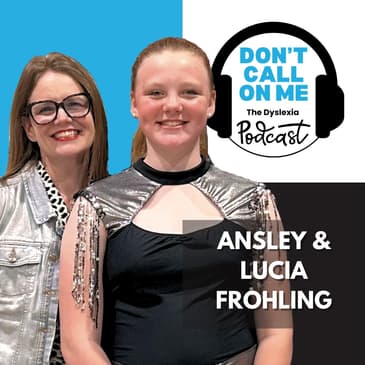
In this powerful episode of the Don't Call On Me Podcast, hosts Megan and Eryn sit down with Lucia and her remarkable daughter, Ansley, to share a family's journey through years of misdiagnoses, academic struggles, and ultimately, triumph. Ansley, along with her twin brother Dawson, both have dyslexia and dysgraphia, yet each faced unique hurdles to get the right support. Misdiagnosed with anxiety in first grade, Ansley endured frustration and even reached a breaking point before finally receiving an Independent Educational Evaluation (IEE) and finding a school where she could learn in a way that matched her needs. Now in a nurturing environment, Ansley has rediscovered her self-confidence and has become a passionate advocate, working on her state's dyslexia and dysgraphia handbook committee and even speaking out at her local school board. Dawson, too, is thriving, reading at grade level and excelling in math.
Lucia and Ansley offer a candid look at their journey, the importance of early and accurate diagnosis, and the transformative power of specialized education for kids with learning differences.
-
Book a consultation with Megan to discuss CALT therapy.
-
Book a consultation with Eryn to discuss advocacy services.
With Love and Gratitude,
Megan, Eryn & The Don't Call On Me Team
[00:00:00] Once my kids were in crisis, I was able to use my voice to help others and I was able to use my voice to actually make meaningful change. And that doesn't happen until someone speaks up. Right. Because you don't know that there's a problem. You think everything's fine until you say something. And it's like that you see, say, see something, say something. It's the same thing with education that it's, it's not working.
[00:00:28] This is Megan, owner of Dyslexia On Demand.
[00:00:32] And I'm Erin, owner of Advocate to Educate.
[00:00:36] And we are the Dont Call On Me Podcast.
[00:00:38] We are here to talk about dyslexia, to remove the stigma, to hear what families really go through and to share their stories.
[00:00:47] In both of our businesses and personal experiences on a daily basis, we listen to people telling their stories.
[00:00:55] Many of heartbreak, many of struggle, but most all have a silver lining. Even eventually.
[00:01:03] It's all about the stories. The more we share, the more we realize we aren't alone and we are a community.
[00:01:10] No, a tribe standing together.
[00:01:16] Today's episode is sponsored by Dyslexia On Demand.
[00:01:20] Dyslexia On Demand uses only the highest trained dyslexia therapists, and it's all one-on-one and individualized to your child's needs.
[00:01:30] The best part is that it doesn't matter where you're located because it's all virtual.
[00:01:35] Visit us at dyslexiaondemand.com to learn more.
[00:01:39] Today's episode is sponsored by Advocate to Educate.
[00:01:43] We help parents navigate through the confusing maze of special education in public schools in California.
[00:01:49] We support families starting as early as preschool through 12th grade, creating individual education plans to support the specific needs of your unique and amazing child.
[00:02:01] To learn more, go to our website, advocate2educate.com.
[00:02:08] Let's start.
[00:02:10] Let's start.
[00:02:11] So briefly introduce yourselves and just kind of a little bit about who you are, how you ended up here, that kind of thing.
[00:02:22] All right.
[00:02:22] My name is Lucia Froling.
[00:02:24] I am a mom of three.
[00:02:26] I have a 14-year-old son and boy-girl 11-year-old twins.
[00:02:31] Both of our twins are dyslexic and dysgraphic and just think so uniquely.
[00:02:38] It's really amazing to see the way that they think.
[00:02:42] And they are such an inspiration to me of how strong they are and how hard they work every single day.
[00:02:50] And joining today is my daughter.
[00:02:52] My name is Anseline.
[00:02:54] I'm 11.
[00:02:55] What grade are you going into?
[00:02:57] Six.
[00:02:58] That's a big year.
[00:03:00] Are you excited about going into middle school?
[00:03:04] Yeah.
[00:03:05] I hear you.
[00:03:06] I think as moms, I bet your mama is a little bit also like, my girl's going into middle school.
[00:03:13] It's just that ripping that bandaid off to move on.
[00:03:16] So.
[00:03:17] Why don't you guys also share where you're from?
[00:03:19] So we live in a suburb outside of Oklahoma City.
[00:03:24] Yeah.
[00:03:25] In Oklahoma.
[00:03:27] I live next to Deer Creek.
[00:03:30] Yes, we are in Deer Creek Public School District.
[00:03:32] Okay.
[00:03:33] Awesome.
[00:03:33] But Anseline will share a little bit more about her experience and what school that she and her twin brother are currently at.
[00:03:39] Okay.
[00:03:40] Yes.
[00:03:40] Excellent.
[00:03:41] All right.
[00:03:42] So how about we just kind of kick it off by you guys sharing a little bit more about your journey, like a little bit about when we learned that the twins had dyslexia.
[00:03:54] Ainsley's when you learned and you first realized, right, that you had dyslexia, kind of some of the emotions tied to it.
[00:04:03] Perfect.
[00:04:04] Okay.
[00:04:05] Do you know what I noticed or when you noticed?
[00:04:08] When I noticed.
[00:04:09] Okay, go ahead.
[00:04:09] So my twin brother, they found out when he was in second grade, which was right after the pandemic.
[00:04:18] Mm-hmm.
[00:04:19] And so they decided to get me tested for it.
[00:04:24] And the guy, it only showed that I had dysgraphia.
[00:04:29] So they thought I just had dysgraphia in third grade.
[00:04:33] But then we got tested that summer again and it showed that I had dyslexia too.
[00:04:40] And so I shadowed at where my brother was going, Trinity.
[00:04:45] I found out that summer that I got in, when I wasn't diagnosed with it yet, I had a struggle with reading and writing.
[00:04:56] And that was like one of my worst subjects because I couldn't do anything about it.
[00:05:02] They didn't really have much help there.
[00:05:06] Like somebody would come to the classroom sometimes, but not a lot.
[00:05:11] Was there something that you noticed in the classroom for you that was particularly hard?
[00:05:16] I was always asking for help to spell stuff and like, what is this?
[00:05:25] What is this word?
[00:05:26] What does this word mean?
[00:05:28] Mm-hmm.
[00:05:29] Mm-hmm.
[00:05:29] And when it came to like, in third grade, we had a spelling bee, but there was a before spelling bee.
[00:05:40] I got out the first try, but other people did too.
[00:05:44] But there was two practice spelling bees and I got out like the first try on the first time, which I'm like, I should know some of these words.
[00:05:56] And teachers were always asking me, what does this say on my paper?
[00:06:02] Were they asking other kids that or mostly you?
[00:06:05] Mostly me.
[00:06:06] Mm-hmm.
[00:06:07] Okay.
[00:06:08] And then do you remember how you felt in that moment when they would ask you?
[00:06:12] I felt embarrassed and different.
[00:06:16] Like I couldn't do it.
[00:06:19] And they recommended her for the Summer Reading Academy after the summer between third and fourth grade.
[00:06:27] And she had a journal.
[00:06:29] Mm-hmm.
[00:06:30] So she had written, I am stupid.
[00:06:34] I'm an idiot.
[00:06:36] And that she didn't want to be on her.
[00:06:38] I bet your mom will never forget that moment.
[00:06:42] So, and it's pretty common to have those.
[00:06:47] It's beyond common.
[00:06:48] Girl, I was going to tell you, I had five of those journals.
[00:06:51] Like for real.
[00:06:52] That's why Megan and I are doing this podcast.
[00:06:56] Because we need other kids that are just like you and me to know that when we have these feelings that, like, does it make you feel a little bit better to know that I also felt that way?
[00:07:12] Mm-hmm.
[00:07:13] Even though you don't know me, but still, right?
[00:07:15] Because like, I felt like I was the most stupidest person in my class.
[00:07:20] And no one else, um, really that I knew came to the summer school.
[00:07:29] I was like, what is this for?
[00:07:33] Why do I have to do this?
[00:07:36] Why do I have to go here?
[00:07:38] Because it wasn't that fun.
[00:07:42] Because summer school, I feel like it just makes some people think that they're stupider than they are.
[00:07:53] 100%.
[00:07:54] And every single time I hear, especially like, you know, the school is recommending that you do this summer school, right?
[00:08:02] But it's not something that's specifically crafted for how your brain learns.
[00:08:06] And as parents, we're just doing our best, right?
[00:08:10] Your mom didn't know, like, what to do.
[00:08:14] All we want to do is help as parents, but don't have all the answers, right?
[00:08:18] So we just kind of trust the people who have, who are in charge of your education, right?
[00:08:23] Yeah.
[00:08:25] And, um, since my brother had dyslexia and dysgraphia, they thought I just had dysgraphia, but I had dyslexia too.
[00:08:35] And they wanted to get me tested because most twins, if one has one thing, then it's most likely the other does too.
[00:08:43] Can I share something?
[00:08:45] Mm-hmm.
[00:08:45] So when she was in kindergarten, she's a really amazing teacher who wrote a note and said that Ansley kept using the same word in all of her stories, like play, mom, dad.
[00:08:56] So she thought something might be going on.
[00:08:59] So talk to the principal.
[00:09:01] And she said, because at the time, neither one were identified.
[00:09:04] Let's give it some more time.
[00:09:06] And I believed her.
[00:09:08] So she's like, there's a new teacher for first grade.
[00:09:11] It's going to be great.
[00:09:11] She was so good for her.
[00:09:13] So we go through first grade and another wonderful teacher, and it still wasn't going like we thought it would.
[00:09:20] And she would come home and she would practice reading before she would have to read in class, like whatever book it was over and over and over.
[00:09:29] And I thought something's wrong.
[00:09:31] I feel like she might be dyslexic.
[00:09:34] And so we had her evaluated and they said it was just anxiety.
[00:09:40] That's why she was struggling to read.
[00:09:42] And then the pandemic hit.
[00:09:45] And she's going to need some therapy, some counseling.
[00:09:48] We have a program with our school district.
[00:09:51] She'll get it next year.
[00:09:52] So this is in March.
[00:09:53] So next year, she's going to get this counseling.
[00:09:56] So pandemic year was second grade year.
[00:09:59] And her first grade teacher stayed home with her kids.
[00:10:02] So we had a learning pod.
[00:10:03] So half the time she was with her first grade teacher, she knew.
[00:10:06] And then the other two days was at school.
[00:10:09] And her twin brother was struggling and his kindergarten teacher was tutoring him.
[00:10:14] Both of them were getting tutored.
[00:10:15] And she said, Lucia, I think he might be dyslexic.
[00:10:16] Had him tested.
[00:10:18] It was someone different who evaluated him.
[00:10:20] Highly intelligent.
[00:10:22] He's dyslexic.
[00:10:24] And I knew our district didn't have what he needed.
[00:10:26] So I worked with some legislators.
[00:10:29] I worked with our local, the only one in Oklahoma, our Academic Language Therapy Association Training Center.
[00:10:36] And met with our director of special education and got funding to train teachers in structured language basics.
[00:10:45] But they were just going to do our reading specialists and our special ed teachers.
[00:10:49] Well, I knew he wouldn't get what he needed.
[00:10:50] So I researched schools.
[00:10:52] Ansley had started counseling.
[00:10:54] And he moved to a school called the Trinity School of Edgemere that does 45 minutes every day utilizing take flight for reading therapy.
[00:11:01] Yeah.
[00:11:02] And so then we start our third grade year.
[00:11:05] And in between second and third, I went to the district again and said, she's still struggling.
[00:11:10] And he's like, well, you know, we had the structured language basics like she's probably going to be OK.
[00:11:15] Again, trusted him because he had started this new program.
[00:11:18] Our son was fine.
[00:11:20] So then Christmas, she's still not doing as well as we would like.
[00:11:25] And we saw the difference in her twin brother.
[00:11:27] So I brought reading samples to him and she was still doing therapy and said, well, you know what?
[00:11:35] So this is going into our third grade year and thought she's dysgraphic.
[00:11:41] Like, OK, like you think that's it?
[00:11:44] He's like, well, yeah, like her verbal comprehension is really high.
[00:11:47] She's so intelligent.
[00:11:48] She her verbal comprehension is incredible.
[00:11:51] Her vocabulary is incredible.
[00:11:52] Like she's probably not dyslexic, like not knowing at the time like that's exactly.
[00:11:56] That's exactly the profile.
[00:11:58] Like that is always the strength.
[00:12:00] And her twin brother didn't have the same profile because for him it appeared different.
[00:12:05] He had the hyperactivity side.
[00:12:08] His emotional IQ and verbal comprehension just wasn't the same as Ansley's because she does theater and all these things are like, that's really high need.
[00:12:16] And that's just he has a different math is more like his strong suit and numbers and like engineering.
[00:12:24] So I requested an IEE and chose someone from the that used to work in the district purposely so they'd have to accept the findings because Ansley didn't really want to switch schools at the time.
[00:12:35] She wanted to stay at our public school.
[00:12:38] Do you want to go where her brother, her twin brother was?
[00:12:41] And they found out that she was reading about kindergarten, first grade level going into fourth grade.
[00:12:47] Wow.
[00:12:48] And I was so upset and frustrated because I said, like, this isn't you missed it.
[00:12:57] You missed.
[00:12:57] And it's not rocket science either.
[00:13:00] I think that's what's so frustrating is that this is something that we've known about for so long that and it's education.
[00:13:08] It's in a system where you assume that there is some kind of knowledge on their end.
[00:13:16] There's got to be someone within that school with their elementary school teachers, for God's sake.
[00:13:21] Right.
[00:13:22] It's like a double letdown when you see that.
[00:13:25] But how did it get missed?
[00:13:28] And how did it in such a profound way for so long?
[00:13:31] It's very disappointing.
[00:13:33] Yes.
[00:13:34] So then she still didn't want to go to the school.
[00:13:38] So I said, well, let's try it for a couple of weeks.
[00:13:40] And we had 10.
[00:13:40] We have the Lenzine Nicole Henry scholarship that if you're on IEP, it pays for part of your tuition.
[00:13:47] And so I met with the IEP team at her home school.
[00:13:51] She went ahead and started at Trinity because we had 10 days to see if she liked it.
[00:13:55] And if she didn't like it and they could meet her needs, we'd move her back.
[00:13:59] And they offered 30 minutes once a week.
[00:14:02] Oh, my gosh.
[00:14:03] And like, that's not going to do it.
[00:14:06] I'm on the board now at Pain Education Center, which is our training center for the trains teachers and trying to become a cult.
[00:14:12] Yeah.
[00:14:13] A certified academic language therapist.
[00:14:14] And so like one lesson of structured language basics, that takes an hour.
[00:14:20] And I'm just saying in her third grade year, they put her on an individualized program for reading instruction.
[00:14:26] And they had written on there she would get structured language basics.
[00:14:29] Well, after a few weeks, I asked her like, hey, are you getting that?
[00:14:32] She's like, no, mom.
[00:14:33] So I talked to the teacher.
[00:14:34] She's like, oh, no, we didn't think she needed it.
[00:14:36] We're just doing fluency phrases.
[00:14:37] No.
[00:14:39] And just to put it in perspective for anyone who's listening, is not familiar with any kind of intensive therapy like the fidelity standard.
[00:14:47] Research shows is going to be more like four hours per week.
[00:14:51] So 30 minutes once a week isn't going to do anything.
[00:14:57] Yeah.
[00:14:57] And they said, well, have you thought about counseling?
[00:15:00] I'm like, well, for two years.
[00:15:03] That's not what she needs.
[00:15:05] No, we need that, too, probably.
[00:15:07] Yes.
[00:15:07] We need both.
[00:15:08] And like, and we're going to push in.
[00:15:10] I'm like, no, she needs direct instruction.
[00:15:12] So I told them, I'm sorry.
[00:15:15] This is I can't.
[00:15:16] Oklahoma is a non consent state.
[00:15:18] So they could do whatever they wanted.
[00:15:21] Right.
[00:15:22] I can send.
[00:15:23] And so I said, I'm sorry.
[00:15:25] We're withdrawing her from the district.
[00:15:26] Right.
[00:15:27] Promise you I will never stop fighting for kids like Ansley.
[00:15:31] And then that's when Ansley really just.
[00:15:35] I am so proud of you.
[00:15:37] So they were redoing the added dysgraphia to our state handbook.
[00:15:41] So Oklahoma is a dyslexia handbook.
[00:15:43] And now it's the dyslexia and dysgraphia about best practices for our teachers.
[00:15:46] And they asked for people to be on the student on the review committee.
[00:15:50] And so I asked to be the parent and they needed students.
[00:15:54] And so I asked if Ansley could be like, we usually do secondary.
[00:15:59] I think her voice is important.
[00:16:01] It was our head of pain education center.
[00:16:04] Another qualified instructor who trains certified academic language.
[00:16:08] Ansley and I were going through this 400 page book page by page.
[00:16:13] And Heather asked Ansley, what is it like to be taught the way you learn?
[00:16:20] And they put her quote on page 61.
[00:16:23] And can I.
[00:16:24] You have to.
[00:16:25] You have to read that.
[00:16:26] Yeah, we need to hear it.
[00:16:27] Yeah.
[00:16:28] Let me pull it up.
[00:16:29] And then if Ansley wants to read it, she can.
[00:16:32] Or if you want me to.
[00:16:33] I can.
[00:16:33] It is whatever you prefer.
[00:16:36] So it says when this 10 year old, because she was at the time student reviewer this handbook,
[00:16:41] 2023 was asked what helped her become a better reader.
[00:16:46] She stated.
[00:16:47] It's the way my take flight teacher teaches me.
[00:16:52] We go step by step and she doesn't move on until I have it before.
[00:16:59] My teacher would just have to keep going and then would try to come back later.
[00:17:05] And if you did to show me again, but I was confused and never had enough time to understand.
[00:17:15] Now I know the rules and how it all works.
[00:17:21] It's like a puzzle.
[00:17:23] And I was missing the piece before.
[00:17:26] Oh, my.
[00:17:27] And can I tell you something?
[00:17:29] Because my job, Ansley, is basically like explaining what dyslexia therapy is.
[00:17:37] And the way you just said it is pretty much what I try to impart on the people I'm speaking to.
[00:17:45] It is a big puzzle piece.
[00:17:48] And we have to start at the very bottom and build puzzle piece by puzzle piece.
[00:17:54] And if we miss one of those puzzle pieces, the other stuff on top doesn't make sense.
[00:18:00] It doesn't fit.
[00:18:01] It doesn't fit.
[00:18:02] You've done a beautiful job of like explaining what that means to people.
[00:18:07] And I hope that you're proud because I'm proud of you.
[00:18:11] And I can't even imagine how proud your mom must be.
[00:18:14] But the voice that you're providing has got so much value and how important it is to educating
[00:18:25] the adults around you as to what you kids need.
[00:18:31] Your brain learns differently.
[00:18:33] It takes somebody who's really specially trained to be able to teach your brain.
[00:18:41] And there's nothing wrong with your brain.
[00:18:43] But like, I'm just proud of you guys both.
[00:18:47] Parents in general of kids with dyslexia.
[00:18:52] You guys, I always say you're the change makers.
[00:18:55] It's the parents in the pin.
[00:18:57] It's the decoding dyslexia representatives.
[00:19:00] It's all that you guys are the ones who push the change in the legislation who got Oklahoma
[00:19:05] to have a handbook to start off with.
[00:19:07] Right.
[00:19:08] But now that is included.
[00:19:10] Yeah.
[00:19:11] And that your quote like just nails it and it simplifies it to the point where it cannot
[00:19:17] be misunderstood.
[00:19:18] It's so simple.
[00:19:19] And if they just took that one direction, just don't move on until I really have it,
[00:19:26] please.
[00:19:27] It would make such a big difference.
[00:19:28] So that that is that's the big fight that we're all fighting so that other kids that
[00:19:33] don't have the family support that you have can also get that same intervention that they
[00:19:39] need.
[00:19:39] I want to know at this point, what is today look like?
[00:19:43] So where are you guys today?
[00:19:46] Well, you're going to middle school.
[00:19:48] But what school?
[00:19:50] What what's happening now?
[00:19:52] I go to Trinity and they gave me this stuff that I needed.
[00:20:00] And so I'm pretty sure I'm on lesson 61.
[00:20:07] I started in fourth grade and now I'm almost done with book three.
[00:20:12] I'm pretty sure.
[00:20:13] Good for you.
[00:20:14] So now being about at going into sixth grade.
[00:20:19] So she's about at end of fourth, beginning of fifth.
[00:20:23] So almost a grade level.
[00:20:24] Yeah.
[00:20:25] Well, where did we go yesterday?
[00:20:26] Because you wanted to the library.
[00:20:30] Yeah, that that is not a place I wanted to go at your age.
[00:20:35] Let me tell you, what were you going to get?
[00:20:38] I got I survived graphic novels.
[00:20:42] Mm hmm.
[00:20:43] Yes.
[00:20:43] Yeah.
[00:20:43] You really like what are your favorite graphic novel series?
[00:20:46] Because I know you really love.
[00:20:47] Uh, babysitters club, sweet valley twins and I survived.
[00:20:53] Mm hmm.
[00:20:54] And how do you feel in general?
[00:20:56] Obviously now I mean, if I had to guess based on every other child with dyslexia that I get involved
[00:21:04] with that, you did not enjoy reading before, but now you do.
[00:21:09] How do you feel?
[00:21:10] Has this just kind of your therapy helped to unlock the potential?
[00:21:15] Yeah.
[00:21:16] Yeah.
[00:21:17] And I'm doing some tutoring because my teacher like left for almost half of the school year
[00:21:25] because she had some personal problems.
[00:21:28] And so I'm doing some tutoring on that and I'm reading the one and only Ivan too.
[00:21:34] It's gotten easier to read chapter books instead of just the graphic novels.
[00:21:40] Yeah, that's awesome.
[00:21:42] And now you don't have to kind of look at everyone else doing the reading.
[00:21:45] You're doing it.
[00:21:46] That's that's huge.
[00:21:48] How would you say now that you moved to Trinity?
[00:21:52] Um, how would you say that you see yourself?
[00:21:55] Do you, has that changed at all?
[00:21:57] Yeah.
[00:21:58] Your confidence.
[00:21:59] Good.
[00:21:59] You're in theater and you just had like one of the top roles.
[00:22:04] The third one.
[00:22:05] Yeah.
[00:22:06] Hey, there's a lot of roles.
[00:22:08] The third one is hugely important.
[00:22:12] Excellent.
[00:22:13] And that goes so much in of reading goes so much into theater and knowing the words
[00:22:19] and reading the music.
[00:22:21] And, oh, what do you have later today?
[00:22:23] Uh, voice lessons.
[00:22:24] Voice lessons.
[00:22:25] Cool.
[00:22:26] Yes.
[00:22:27] I do a voice lessons, dance, basketball and theater.
[00:22:33] Yeah.
[00:22:33] And I help teach dance.
[00:22:35] Oh, cool.
[00:22:36] So lots of creative, creative endeavors.
[00:22:40] That's so sweet.
[00:22:41] Right.
[00:22:41] And I'll say before she just didn't have the energy for all of that because there was
[00:22:45] some cognitive overload.
[00:22:47] Right.
[00:22:48] Um, that now she has the space.
[00:22:50] Mm hmm.
[00:22:51] To do all the things that she enjoys.
[00:22:53] And that was a big part of us picking Trinity was I didn't want her going to school and being,
[00:22:58] not being taught the way she learned and then having to go somewhere else after school
[00:23:02] to be taught the way she learned.
[00:23:03] Um, that's so hard on a kid.
[00:23:05] You don't get to be a kid.
[00:23:07] Totally.
[00:23:07] It's what I would say is that like, um, sometimes it's a mean to an end, right?
[00:23:12] Sometimes you have to do that.
[00:23:14] Um, just for a short amount of time, but it's almost like Ainsley, like you got like, if you
[00:23:20] would have to do that, be penalized for your, for the fact that the school wasn't teaching
[00:23:25] you the way that they're supposed to be teaching you for your brain.
[00:23:28] Right.
[00:23:28] And then after school, it's like all those opportunities for those confidence building
[00:23:33] activities that you really need, um, as somebody who has struggled through school.
[00:23:40] Yeah.
[00:23:40] So how would you say that like dyslexia impacts you now?
[00:23:45] Like, what does your dyslexia look like?
[00:23:47] Maybe how's it changed?
[00:23:49] Do you have any, any thoughts on that to share?
[00:23:52] What it looks like now, you would think like she can read really well, but not as well as
[00:24:01] some other people.
[00:24:02] Well, that like our bookworms, but I can still read all well.
[00:24:09] Well, my confidence definitely boosts up and it's more fun to read than it was when I didn't
[00:24:19] have the help I needed.
[00:24:22] I can write better with my dyslexia.
[00:24:26] It's beautiful handwriting.
[00:24:28] We do cursive.
[00:24:30] Yeah.
[00:24:30] I was like, nothing like that cursive.
[00:24:32] You should have seen my son is writing like his letters went from this big to like, and
[00:24:38] now he's got beautiful handwriting just from that cursive integration.
[00:24:42] That's so important.
[00:24:43] Can I ask you, Ansley, do you remember the first book you finished that you read on your
[00:24:50] own?
[00:24:52] Babysitter's club.
[00:24:54] I think all of us will remember our first book because it really feels like a huge accomplishment,
[00:25:00] huh?
[00:25:01] Yeah.
[00:25:02] Like huge.
[00:25:03] I went to church camp and there's this graduate speaker.
[00:25:08] She was speaking at worship and she couldn't read till fifth grade because of her dyslexia.
[00:25:16] It was harder for her because everybody was reading out loud before her or like, and in third grade,
[00:25:28] she had to read out loud.
[00:25:30] So she stalled.
[00:25:32] And so she didn't have to read.
[00:25:35] Oh, well, that's why we titled our podcast.
[00:25:38] Don't call on me.
[00:25:39] I mean, I would come up with all sorts of things, but to avoid getting called on.
[00:25:44] Yeah.
[00:25:45] I mean, anything I could.
[00:25:46] Cause I don't like when teachers like when, when they like, who should you answer this
[00:25:56] question and you're not even raising your hand cause you're like, I'm not sure.
[00:26:00] Exactly.
[00:26:01] And then they call on you and you're like, excuse me.
[00:26:05] I was not making eye contact with you.
[00:26:06] I was giving you all the body language not to call on me, but then they call on you to
[00:26:12] be like, are you paying attention?
[00:26:14] Oh my God.
[00:26:15] Yeah.
[00:26:18] But, but I have to go to the bathroom.
[00:26:21] Just can I, uh, yes.
[00:26:24] One time I raised my hand and then I forgot the answer.
[00:26:29] So I just asked to go to the bathroom.
[00:26:30] There you go.
[00:26:32] That's what we do.
[00:26:33] That's what we do.
[00:26:34] I know.
[00:26:34] She actually, um, because she cares, she has such an empathetic heart.
[00:26:38] And I think a lot of that comes from the way she's wired and because she struggles.
[00:26:42] So she has such a heart for other people, um, that she spoke at our public school school
[00:26:49] board meeting.
[00:26:50] So I spoke about what is dyslexia, but Ansley spoke and shared her story.
[00:26:54] And what did you ask them to do?
[00:26:57] Do you remember?
[00:26:58] To help the kids like me.
[00:27:01] Yeah.
[00:27:02] My heart, my mama heart, my dyslexia advocate heart is just swelling with pride for you
[00:27:11] and your confidence and your willingness to help to advocate for all these other kids.
[00:27:18] I just see huge things for you.
[00:27:20] If you're going into sixth grade right now and you have this ability and willingness to
[00:27:27] speak up and, and speak in front of audiences and be so confident.
[00:27:32] I just think it's so special too, that you have this story to share and you're going to
[00:27:38] change people.
[00:27:39] Yeah.
[00:27:40] Cause if you see people that have dyslexia, but they're not getting the help you need compared
[00:27:46] to somebody that has dyslexia and are getting the help you need.
[00:27:50] And you compare them with their writing and reading, you can see which one's better.
[00:27:56] And it's the one that's getting this stuff.
[00:27:58] And so, um, now, uh, that school, um, they are teaching take flight.
[00:28:06] Uh, and it's one of my favorite teachers that's helping teaching take flight.
[00:28:13] And she lives in our neighborhood.
[00:28:14] That's awesome.
[00:28:16] Awesome.
[00:28:17] Just there like reading and writing, right?
[00:28:19] It is.
[00:28:20] Like they're thinking.
[00:28:23] Yeah.
[00:28:23] But it's also what their opera.
[00:28:25] I mean, when you don't have diagnosed dyslexia, but you're struggling, it's like what the
[00:28:32] future decision, like what the future holds, you know, like so many voices are important.
[00:28:38] So, and like both of you guys, your voices are so hugely important.
[00:28:42] Um, and you're making a huge difference.
[00:28:44] So the next question I was going to ask your mom was what your mom sees as being your strengths
[00:28:51] and weaknesses related to your dyslexia.
[00:28:53] We already know what one of the strengths is.
[00:28:56] Um, I would say for Ansley, it's her strengths.
[00:29:00] She's so artistic, um, and has such a way of expressing that.
[00:29:04] And as you all have evidence here today, her ability to so eloquently speak and so confidently
[00:29:12] speak in public, um, and be so open and honest about her journey.
[00:29:18] I admire that so much and the empathy that she has, um, for others.
[00:29:23] I will say one of the, I wouldn't even say it's a weakness.
[00:29:27] It's something that we're working on, um, is the impact that not receiving the help she
[00:29:33] needed and being misidentified for so long really did impact her mental health.
[00:29:39] Yeah.
[00:29:40] And so we, um, she still sees a counselor, um, that helps with anxiety because that's something
[00:29:48] that is so ingrained in you when you're so, when you're young that you have to rewire that
[00:29:53] part of your brain and that emotional response.
[00:29:56] And I am so proud of her for being so open about that and sharing that she struggles with that.
[00:30:07] Um, I struggle with anxiety as well and knowing it's, it's okay to have feelings and it's okay
[00:30:13] to be upset and mad that things didn't happen like they should have and taking that to do something
[00:30:21] positive.
[00:30:21] Um, so recently Oklahoma just got signed into law in May, which Ansley helped inspire.
[00:30:28] And I've got to be a part of giving feedback was Senate or Senate bill 362, which is a science
[00:30:35] of reading bill called the strong readers act.
[00:30:37] So redoing our reading sufficiency act because we shouldn't have sufficient readers.
[00:30:41] We should have strong readers.
[00:30:43] And so it eliminates the third grade retention because more of the same louder does not help.
[00:30:48] Yeah.
[00:30:49] And advance three queuing and it mandates teacher training, um, for all, um, starting through
[00:30:57] third grade, then adding a year every year up till eighth grade.
[00:31:00] And it creates a content test for teacher certification and it creates dyslexia micro credentialing as
[00:31:05] well.
[00:31:06] That's awesome.
[00:31:07] Hey, I'm moving to Oklahoma.
[00:31:08] I'm moving to Oklahoma.
[00:31:10] I mean, this sounds like a, this is magical.
[00:31:13] Absolutely magical.
[00:31:14] One of our friends that knows Ansley is a Senator and helped with crafting the bill and
[00:31:20] they wanted our feedback on it and what helped, what didn't help.
[00:31:24] And, uh, it's been pretty phenomenal to see that happen.
[00:31:29] Um, and it wouldn't have happened without Ansley.
[00:31:32] That's amazing.
[00:31:33] Like, so that's the model.
[00:31:38] I mean, there are several states who are like in that, um, taking that path.
[00:31:45] There's so many more that have to, to get on board.
[00:31:48] Um, California where Aaron is, is one of them.
[00:31:52] That's a nightmare over here.
[00:31:54] We get that those changes.
[00:31:57] We're not going to see huge differences to our proficiency rates for reading and those big changes.
[00:32:05] And just to add one more thing for like, for what it's worth that what you guys did is enormous.
[00:32:14] And huge.
[00:32:15] The next thing is we need to figure out some way to hold them accountable.
[00:32:21] I have a question about, um, Ansley's ability or, and, and, you know, you guys can both answer this,
[00:32:28] but do you think that you, you're comfortable speaking up about being dyslexic?
[00:32:35] Was that something that you match that came naturally to you and just kind of, it was easy for you from the start?
[00:32:41] Or was that something that you kind of built up the courage to, to, to start doing?
[00:32:47] I mostly built up the courage.
[00:32:51] Cause like, I was embarrassed, like in like first and second grade, if I would ask for help of how to spell like one of the sight words.
[00:33:08] I didn't really know how to spell what till fourth grade.
[00:33:12] Cause I was too embarrassed to ask for help.
[00:33:15] And it was like, everybody was just like, it's the most easiest word in the world to spell.
[00:33:21] No, let me tell you, I have a word like that.
[00:33:24] The word is being whether you and I think it's the hardest word and somebody else thinks that's an easy word.
[00:33:31] The impact of feeling like we don't know how to spell things that a first grader could spell.
[00:33:39] And we're in fourth grade or fifth grade or sixth grade or whatever really does affect us.
[00:33:44] And it affects our heart and it affects how we view ourselves.
[00:33:48] And so my hope for you through your journey of healing is that you learn that it doesn't mean anything about you.
[00:33:57] How you spell has no bearing on who you are as a person.
[00:34:01] It really makes no difference.
[00:34:03] Like, so as soon as you move into that next phase in your life where you can decide to own a dance studio and teach dance to kids.
[00:34:13] Read reading, writing and spelling like you could pay someone to do that.
[00:34:17] You don't need to do it yourself.
[00:34:18] Yeah, we need to learn the basics, but it's not gonna make or break your choices in the future.
[00:34:25] Do you think knowing did it help you to become more outspoken about it?
[00:34:30] Knowing what it was.
[00:34:31] Knowing that you struggled because you're dyslexic and your brain is wired differently.
[00:34:36] And you weren't being taught the way you needed to learn, which had nothing to do with you.
[00:34:42] Is that what helped you?
[00:34:44] Yeah.
[00:34:45] Just giving it, giving it a name.
[00:34:47] Can you tell them what you said not to tell hate till he's 18?
[00:34:51] Oh, yes.
[00:34:52] So I love her.
[00:34:54] So I told her and I listened to this podcast by ADD magazine attitude.
[00:35:01] And it talked about how when you are neurodivergent, your brain is literally bigger.
[00:35:08] Yeah.
[00:35:09] And particularly if you are dyslexic and have ADD or ADHD and Ansley has the ADD inattentive type.
[00:35:17] And that you have, you have to make more neurological pathways in your brain.
[00:35:23] So your brain has more connections and your brain is literally bigger.
[00:35:30] And I told her she's not allowed to tell her older brother that until he's 18, that her brain is bigger and that she has neurological pathways and he does.
[00:35:40] Yeah.
[00:35:42] Yeah.
[00:35:43] He and I are neurotypical.
[00:35:45] My husband, Ansley's our kid's dad, he is dyslexic.
[00:35:51] And my dad is undiagnosed dyslexic and dropped out of school in eighth, eighth going into ninth grade and did well for himself as a truck driver.
[00:36:01] But he didn't get the help he needed.
[00:36:04] And I see that.
[00:36:05] Yeah, DD did.
[00:36:07] Was he home school?
[00:36:07] To support his family.
[00:36:08] No, he got his GED when Cupcake, your grandma was pregnant with my brother after they were married.
[00:36:15] There's usually a path we can follow to figure out how we got to where we are.
[00:36:22] So.
[00:36:22] And he moved to Texas.
[00:36:24] My parents moved to Texas.
[00:36:26] Sorry, moved from Texas to Oklahoma to help with the kids when her brother got diagnosed with dyslexia to help drive him to school.
[00:36:35] Yeah.
[00:36:36] Because he didn't want the same thing that happened to him to happen to his grandkids.
[00:36:39] Yes.
[00:36:41] And so they live four streets over from us.
[00:36:44] Oh, he practices reading with them.
[00:36:47] Sometimes not as comfortable.
[00:36:50] But it's so sweet.
[00:36:52] Because he was never taught.
[00:36:54] I have homework from my tutoring.
[00:37:00] It's called a wrap.
[00:37:01] It's where it's words.
[00:37:04] And you read them.
[00:37:06] And so we are timing them.
[00:37:09] And my grandpa was like, I'm not doing it.
[00:37:13] If I do it, you're not going shopping for the year.
[00:37:18] Yes.
[00:37:18] That he likes to watch you do it, doesn't he?
[00:37:20] Yeah.
[00:37:21] Because he's learning alongside you.
[00:37:22] He's just not comfortable saying it out loud yet.
[00:37:25] Yeah, totally.
[00:37:26] Because my grandma got like 13 seconds.
[00:37:28] And my dad got 27.
[00:37:31] Yes.
[00:37:31] It was hilarious.
[00:37:32] But I think it's also, it's really valuable too, that you have those people around you that you can identify.
[00:37:40] Yes.
[00:37:40] Right?
[00:37:41] That you're not the only person in your world who is walking that walk.
[00:37:46] So speaking of, what would you say is the best advice that you could give someone else with dyslexia?
[00:37:55] And this question actually goes to both of you.
[00:37:58] Because I want to know Ansley's thought and also mom's thought on a parent who just finds out.
[00:38:06] You can.
[00:38:07] Yes.
[00:38:08] Yeah.
[00:38:08] Just short and sweet.
[00:38:10] I want a hat that says that.
[00:38:12] I have to say what she was saying that her brothers and my husband were at the door.
[00:38:17] That's why I was looking at those.
[00:38:18] And they were just giving thumbs up because I had three earphones.
[00:38:23] I didn't know they were there.
[00:38:25] I love that it's a family affair.
[00:38:28] And Ansley, tell me if this feels true for you now.
[00:38:31] Now that you're living what it feels like to go to a school that's supportive.
[00:38:37] And you're getting what you need.
[00:38:40] If your family giggles about something, you're not.
[00:38:44] And this is how I feel like I'm okay with it because I laugh too.
[00:38:48] But had that happened a couple years ago, it wouldn't have been as funny.
[00:38:53] Or it wouldn't be something you'd be okay with joking about.
[00:38:58] Is that accurate?
[00:39:00] Yeah.
[00:39:01] Yeah.
[00:39:01] Which at my school, like all me and my friends are really close because we all have dyslexia.
[00:39:11] And we're like, just close because it's like easy knowing each other because we all have dyslexia.
[00:39:19] Yeah.
[00:39:19] And if we miss smell something or accidentally say something wrong while reading, we'll just giggle it off because we're so close that you know, like, you're probably going to do it next.
[00:39:35] Exactly.
[00:39:37] Yeah.
[00:39:38] Yeah.
[00:39:38] That support group is so, so hugely important.
[00:39:43] So, mom, what would you say the advice is to a parent?
[00:39:49] Um, trust your gut.
[00:39:51] I would say, you know, as a mom, when something's not right, you know, your child best.
[00:39:56] And now, um, I work for an education nonprofit and I'm a master IEP coach.
[00:40:02] So I get to walk alongside families and finding the right educational environment for their child and going to IEP meetings and all of those things.
[00:40:10] And to use your voice that you can actually make change because that's the wonderful, the beauty that once my kids were in crisis.
[00:40:20] I was able to use my voice to help others.
[00:40:23] And I was able to use my voice to actually make meaningful change.
[00:40:27] Mm hmm.
[00:40:28] And that doesn't happen until someone speaks up.
[00:40:32] Right.
[00:40:32] Because you don't know that there's a problem.
[00:40:34] Yeah.
[00:40:34] You think everything's fine until you say something.
[00:40:38] And it's like that you see, say, see something, say something.
[00:40:41] It's the same thing with education that it's, it's not working and no teacher is there to hurt a child.
[00:40:48] They love their job.
[00:40:49] They just when you know better, you do better as I think Maya Angelou says.
[00:40:53] Yep.
[00:40:54] So we, we have to share that information and the impact and educate teachers that there's a better way.
[00:41:02] Mm hmm.
[00:41:03] And to give it a name.
[00:41:05] Mm hmm.
[00:41:05] And there's power in that.
[00:41:06] And I think for parents, I mean, we say in our house, it's a superpower because we're looking at it strength based.
[00:41:13] I know for others, they would not say that because that's their truth.
[00:41:16] Right.
[00:41:16] And that's completely accurate for them.
[00:41:18] Yeah.
[00:41:19] On a superhero day, um, or I need to dress up.
[00:41:23] We had an old cape, like a Superman cape.
[00:41:28] So we put it on the other way and she has a cricket and she says, and she put on it in blue glitter.
[00:41:35] It's like Santa's graphe as my superpower.
[00:41:38] I love it.
[00:41:39] Yeah.
[00:41:40] I want them to see that they can do anything and be anything.
[00:41:44] And it's our job as a parent to protect them.
[00:41:47] And once you talk about it out loud, it's hard to talk about what your child's struggling with.
[00:41:52] You find a community of support.
[00:41:54] Right.
[00:41:55] That, oh, it's not just me.
[00:41:57] Okay.
[00:41:58] Yes.
[00:41:58] And you can make change together.
[00:42:00] And it's, it's wonderful because we've had teachers reach out of like, I don't feel comfortable saying anything.
[00:42:05] Can you speak out for me?
[00:42:06] Yes.
[00:42:06] This is how I feel.
[00:42:07] I'm like, yeah, I'm good.
[00:42:10] I got this.
[00:42:10] I got this.
[00:42:11] We call it being a positively persistent.
[00:42:14] Yeah.
[00:42:15] You don't want to do it from a place of anger or hurt, although that's valid in there, but that doesn't change things.
[00:42:21] No.
[00:42:22] Being positive and being persistent.
[00:42:24] Um, it seems to be effective so far.
[00:42:27] Yeah.
[00:42:27] A hundred percent.
[00:42:28] Cause when you take it the other direction, it tends to people just close their ears.
[00:42:32] So you're exactly right that that's the right approach to take.
[00:42:36] And, and it affects so many people that it makes being positively persistent using your words, something that, that it's, it's critical in a typical school.
[00:42:48] We're dealing with 20% of their population.
[00:42:51] I had this one private school say to me, uh, yeah, no, not at our school.
[00:42:57] And I, and I was just like, that's so sad that you really think that dyslexia is such that you've handpicked who isn't dyslexic when it's a school that starts in preschool.
[00:43:10] That happens all the time, Aaron.
[00:43:12] Like we just, my company just got back from representing at the national charter school conference and an extremely common response from administrators was we don't need to talk to your table because we don't have any children at our school with dyslexia.
[00:43:28] Yes.
[00:43:29] And we heard that over and over and over.
[00:43:32] Oh, it actually, the, uh, the superintendent in the school district where we live, cause I was telling them sharing information.
[00:43:40] And he said, um, those statistics don't apply to where we live.
[00:43:45] Oh, right.
[00:43:46] Of course.
[00:43:47] We're a six day school district.
[00:43:49] And I mean, it's female.
[00:43:51] A six a school district.
[00:43:53] I'm like, it doesn't apply.
[00:43:56] Those, those are national statistics and they don't apply to here.
[00:44:00] And I said, well, I don't think that neurons when they land at 34 days in utero, um, know where you live.
[00:44:06] Oh, respect.
[00:44:08] And I'll be here to help.
[00:44:10] That's a great.
[00:44:11] Oh my goodness.
[00:44:12] That is just, that's just not.
[00:44:15] It's all.
[00:44:16] You have to laugh cause it's so outlandish.
[00:44:18] Like, no, it's, it's one in five there.
[00:44:22] It's your job to identify, to find them as a teacher.
[00:44:25] Yeah.
[00:44:27] It's a testament to how far we still have to go.
[00:44:31] Yeah.
[00:44:32] Okay.
[00:44:32] I have one last question.
[00:44:34] Unless Erin, you've got something burning.
[00:44:36] I'm good.
[00:44:37] Let's hear it.
[00:44:38] So I'd like to ask you, and this is pretty much for you.
[00:44:42] Ansley is if you had to craft your life again, would you choose for dyslexia still to be part of it?
[00:44:49] And I want you to answer honestly.
[00:44:50] I don't want you to tell me what like you think people want to hear.
[00:44:54] I want to hear your honest answer.
[00:44:56] I don't really know.
[00:44:57] Cause dyslexia is hard for me, but it also makes me different than anybody else.
[00:45:07] But it's hard to really learn and get that to grade level again.
[00:45:17] Mm hmm.
[00:45:18] So I don't think so.
[00:45:22] You don't think so?
[00:45:23] Well, I don't think I have an answer to that.
[00:45:27] Cause like, I love having dyslexia cause it's, it's really cool being different.
[00:45:35] Cause if everybody was the same, like nobody had dyslexia and nobody had dysgraphia or anything like that, it'd be boring.
[00:45:47] But if some other people had dyslexia and dysgraphia, like it's cool cause that's what makes you different.
[00:45:57] But it all comes at a price and I think we can all respect that.
[00:46:02] Thanks for spending time with us on don't call on me.
[00:46:05] If today's stories touched you, please take a moment to follow us on social media and subscribe on YouTube.
[00:46:13] Extend the impact by sharing your story at don't call on me.com.
[00:46:18] Your experiences can foster understanding and strengthen our collective voice.
[00:46:24] Let's keep making a difference together.
[00:46:26] We look forward to having you back for the next episode.