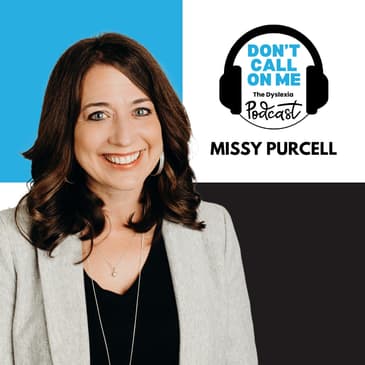
In this episode of the Don't Call On Me Podcast, Megan and Eryn sit down with Missy Purcell, a former balanced literacy teacher whose perspective on reading instruction was transformed when her son was diagnosed with dyslexia. Faced with the gaps in his education, Missy discovered the power of evidence-based instruction and became a passionate advocate for structured literacy. Now, she's on a mission to ensure every child learns to read. Tune in as she shares her personal journey, insights on the shift from Balanced Literacy to the Science of Reading, and ideas for parents and educators who work toward literacy for all!
-
Book a consultation with Megan to discuss CALT therapy.
-
Book a consultation with Eryn to discuss advocacy services.
With Love and Gratitude,
Megan, Eryn & The Don't Call On Me Team
[00:00:00] When he was in first grade, it was, I can't do this. Or I just can't do it. I can't do it. I have a bucket of his work. I kept all my kids' work and I have a bucket. And I remember going back to the bucket to look for clues. There were pages in first grade where he had erased so hard that there were holes in the paper. And then he got all of them wrong or you could see where he had just quit.
[00:00:22] He was in his own way saying that now when he got older, those phrases turned into I'm stupid. I can't read. Even though we've done all these things to help you, the school has still not updated themselves. And so you're still struggling. And I totally get it now. This is Megan, owner of Dyslexia On Demand. And I'm Erin, owner of Advocate to Educate. And we are the Dont Call On Me Podcast.
[00:00:50] We are here to talk about dyslexia, to remove the stigma, to hear what families really go through, and to share their stories. In both of our businesses and personal experiences on a daily basis, we listen to people telling their stories. Many of heartbreak, many of struggle, but most all have a silver lining. Even eventually.
[00:01:14] It's all about the stories. The more we share, the more we realize we aren't alone and we are a community. No, a tribe standing together. Today's episode is sponsored by Dyslexia On Demand. Dyslexia On Demand uses only the highest trained dyslexia therapists, and it's all one-on-one and individualized to your child's needs.
[00:01:42] The best part is that it doesn't matter where you're located, because it's all virtual. Visit us at dyslexiaondemand.com to learn more. Today's episode is sponsored by Advocate to Educate. We help parents navigate through the confusing maze of special education in public schools in California.
[00:02:02] We support families starting as early as preschool through 12th grade, creating individual education plans to support the specific needs of your unique and amazing child. To learn more, go to our website, advocatetoeducate.com. Welcome back, listeners, to the Don't Call On Me podcast. Today, we have a very special guest.
[00:02:27] Her name is Missy Purcell, and the way that we came about connecting with her is that she is on the famous Soul to Story podcast. And so we're so excited to have her. I know, Missy, in preparation for this, of course I had listened to all of Soul to Story, but I went back and re-listened, and it definitely got me just as fired up in this listen as it did the first time. So we can't wait to hear your story.
[00:02:55] So why don't you go ahead and introduce yourself and tell us a little bit about you. Well, great. I'm excited just to have this conversation with you guys. And I'm Missy Purcell. I am from Georgia, born and raised, also was a school teacher here. I taught both elementary and middle school for several years before I had children. And then I even went back another time after having kids.
[00:03:21] I ended up stepping away from the classroom as I began to really have to advocate more intentionally for my youngest child. But I do have three children, a wonderful husband, and two puppies who I really hope are going to behave during today's episode. We're definitely very interested in how you came about appearing in Soul to Story. But I know all of that was tied to your child with dyslexia.
[00:03:50] So tell us a little bit about your journey in terms of finding out that your son had dyslexia, the experiences around the school and interacting with the school. And then, of course, that's going to naturally parlay into your teacher history. Yeah, that's a great question. And when I think about it, I remember when I was reflecting on this, how many red flags there were. But because of lack of information, we weren't fully aware.
[00:04:19] But it goes all the way back to preschool. He left preschool. I remember getting his – they gave a little report when your kid leaves preschool. And it tells you all the skills your kid has mastered and then the skills your kid hasn't mastered. And Matthew was a lovable kid and well-liked. I joke that he is like a little politician. And just imagine like a little two-foot-tall four-year-old with his hands like this, you know, just telling his things. And he's saying words, kind of not correctly, but it's cute. So you just let it go. And you're just like, that's so adorable.
[00:04:48] I read the report. I'll never forget reading the report that said, of course, we love Matthew and we're so proud of him. We just wish he had mastered more. And I got this report at the end of preschool. And I was like, what? He's doing great in math. He's doing great social skills. Although looking back, some anxiety was creeping in that we now know was anxiety. But not on grade level for reading. And our school was full about literacy. So I got a letter that was not where it was supposed to be.
[00:05:18] And that just continued. First grade, same story, second grade. And so as this continued and I kept picking up, I kept being met with the oddest responses. I mean, it morphed from, oh, you know, boys, they'll catch up. The whole boy thing. Like boys sometimes are behind, but they'll catch up. And, you know, we're really not worried because he's really doing well in all these other subjects. It's just this will this will just come along. Just give it more time.
[00:05:44] I got a lot of uneven responses. Even the paperwork when I started going back in time was so all over the place telling me like what he could and couldn't do and how great he was, how behind he was. Looking back with educated eyes, it was so obvious. But everybody in the game didn't know. Didn't know what they didn't know. And so they weren't helpful.
[00:06:10] This came up in the last pod that we did interviewed on Friday. And she was mentioning how she felt gaslit by the teachers. And the funny thing is what we say is, look, it's not technically gaslighting because they don't realize that they're doing it. But it is the exact same common experience as all parents out there. And it got a lot of comments, actually, when I put that on to TikTok because that is everyone's experience.
[00:06:38] And they don't know what they don't know. But hearing we need to wait a little bit longer. He's a June birthday. All of these things that are obvious red flags when you know anything about dyslexia is one of the things. But just in general, that we need to start. It's hard because you love that teacher and you know that teacher has your child's best interest. But you oftentimes you have to follow that mama gut, that tummy feeling.
[00:07:07] What upsets me the most, and it was the same experience I had with my son. And, you know, there's a part of me that because my son is in first grade now, certain things that I'm saying are not too far away. And I want his educators to listen to this podcast. And I don't want them to hear me in a light that I'm ragging on them or not thinking that they're smart or whatnot.
[00:07:30] But, you know, the reality is when I brought up my child being dyslexic now, I knew. I mean, there was no question, but I'm dyslexic. My father's dyslexic. He's a psychologist. Like it runs in our family. It's very obvious. Right. To me anyways. And when I brought it up in TK, you know, the response I got was, but he's in TK. Like things are going to work itself out.
[00:07:55] And the teacher said, you know, my kids also have dyslexia and, you know, they're in middle school. And, you know, one day I hope it clicks. And I'm thinking if there's any teacher on this campus that should say, wait, you are identifying dyslexia. Hold on. Let's not bypass what you're saying. You're at the beginning. This is the opportunity to get in front of it, mama. This is perfect. Right.
[00:08:23] But to be blown off and say, oh, well, he's doing good. He's doing so good in the classroom. Yeah, he's doing good because I'm paying for intervention. Duh. What is the most unsettling is how common. Once you know what you know, once you got over that hump and you knew you started researching all the things you probably did, you're like, wait, it's so common. How do these people not know? No. And that's the that's the scary part, in my opinion. That's the part where, you know, I'm I'm a former teacher, too.
[00:08:52] And even as a teacher, I had never I didn't hear about this stuff. I didn't get educated in how to teach them how to read. So I was guilty of it, too, in the moment. Right. So I want to make sure today this is all about your child. And I want you to share your mother side of things. I want to really get into all the feels about what it felt like for you as a mom, because, you know, if not all moms are educators, but that doesn't exclude them.
[00:09:20] And clearly, based on what you're saying from the not knowing what we don't know. You were an educator. You still didn't know what you needed to know. So it's kind of. For all to hear that you can be an educator, you can be right in the thick of it and still not have the knowledge that you need. And that's why it's important to be humble.
[00:09:47] It's important to not, you know, knock on other people for not knowing these things, because ultimately, once you learn what you need to know, you're kind of like, OK, like, yeah. Oh, oh, oh, yeah. You're right. That. Oh, how did I not know that? Right. But we want to hear we really want to get into like as a mom not knowing what you didn't know, what did it feel like to see all the signs of your child?
[00:10:16] And when did it start to shift? You talked about, you know, him being at grade level until first grade. And then I want to know, like, when did it shift? When did the ball drop? And when what happened? First grade was that was the game changer year for me. That year he was placed in reading and reading recovery. I was told, oh, you should be so excited. This is the most comprehensive re-intervention we have.
[00:10:45] This was after I emailed the school because I got an email from his reading recovery teacher around the halfway mark, which would be about week 10, letting me know that she was seeing that he was stalling in his progress. That she wasn't seeing as much, you know, effort on his part and that she wanted to see if I could give him a pep talk. And also the end part of that letter was, and we're just going to keep plugging away.
[00:11:13] I have reflected and posted about this numerous times about how just the red flag of he's no longer giving effort. He's six. The effort falls on the educator here, not the six-year-old. You know, he's shutting down. Why can't you see that? You know, maybe your instruction isn't working. So what are you going to change versus us changing him? A pep talk? Come on. Is that what we need to teach a kid to read a pep talk?
[00:11:39] No, we need highly trained individuals who can deliver what we know is evidence-based instruction that we know works for a kid, not a pep talk, not we're going to keep plugging away in what's not working. Also, now my question is how much data do you need to show you this isn't working? So that's when I asked for my first SSD, actually my second. And then I was told we should just wait because this is the most comprehensive reading intervention that the county has.
[00:12:05] Like I should be so honored that my kid is in this and I should just give it the full 20 weeks and then we'll talk. You know, 20 weeks goes by. He still can't read. He also doesn't successfully complete the program. I get a letter with Reading Recovery letterhead letting me know that he's being exited and that they're going to recommend that we go back into, you know, RTI or EIP, early intervention program. Not to be confused with IEP, not the same thing.
[00:12:33] And so, you know, I'm sitting here thinking, okay, we just did 20 weeks of what's your best. He can't read. What's next? No one seemed concerned. I actually had to schedule that meeting. So this is when I was starting to wake up. Additionally, this is the same year. This kid, y'all, if you could just meet him. I mean, like I mentioned, my little politician from four-year-old pre-K, right? Like, he's social, right? And he's a baseball player.
[00:13:01] I mean, the kid hit a home run of Coach Bitch and T-Ball. Just brag about him all day, right? You know, this kid's got it. But at school, he's shutting down. He's not trying. We need a pep talk. Look, I'm starting to see two different kids. And I'm getting worried. No one else seems to care that there's two different kids. And I start getting, Ms. Purcell, Ms. Matthew's, you know, misbehaving during reading group, Ms. Purcell.
[00:13:29] Here's an action plan. My first grader gets an action plan. Y'all late for this one. This is my favorite story to tell. For making armpit noises. He's starting to check out of school all the time with stomach bugs, headaches. And he's obsessive about things he can't control, like his clothing. All red flags for anxiety. I didn't have all those words and that terminology in first grade. I do now. But I didn't then. But I knew enough because this is my kid who is not this way.
[00:13:59] You want to know when it happens? I get one more. I get a text message. And honestly, this is probably the hard side of me. I still need to forgive a few people along the way. But I'd had it by this time with first grade. I'm not going to name any names. But I'd had it. And I got another text message letting me know that my kid was getting another action plan and that I need to sign it. And I was like, no. Not that I think my kids can't get in trouble. This is not that. I just knew that he wasn't a disrespectful child.
[00:14:29] And I knew that he wasn't trying to get in trouble. And this is not common for a child in our house. It wasn't common for what I was seeing at home. It wasn't the way I saw him treat any other authority in our life. And I called the principal. And because I was like, I was sitting in the car waiting to pick my kid up. And I'm just literally having an internal meltdown. Like, I don't want my kid to become a behavior problem. Like, why is he becoming the behavior problem? And I told her that. I said, he's struggling. And everyone's seeing behaviors.
[00:14:59] But no one is answering my questions about why can't he read? Why can't he write? What's going on? She was like, he's not going to be a behavior problem. You know, we're going to get to the bottom of this. And she's super nice. And I believe her. I think she did mean what she said. But they weren't equipped. They didn't really know what dyslexia looked like. I believe that 100%. They didn't know. They weren't seeing the red flags. And they were so entrenched in a method of instruction that was actually blinding them
[00:15:28] to see the red flag. It wasn't allowing them to see that what was going on was a failure of their instruction. And not this child just choosing to misbehave. When your child would come home from school on those days, what was that like for him? Like, what did you guys talk about when he would come home? And you'd be getting these, like, notes about his behavior. But then you'd see him out in other activities, like being himself, the kid that you do know. Well, he didn't have the terminology.
[00:15:57] You know, to explain things. But what I did see from him was, I now have a term for it. It was after school collapse. But I didn't know that's what it was called. My kid came home every day. And just everything just came out of him. I thought something was wrong because he was so angry. And he was so frustrated. And then he would nap. I'm talking like hours, which is not normal for a child of his age. I'd have to wake him up for dinner. It'd be hours of napping.
[00:16:26] Now I know it's because he was just surviving all day. He was just doing his very best to get through. So, yeah, I got an angry kid. I got a frustrated kid and a very tired kid. And a kid telling me, I'm not trying to get in trouble. Or, you know, I'm just really tired. Or my head hurts. For him, that was his way of communicating. I'm overwhelmed. I'm frustrated. I'm not successful here.
[00:16:49] So, for me, even today, if my kid is checking out or going to the clinic for a headache or a stomach ache, that is a trigger. Because I know something in the building is just not going right. And we need to figure it out. And this was also, let's think about it. This is what he thought school was. He was already conditioned to think school was hard and not accessible to him. And that it was not a place where he could win. He could win in baseball.
[00:17:19] He could win playing those games and those little groups we were in and our little family experiences. But he couldn't win at school, ever. Looking at you, I see in your eyes, like, when you got to that point of saying, like, the tipping point for you, that there was so much emotion and frustration in your eyes. That it's like it brings back and relives something really deep.
[00:17:42] And I think that as all parents, we can identify with that piece of just desperation, of trying to find the answer. Because it doesn't make any sense. This is not what a child of this age is supposed to be feeling about school. These are the fun, happy years. And I'm thinking about my own experience and wondering if you had any of these, if not totally valid, too.
[00:18:06] But I remember, like, when I was in second grade, just admitting my inner dialogue of, like, I'm just dumb. Like, I remember saying that because that was what I had to decide. About myself. Like, did he ever vocalize? Maybe not having the vocabulary to say, of course, like, I'm not learning the way I need to be learning. Of course, not that.
[00:18:32] But in those moments, in those tantrums, in those meltdowns of sheer exhaustion, did he ever say anything like that about himself? Oh, 100%. And it got worse. You know, when he was in first grade, it was, I can't do this. Or I just, it just, I just can't do it. I can't do it. I have a bucket of his work. I kept all my kids' work. And I have a bucket. And I remember going back to the bucket to look for clues.
[00:18:58] There were pages in first grade where he had scribbled, sorry, erased so hard that there were holes in the paper. And then he got all of them wrong. Or you could see where he had just quit. He just quit attempting. So he was in his own way saying that. Now when he got older, those phrases turned into, I'm stupid. I can't read. When I got really concerned was just throw me in the trash can.
[00:19:24] Why is a nine-year-old child that was fourth grade and that was me, that was 2020. I just jumped a few years. We can always come back. But I jumped up to 2020 because that was when I sat beside him during the pandemic. And I could see that was my aha year. I go from like my discovery year to, I get it now. I see what's happening to you. Like even though we've done all these things to help you, the school has still not updated themselves. And so you're still struggling. And I totally get it now.
[00:19:52] So yeah, he would sit there and say the most horrible things. And he would, you know, close his computer. They tried to create, y'all, I will. This is when I go from sad to angry. A goal on his IEP for not turning his camera off. And I literally just said, so maybe we just need to figure out why he's turning his camera off. I have some inside information that might help you, you know.
[00:20:19] But, you know, and I wasn't so nice probably when I said that. But, you know, but those were my fighting years when I was like, I know what's happening. And I'm angry. And I'm done. That was my draw the line. I'm done. I'm no longer bringing brownies to the IEP meeting. And I am no longer yourself a co-worker. And I don't care if I'm on the PTA again. Like, I am. It's a big PSA to all the parents.
[00:20:45] Like, wouldn't you rather, okay, if you have, you're seeing the signs, your child is miserable, you know, unless there is like hereditary bipolar on every side of the family. And there's like mental health needs that even so, even so. If you're a parent of a child that hates school and the school is telling you what Missy has described or worse, get curious.
[00:21:13] Like, wouldn't you rather look like a total dum-dum? Yeah. And like make a big deal about it, get them assessed all the things and be wrong about the situation. I'd rather go and her say, you're over-exaggerating. Like, they're fine. I'd rather do that and just kind of look like I'm anxious than have them have something really serious and not catch it sooner. Yeah.
[00:21:40] And that's the PSA for all the parents. Yes. The PSA is don't wait for your kid to fail. And the PSA is don't wait for kids to fail because you and I know this. I'm preaching to the choir. But what happened to my kid is because they waited for him to just – actually, I think they would be – if it wasn't for me, they would still be waiting. I'm sure that's the case. I am 100% sure.
[00:22:06] But we also could have caught it back in first grade and we could have given, like, appropriate intervention and him not have had that same story in fourth grade. We could have given him a screener that was actually going to identify his true weaknesses versus the reading recovery survey, which told them nothing, which also didn't stop them from admitting him into that program. You know, because they always say, well, it's not for kids that have dyslexia.
[00:22:33] Okay, well, then why don't you have some way for, like, making sure you don't take children with dyslexia into the program? You know, let me just clarify. I think no kid should go into reading recovery, but especially children who have language-based learning disabilities. Right. Of course. Because we know what they need. We're not guessing anymore. Yes. So don't wait for them to fail because they, along the way, they collect other things that are harder, you know, to remediate.
[00:23:03] I mean, when you collect raging anxiety and depression and low self-esteem along the way because your school wanted to just, I guess, think that what they're doing works and just push you through it. I don't even like to give them the credit of waiting to fail. They were just, like, not assuming that my kid probably could ever become a proficient reader and allowed him to fail.
[00:23:27] You made the comment about, okay, yes, reading recovery is not intended for children with dyslexia, but do they have an answer for what we do with that child with dyslexia? Because we don't need to guess. When you say we don't need to guess anymore, well, we haven't actually needed to guess for the last, like, 25, 30 years. It's just not connecting on the campus level.
[00:23:48] And so, you know, when you send them to that resource room and you just go deeper into the improper intervention, which is, P.S., what's happening all over the country continually even now in 2024. We're not doing them justice. And that's, I've said this many times. I need to say it again. And you just brought it up. It's not a mystery anymore. It hasn't been for a very long time, you guys. It's once you know, you know.
[00:24:18] You have to use the science of reading. You have to teach them. And a little girl that came on our podcast said this. She said, the best thing that the teacher did for me was they didn't move on until I mastered what I needed to master. If that piece of advice could just be taken, if we need 12-year-olds, 11-year-olds, 6-year-olds to explain that to their teachers, I mean, so be it. Like, yes, bring those kids in.
[00:24:46] If you can't hear that from adults, then maybe we need to bring in the kids because they really are their own experts on themselves. Like, let me get my foundation first. Let me get the building blocks. So we know what to do. We also know early intervention is key. Throughout doing this podcast, I've wanted to coin the phrase early intervention for dyslexia. It's not just early intervention for autism. That got a lot of publicity. And great, fantastic.
[00:25:16] I'm not saying anything bad about it. But that got to the masses. Because when you think of autism, you think early intervention. That, I mean, put it that way. At least it got to the college level. Most people know that. But why is it for reading that that is like, no, no, just wait a little bit. Like, no, you know, just let them mature. What? No.
[00:25:42] Early intervention, if you, it's like you want to teach them to do something wrong and then have to go back and reverse it once they already hate what they're doing because it's been so difficult for them to even learn. And then at the end of the day, who does that hurt? The child. And then the trauma builds. And then you have trauma after trauma after trauma.
[00:26:06] Also, parents, you're bringing your kids back to the same traumatic place every day. And if they are coming home miserable, you cannot please stop taking them there until you figure out what's going on. Because behind the scenes, there is so much more. And as the three of us being educators, we know. We know the teasing occurs. We know the giggling occurs. Even with the best of intentions. Because kids are raw.
[00:26:34] And kids don't, you know, they don't know any better. But at the same time, it is your job to protect them. Don't think the school is going to do it. They're not going to do it. And if they do, let us know what school it is and we'll give them a shout out. Because it's so rare that that happens. Okay. Back to your son. So you jumped to COVID. And this was a big eye-opener for a lot of parents. I know my advocacy world, like, exploded when parents started sitting next to their kids.
[00:27:03] Because they were like, wait, what? The way in which instruction is delivered over a computer just opens the eyes for us watching our kids not be able to type chat. To connect with their teachers. All of a sudden, everything's in writing. They're not orally telling the kids what to do anymore. They're like, okay, read the daily activity. Type in the chat.
[00:27:27] All of a sudden, these little kindergarten, first graders, second graders, third graders need to have literacy skills in order to just be part of. So what were some of those things that, I mean, you said some of them. But what were some of the things that you noticed? Well, obviously, he was shutting down and shutting down the computer. Literally. Which, that's a big sign. Yeah. Yeah. Yeah. And I was seeing a lot of that with my clients as well.
[00:27:55] And so was there like a moment where you just said, we're done with this? Like, what happened? That year, that could be like an entire book. I felt like how we survived. But gosh, it was for me the first month. And I, you know, all of us were working from home. So I'm sitting off to the side on my computer trying to take care of things. And I'm just listening. I'm there to support. Give him what he needs. If he can't find something. I was trying to eliminate.
[00:28:23] I was trying to eliminate all the barriers so he could learn. And what I will never forget. This is when I was like, oh, this is what is happening. I was watching his resource teacher. He's got goals for decode for specific decoding skills and encoding skills. And I'm sitting there. And I'm like, wait a minute.
[00:28:49] She's literally doing like the first 20 days of guided reading from Fontes and Pinnell. And I was like, she's his resource teacher. And then I was like, okay, well, maybe she's trying to set classroom expectations, you know, blah, blah, blah. And I kept waiting. I was like, when's she going to address his goals? Like, when does he get his individualized instruction for his decoding and his encoding? When's all that going to happen? And so I'm like, you know, I probably should get them on the same page.
[00:29:18] So they know where she is in the scope and sequence. So I was like, where's the scope and sequence? And where is he? And I might even say it might have been true gaslighting because it was like avoiding my questions. I started sending emails. And then randomly, there would be a random lesson. Like, I'll never forget. And this was a great day. Soft G, hard G. And the teacher's just random phonics lesson just throws out for the group.
[00:29:46] And I was like, okay, let's watch this. And she does it a little incorrectly. And so my sweet little boy raises his hand. And he was like, well, actually, she's like, that's right, Matthew. And maybe tomorrow you can help me teach this lesson. And I'll be like, you know, kudos to her for saving face. But also like, no, he does not need to teach the lesson. He needs a direct explicit instruction following a scope and sequence. And where is your scope and sequence?
[00:30:16] And where are you in the scope and sequence? And what does he need specifically? Because we're well past this. You know, he was already, we're pretty far into our therapy by this point. Man, that for me was another like big moment. You know, if you're going to have one of those line graph charts, I'm going to be like way off the chart because inside just mama bear is like, no, this is wrong. And I started advocating really hard. And I called an IEP meeting.
[00:30:44] That was the beginning of the end for public school for us because I didn't know it when I started that journey in fourth grade. But I spent an entire year advocating for my son's access to his individualist instruction to meet his specific needs for his dyslexia and also all the accommodations that come alongside that to support him as he's getting his intervention. And I learned how to file state complaints that year.
[00:31:11] Eventually, I learned how to exercise my parental rights to the fullest extent to advocate for my child. I also learned how to get involved. I learned how to use Twitter during that year. That's when I started like I was frustrated and I felt a little alone. And so I go on Twitter and I start just posting like random snippets of our experience and our journey.
[00:31:36] And as I'm learning more and people started liking it and sharing it. And I was like, oh, I'm not alone. I had already had this one epiphany when I joined the sites of reading what I didn't know in college page. I was like, oh, there's a whole bunch of other former teachers or current teachers. They're like me. We are in the dark. Someone's just, you know, withheld this from us. So I'm over there doing that. And then I'm over here on Twitter, more like mom advocacy, like sharing this dark side of
[00:32:06] what it's like for kids in the classroom that I don't think any of us really realized. I know the pandemic was hard for so many people and it was for us too. But it was for me, it actually saved my kid's life because I was actually able to see why he was so angry. The after school collapse, what that was all about, because I was seeing it in real time. And then also just the struggle of like, I have knowledge that's relevant. I'm a mom. I'm a former teacher. I understand this world.
[00:32:36] I have relevant knowledge and no one is listening to me. I'm literally, I go in these meetings and they go silent. This is good for parents out there. When no one in the room will answer your question, it means you're right. And they don't know how to answer you. Yeah. Either they have no idea or they know that they cannot say anything. Or when you ask a teacher a question and then the admin starts talking instead. And you're like, no, but I'd really like to get the insight from the teacher.
[00:33:06] And then the admin was like, well, but whatever, you know, because it's so unhelpful. And then we're doing a dance. Then it's a, it's not about the kid anymore. It's about who's right and who's wrong. And you probably don't have the decision makers. I mean, another thing for parents is recognize that at the IEP, even if there is a director there or a coordinator or a district representative, they have a boss.
[00:33:32] There's times where the head person comes to an IEP meeting. That being said, it's very rare. So I think it's important to know who you need to ask for what. If you're in a state where you can record, record every single meeting so that you can go back and re-listen and say, am I being tiger mom or am I being reasonable? Or wow, they jumped down my throat for no reason. And I just asked a simple question.
[00:33:59] It's very important to be able to go back and look at what happened because a lot of parents like blackout in IEP meetings. And I don't, I don't blame them, especially when they're alone and have no support. And these aren't things where you need to necessarily be, it's helpful to have somebody in the meeting that's educated, but sometimes you have to do recon after the fact. And that's why you need to not be embarrassed to record a meeting. Schools are the ultimate barrier.
[00:34:28] And it's not, we're not waging war on schools, but like it's the whole system that you mentioned. But for me, I know for sure I carry around my own bag of rocks of just advocating for him. I had my first panic attack while I was going through that year of, I call it the year of IEPs. I think I had, it wasn't actually 16 meetings that we had to meet sometimes four or five times for one meeting to get finished. We met, I think a total of 18 times, if I'm not mistaken, in one school year. It's really ridiculous.
[00:34:57] And it did just trigger this immediate, I'm like waterfall crying, thinking I got to get myself together. I got to go on a podcast. I look like I'm, you know, like falling apart. And my husband's looking at me and he's like, you okay? And I'm like, I'm okay. I feel that to my core that you, you know what your kid can do. And you're sitting with someone. I mean, Matthew's psychologist, educational psychologist in second grade in the eligibility
[00:35:24] meeting told me that he would probably never be a proficient or a fluent reader. And it does create trauma. I had talked to parents all the time like me and we, we all have these lingering effects of fighting for our kids, right? Yeah. And it shouldn't be that way. And my child has the same, you know, amount like that we work through daily. We have to remind him he can be brave and bold and he's a champion. He's not a victim.
[00:35:52] We were all refused to be victims, even though the system wanted that to be the story. We're not. Okay. I want to pull us back to intervention for your son. So what did he, what, what ended up happening with intervention? So fourth grade, like I said, I call it the year of the IEP. May of that school year.
[00:36:13] So 2021, I had my last IEP meeting and that's because following that IEP meeting, I was in just constant communication with the district, the people that can make decisions. Cause I know who, I know who they are. You learn that if you fight long enough, you start to know all the players in the chess game. And I got an email response back to my request for something very simple. I just wanted a simple work.
[00:36:41] And, and, and she copied a random person on the email and then apologized almost within five or 10 minutes. But I looked the person's name up cause the email was rather odd. And it turns out it was the, it was a partner at the school law firm, the one that defends the district. I didn't retain counsel. And so I was like, they have a lawyer. I like this whole new level of like paranoia, anxiety. They have a lawyer. Why are they talking to a lawyer? This lawyer has seen all my kids' private information. Like what's going on?
[00:37:10] Like, and I'm just, wheels are just spinning. Well, I did send a nice email back and it just said, it would appear that this was your lawyer and you have shared my child's private information without my written consent. And then I did finally get the one, I got a lawyer. And, you know, here's the deal. That was never my intention when we, when I began to really advocate, I really thought the school, she's going to do the right thing. And the crux of my original argument with the school was that he had gotten Wilson the year
[00:37:39] before in a pilot setting and they removed it because he did so well. Even though he didn't complete the program and still had, you know, unmastered skills in both decoding and encoding. I just really simply wanted him to be in the right program and I wanted his accommodations. That's literally how simple this request was. And it just got more and more, more and more difficult to get that message across. And it was so frustrating.
[00:38:04] And so I, I did, I exercised my full parental rights and there was a settlement and a fun little part of special education world is when you settle, you often sign an NDA. So I can't tell you what's inside of my settlement, but what I can tell you is that my child went to SAGE, which is a school for kids with dyslexia here in Georgia. It's designed from the bottom up. Everyone in the building is a fully certified with years of experience in Orton-Gillingham,
[00:38:34] just straight up OG, nothing, nothing fancy, no bells and whistles here. We don't need any fancy curriculum. This just straight up trained, amazing teachers who know how to teach kids to read. Everybody, including all the connections and specials teachers. Are fully aware of your child's profile and are fully capable of training. They get their intervention in a very small setting, sometimes one-on-one or one-on-two, depending on where your kid is.
[00:39:01] Their whole day is built around ensuring their success and closing gaps and getting them up to speed. And guess what guys? My kid responded. I mean, like almost immediately y'all, this kid, it was just like, just, he's just blowing through that scope and sequence. And also, funny story, a little thing that a lot of parents don't know about in this world is in the middle of this struggle with the school, that fourth grade IEP year, we got
[00:39:30] something called an IEE, which is Independent Educational Evaluation, which is also a ride of yours if you don't know. And we discovered that Matthew, in addition to having dyslexia, had dysgraphia, as well as a developmental language disability. And so he needed speech language services, which we had been denied numerous times in the public setting. But because of the IEE, we were able to know that there was a school that specialized in
[00:39:58] both dyslexia and had on-site speech therapists. Which honestly, I mean, this is, you know, unsolicited advice, but like, I think those two should always go together. Just because it was amazing. When we got language therapy with our OG, he just responded. I mean, it was just like, light bulbs were going off because we were paying for private therapy. And we weren't getting the success that we needed for him.
[00:40:27] And it was all this, these two worlds kind of colliding all at the same time. And the therapy and within, he was there for two years. And it was, we call it heaven. He every day wishes he could go back. Not that his school now is bad or, you know, not great, but because it was a place where everyone in the building was trained to understand his profile and to give him the support he needed. And that is a dream for a kid.
[00:40:56] After having five years in a place where no one knew how to meet your needs, even when they were trying, they weren't successful. You had someone meeting every single one of your needs every single day. And it built a strong, resilient kid. It just kind of repaired a lot of the broken pieces. It reminded him that he was capable. And we just had some of the top notch best teachers there. I mean, I'll give a shout out to Mrs. Backus if she's ever listening. She is sent straight from heaven.
[00:41:25] She used to be a lawyer and went back to school to become a teacher because her own child has been failed. And she gave up her law career to go teach in a school for kids with dyslexia. And her kids like my kid. And so I just don't think it was an accident that we ended up in her classroom in that school. And so I just wish we'd had it earlier because that would have made a lot of other things.
[00:41:53] But like you mentioned before, we learned so much on this journey. And he's doing so well now. We do have residual. I mean, anxiety is still there. We always say, get your kids in therapy. Have them work on the trauma because it's going to follow you into adulthood, number one. Number two, you need to learn to have a voice.
[00:42:18] And the advice that I want to give him right away is become your own advocate and know how to talk to your teachers. Because when you can explain to your teacher what you need rather than needing mom and dad to explain it, it is a whole different level of understanding. And also, I feel that teachers are much more amenable when the student says to them, I need X, Y, and Z.
[00:42:47] All the time, as an advocate, I'm supporting parents that are telling the teachers what to do. But every now and then, when I hear a teacher say, yeah, we spoke and he told me this, I'm like, great. Thank you. Thank you for actually talking to them and asking them what they want. But having him be able to say, hey, it's going to take me longer. I might need extensions or whatever, whatever his residual things are, build that muscle to
[00:43:17] be able to do that yourself because it'll be a huge gift later in life. And that's another reason why I say the kids that have to go through this, when we ask them, would you, you know, if you had a magic wand, would you still want to have dyslexia? Right. And I think one little girl said no, because she's not old enough yet to see the silver lining. And that makes sense. That was real for her in the moment.
[00:43:44] But as parents, when we or as a mom with dyslexia, for me to be able to see the differences that my child brings to this world, I love and I'll say I love my other child as well. This has nothing to do with me picking a child because my little nine-year-old will, Ivy, I love you. Don't worry. They're just, they're different. They have different personalities.
[00:44:12] And we want to not forget that under all of the pain is still this kid who is going to be big someday. I want to know what advice you directly want to give other children going through this pre-intervention. I mean, for me with my kid, it was, don't forget how amazing you are.
[00:44:39] And that's not just cliche because when you're struggling with something, it's so easy. I noticed for Matthew to just focus on the struggle. And that was because that is a huge source of pain. But there was so much more to my kid and so much more, all of you kids out there, there's so much more to you than your dyslexia. Your dyslexia is one piece of you. And yes, when it's not supported, it's a big piece because it's just on fire. There's so much more to you.
[00:45:07] So don't forget, you know, and if you have to make a, make a list and you put dyslexia over here, it's one thing and it's not good right now, right? Because you haven't gotten what you needed, but think about all the things that you are doing. Maybe you're a dancer or you're a writer or you're a singer, or you're just a good helper or a server, or you see other great things about people. You're an encourager, whatever that is. Just remember all the wonderful things that make you up. And then don't be afraid to ask for help.
[00:45:36] Sometimes the world doesn't respond to your self-advocacy. So what do you do then, right? So like we've had a few hiccups since then where, you know, some teachers are more like it's safer to self-advocate and some it's not, right? That's okay. That's life. And you have to work through that. Like don't shy away. If one of your teachers a little, a little funky about like responding in an odd way, we don't need to like get all up in arms and change the teacher or this and that.
[00:46:04] It's like, okay, next year, let's try the next one. Because you have to, they do have to learn to work with people that are going to be very receptive and people that are going to shut them down. Yep. That's part of the process of learning to be a self-advocate and not stopping just because somebody like looks at you or says something completely condescending after you say what it is. Exactly. Self-advocacy, knowing who you are, all the things that make you up. That, that's what I would have every kid focus on. Well, it's awesome.
[00:46:33] I think that, you know, definitely we, we talked about your, your mom guilt and your own backpack full of rocks. And, and, you know, I love how Aaron was like, you need to let go of that. And a lot of it, um, if anything, it's because you have become that voice, you being on Soul to Story, not even that you being here, but also just that voice within the schools and, and, you know, helping them to raise awareness. Cause even if they didn't want to acknowledge it, they heard you.
[00:47:03] And I think that that's the important message to say for so many parents who might not have the same or have developed the same platform that you eventually did just being it's, it's, it's bean soup, right? If we all throw one bean in, we make a soup. And that I think is such an important message just to, to, to carry as parents, um, with children who struggle in any, in any shape or form. So thank you so much, Missy.
[00:47:31] Also, I know that you've created quite a platform for yourself and you have a lot of followers. Do you want to share any of your personal contact information, how people and parents can connect with you? Yeah. I mean, I'm on Twitter and Instagram and Facebook at Ms. Purcell. It's on Instagram or Ms. Purcell advocates on Facebook, um, and Twitter. I'm constantly just sharing things I've learned, sharing, um, ways that you can advocate both locally and even state at your state level.
[00:48:01] I'm very involved in Dakota and dyslexia, Georgia, which I'm a service, the education chair. So we've, we have really fought hard with a group, not me, but just a giant group of mamas who, um, advocate for changes so that our kids, future kids, the next generation of kids with dyslexia coming through can have a much smoother path. And, uh, our goal is that you get intervention early and you don't have to pick up a bunch of extra of those rocks along the way. Right. Just lightening their loads.
[00:48:30] Also, I think it lightens our loads too, because we do all carry that around as well. So yeah, follow me, share. I love to, um, I love to find more people who are in our little village, um, or maybe not little, but our big village. Um, and we learn from each other. I say this, I know it sounds cheesy, but we really are better together. Um, so many people have little pieces of this puzzle and we've all come together. We're just stronger. We can advocate better.
[00:48:58] We can help more quicker, sooner, all those things, um, which is the goal. So yeah. Thank you so much. Thank you. Yeah. All right. So we're wrapping up for today. Thank you listeners. And we'll catch you next time. That's it for today's episode of don't call on me. If you enjoyed this conversation, share it with someone who might need to hear it. We'll be back soon with more real stories and shared strength of living with dyslexia.