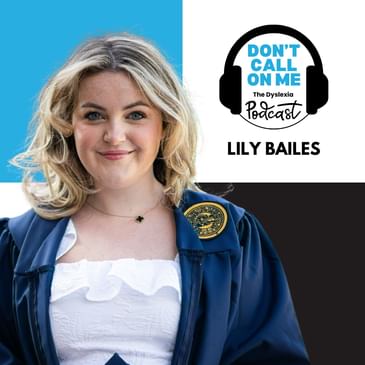
In this inspiring episode of Don't Call on Me, Megan and Eryn sit down with Lily Bailes, a young woman who overcame significant educational challenges to achieve academic excellence. Diagnosed with dyslexia, dyscalculia, and dysgraphia at just seven years old, Lily struggled to find effective support throughout her early schooling. It wasn't until her freshman year of high school that her mother, Samantha Bailes, took matters into her own hands, teaching her with the Sounds In Syllables (SIS) method. This breakthrough helped Lily go from functional illiteracy to reading at grade level, paving the way for her to graduate summa cum laude from West Virginia University. Now a graduate student in the advanced standing Social Work program at the University of Pennsylvania, Lily reflects on the powerful role her mom and SIS played in transforming her life.
-
Book a consultation with Megan to discuss CALT therapy.
-
Book a consultation with Eryn to discuss advocacy services.
With Love and Gratitude,
Megan, Eryn & The Don't Call On Me Team
[00:00:00] Going into my adult life, I feel like I've definitely had to learn to embrace my dyslexia and say, yeah, it makes me different, but it also makes me different in an amazing way.
[00:00:13] And I think it has taught me so much just about myself and grit and that I'm a strong person.
[00:00:22] And now I embrace it in that way, but when I was a child, I very much hit it. It was like a big secret of mine.
[00:00:32] This is Megan, owner of Dyslexia On Demand.
[00:00:35] And I'm Erin, owner of Advocate to Educate.
[00:00:39] And we are the Dont Call On Me Podcast.
[00:00:42] We are here to talk about dyslexia, to remove the stigma, to hear what families really go through, and to share their stories.
[00:00:50] In both of our businesses and personal experiences, on a daily basis, we listen to people telling their stories.
[00:00:59] Many have heartbreak, many have struggle, but most all have a silver lining, even eventually.
[00:01:06] It's all about the stories. The more we share, the more we realize we aren't alone and we are a community.
[00:01:14] Know, a tribe standing together.
[00:01:17] Today's episode is sponsored by Advocate to Educate.
[00:01:23] We help parents navigate through the confusing maze of special education in public schools in California.
[00:01:30] We support families starting as early as preschool through 12th grade, creating individual education plans to support the specific needs of your unique and amazing child.
[00:01:42] To learn more, go to our website, advocate2educate.com.
[00:01:47] Today's episode is sponsored by Dyslexia On Demand.
[00:01:52] Dyslexia On Demand uses only the highest trained dyslexia therapists, and it's all one-on-one and individualized to your child's needs.
[00:02:01] The best part is that it doesn't matter where you're located because it's all virtual.
[00:02:06] Visit us at dyslexiaondemand.com to learn more.
[00:02:11] Welcome back, listeners.
[00:02:13] We're here today with somebody I'm really, really excited to interview because I actually, I've never met Lily here, but I know her mom.
[00:02:26] And I think it's a great example of how often, and she hasn't even told me her story.
[00:02:31] I'm totally assuming what's happening.
[00:02:33] But when moms find out that their child has a dyslexia diagnosis, and then they choose to kind of uproot their lives, change their lives, and change and go in a professional direction that is now dyslexia-related, oriented.
[00:02:51] So, I know Lily's mom.
[00:02:54] She's another count.
[00:02:55] I've worked with her on the Alta board, and she's amazing.
[00:02:58] So, I can only imagine that this woman here in front of us is also amazing.
[00:03:02] So, without further ado, this is Lily Bales.
[00:03:05] I'm going to let you introduce yourself or just give us a little bit about who you are, where you are.
[00:03:11] Yes.
[00:03:12] Hi, guys.
[00:03:14] I'm Lily Bales.
[00:03:15] I am currently in Philadelphia, Pennsylvania, getting my master's degree in social work.
[00:03:21] I have dyslexia, dyscalculia, dysgraphia, and ADHD.
[00:03:26] And that's something that has affected my life so much.
[00:03:30] And so, I'm so excited to be able to talk to other people about this whole experience and how dyslexia has affected me.
[00:03:38] Yeah.
[00:03:39] So, you got it all, girl.
[00:03:40] So often.
[00:03:41] Seriously, I talk to people as like the exact same boat, like all the time.
[00:03:46] So, realize that you are not alone.
[00:03:50] Yes.
[00:03:50] But why don't you go ahead and tell us a little bit about your journey, a little bit about when you learned you had dyslexia, maybe even before, right?
[00:03:59] Like when leading up to that point.
[00:04:02] And then kind of where that's brought you.
[00:04:04] Yes.
[00:04:05] So, I do have my little phone notes because a lot of it, I was so young when this all happened.
[00:04:12] So, my mom, amazing woman, she sent me all of her little notes about all of it.
[00:04:18] So, I just know that a little bit before first grade, my mom started noticing that I wasn't reading.
[00:04:25] I wasn't understanding the alphabet, anything like that.
[00:04:29] And in the first grade, my first time in first grade, which we'll go in that, my teacher also noticed it.
[00:04:35] And so, they said that vision therapy, which I don't know if you guys ever have heard or know of vision therapy.
[00:04:42] Oh, yeah.
[00:04:43] Yeah.
[00:04:43] They were like, okay, we'll set her to do vision therapy and then repeat the first grade.
[00:04:49] And so, that was kind of the school's solution to my reading problems.
[00:04:54] So, I did vision therapy for two years.
[00:04:57] Wow.
[00:04:57] Wait, can I interrupt and ask you?
[00:05:00] So, I'm dyslexic also.
[00:05:03] Yes.
[00:05:03] And hearing that your mom had your notes written for you and she's talking, you know, say this is what it was like.
[00:05:11] Yeah.
[00:05:12] I'm curious, in first grade, what do you remember about first grade?
[00:05:17] I remember, one thing about me is I try really hard.
[00:05:21] I'm one of those people that like do not give up, nothing like that.
[00:05:25] But I remember reading really being one of those things where it was like, I'm giving it my all and it's not giving anything back to me.
[00:05:34] You always hear the quotes that's like, I can't think of the quote off the top of my head, but it's like, if you try hard enough, like you'll do good, basically.
[00:05:43] And that was always never what happened to me.
[00:05:47] And I think at that point in my life, I was so like, why?
[00:05:53] Like, what is wrong with me?
[00:05:54] What is the reason that how hard I'm trying isn't like working?
[00:06:00] Oh, it's like, it's like we were living parallel lives.
[00:06:04] You seem much younger than me.
[00:06:06] But I just want to say that I 100% relate.
[00:06:10] And I remember thinking the same thing, like, what's wrong with me?
[00:06:16] And first of all, why me in the sense of when I remember looking around at everybody else being like, OK, feeling very alone, feeling like and I was very cognizant at a young age of people with disabilities.
[00:06:32] But that meant they were in a wheelchair.
[00:06:35] They were nonverbal.
[00:06:36] They had cerebral palsy or something that you could visually see.
[00:06:41] And that was really obvious.
[00:06:42] So when I was comparing myself to others, there was a part of me that felt even more ashamed because it wasn't like you wouldn't look at me and assume something was wrong.
[00:06:55] Yet there was a big disconnect between my own inner voice, as I've done a lot of therapy to bring out what was that broken record was no matter how hard I try.
[00:07:09] It's irrelevant.
[00:07:10] It's just it's it it didn't feel to my little body and my little mind.
[00:07:19] Because, you know, and we're that small, it feels like everything's only happening in that exact moment.
[00:07:24] But it felt like I'm trying.
[00:07:27] Clearly, I'm doing all the things.
[00:07:30] Am I not doing them hard enough?
[00:07:32] Am I not doing them long enough?
[00:07:34] But as I got older and realized it was that automatic, like, why even try?
[00:07:43] Not that I ever gave up.
[00:07:45] But it was why would I try?
[00:07:47] Like, it's a it's just it's pointless.
[00:07:49] And that's why so many of these kids who have suffer from such insane lack of self, like the self-concept, the worth, all of that just tanks.
[00:08:01] And then the anxiety and the depression just keep going up.
[00:08:05] Because, yes, like you're taught, like if you just practice enough, you're going to get better at something.
[00:08:10] Right.
[00:08:11] Well, guess what?
[00:08:12] Not when my brain can't process the language.
[00:08:14] But you don't know that like as a kid.
[00:08:17] And that's one of the reasons that I always say, hey, at least when we have it like documented, like a diagnosis, you at least have an answer.
[00:08:24] But we're not going to totally bogart your story, Lily.
[00:08:27] Keep talking.
[00:08:29] Oh, you are absolutely fine.
[00:08:31] Because that is such a big part of my own story.
[00:08:33] I when I say I truly for so many years, I think up until I went to college, truly and wholeheartedly thought I was like stupid and not in the sense of like, oh, like I did something stupid.
[00:08:45] Like I truly and utterly thought I was stupid.
[00:08:49] And that is something that like now I look back on and I can kind of laugh and be like, I can't believe I thought that way.
[00:08:57] But it was like it was such a big part of my story because you're always told like try hard enough and you'll get there.
[00:09:04] And yeah, but but I mean, I found evidence, you know, like looking around like it wasn't that I was just feeling sorry for myself.
[00:09:12] And I don't know if this was like it was for you, but there was evidence when you had to take a spelling test or you had to, you know, maybe a little bit later, maybe your second time around in first grade where I guess I'm thinking back like, yeah, there's opportunity to read out loud because it's the time that the teachers know you're learning it.
[00:09:34] So it's practice.
[00:09:35] So, yeah, I'm assuming they called on lesson and in first grade.
[00:09:40] Right.
[00:09:40] And so I looked around and I saw that I was dumb and that it didn't matter that I worked hard because all these other kids are doing fine.
[00:09:50] And so is that the same for you?
[00:09:53] Oh, absolutely.
[00:09:54] I remember in the fifth grade, I actually had a time where the teacher was doing one of those like popcorn readings and it got to me.
[00:10:03] And another kid in my class like was like, can you read faster or something like that?
[00:10:09] Like almost screamed at me.
[00:10:11] And I just remember breaking down in tears.
[00:10:13] And I was like, oh, I was like, oh, my God.
[00:10:16] Just because of like, I was like, that just shows to everyone in the room also that like, obviously, I was struggling when it came to reading.
[00:10:25] And that's the one thing that I think very much affected me was I was not nervous that I wasn't reading.
[00:10:32] I was nervous that the people around me would notice that I wasn't reading.
[00:10:36] Yes.
[00:10:36] You're like inserting your assumption about what they are thinking about you.
[00:10:44] Yes.
[00:10:45] And that and our name of our podcast, Don't Call On Me, obviously resonates.
[00:10:50] I was going to say like your story, your story just that you just told about sobbing after some, excuse my language.
[00:10:59] Are we going to make this R-rated?
[00:11:01] I know.
[00:11:01] Yeah, we should like, we should jerk said something to you.
[00:11:06] I mean, it's, you know, now as a former teacher, we realize or I've realized it was the teacher's responsibility to take care of you in that moment.
[00:11:16] Right.
[00:11:16] But still kids say things and they sometimes don't even tend on it being mean, but it lands that way.
[00:11:23] Yeah.
[00:11:24] Yeah.
[00:11:24] And that kid, I think, really was just like getting frustrated in general.
[00:11:30] I'm not even blaming what he said on like all of that.
[00:11:34] I think it was truly just like he was getting frustrated because he knew like he could read faster and all of that stuff.
[00:11:40] Well, I mean, you do have a voodoo doll of him in your closet.
[00:11:44] Don't lie.
[00:11:45] I know.
[00:11:46] Maybe.
[00:11:47] Yeah.
[00:11:48] Yeah.
[00:11:48] It's okay.
[00:11:49] Well, look, he deserved it.
[00:11:50] You're clearly like in your 20s and this is still a very vivid memory.
[00:11:55] And I know that like when I think back to my childhood, the things that I remember are that those that that's a little T trauma moment.
[00:12:03] Right.
[00:12:03] Like, and that's why you remember it.
[00:12:06] Yes.
[00:12:07] Oh, absolutely.
[00:12:08] Absolutely.
[00:12:09] And so kind of back to my story, I guess.
[00:12:11] I did this vision therapy for two years.
[00:12:13] And after that, I still really couldn't read anything.
[00:12:16] And it wasn't until third grade that the school was like, okay, we have to give her some sort of services.
[00:12:23] And so then they gave me the read naturally fluency program.
[00:12:28] Yeah.
[00:12:29] When I couldn't decode.
[00:12:31] Right.
[00:12:32] That's not going to do anything.
[00:12:34] But thank you.
[00:12:35] Yeah.
[00:12:36] Yes.
[00:12:37] And so I still couldn't do anything.
[00:12:40] And it wasn't until the fifth grade.
[00:12:41] My mom was a teacher in that same school district at the time, which was very important to this whole story.
[00:12:48] It's like she really trusted in the school system.
[00:12:50] And she's such an amazing woman.
[00:12:52] And she just like really thought like, oh, they must be like trying to help.
[00:12:57] This must be like helping.
[00:13:00] And it didn't get until the fifth grade where my mom was like, okay, this obviously isn't working.
[00:13:06] And I'm very grateful in the sense of we had the financial status and being able to go get outside testing.
[00:13:14] I feel like when talking about this, I have to recognize the fact that that is so it's so amazing to be able to go and do that.
[00:13:23] And it didn't financially like really hurt my family because that is something that so many kids, so many kids with dyslexia don't get to go do.
[00:13:32] No.
[00:13:33] And so.
[00:13:35] I call dyslexia the disability of the privilege.
[00:13:38] Like, and it's sad because those are the only people who can really afford the support that they need.
[00:13:47] And it's because the school doesn't know what to do.
[00:13:51] So one of the things that like with everyone we interview and Aaron and I knew this before we started, it was that like, because we listen to stories all day, right?
[00:13:59] In our professional careers.
[00:14:02] And the stories are all the same.
[00:14:04] Right.
[00:14:05] And it's at the end of the day, at some point we all say, and we trusted the school, but they didn't know what they were doing.
[00:14:12] And we always say, look, we know that everyone is so well intentioned at that school.
[00:14:16] We get it.
[00:14:17] Like, right.
[00:14:17] We're not trying to.
[00:14:19] Well, not everyone.
[00:14:20] No, I know.
[00:14:21] But you know what I mean?
[00:14:22] In general.
[00:14:23] Right.
[00:14:23] You're, you're, you're accepting dirt for pay because you're a good person.
[00:14:30] So, but that's kind of what happens.
[00:14:32] And so everyone, even now in 2024 is having to pay outside services.
[00:14:40] And yeah, so it is an important part of the story.
[00:14:44] It's actually, I'm glad you brought it up.
[00:14:46] It's a huge part because you don't know a lot about me, but I used to be a special ed teacher and became an advocate after teaching.
[00:14:53] Cause I realized that there was really just that, that there was a gap missing.
[00:14:58] Um, just like your mom had the knowing, but there was probably some discomfort because she worked for the district as well.
[00:15:06] That being said, when families call me and they know their child's struggling and they need the intervention.
[00:15:15] I hate that.
[00:15:17] I hate that.
[00:15:17] My next question is, do you have the financial means to pay?
[00:15:22] Um, Megan, what would you say, um, um, per month, a typical, the typical cost is per month?
[00:15:33] Um, four times.
[00:15:34] $1,200.
[00:15:36] Right.
[00:15:37] Right.
[00:15:37] And that is, um, like, that's some people's mortgage time.
[00:15:43] Yeah.
[00:15:43] I, I was going to say that in California, but yeah.
[00:15:47] Yeah.
[00:15:47] I was like car payments, maybe two car payments, you know, whatever it is.
[00:15:51] Okay.
[00:15:52] It's like, why are you driving?
[00:15:53] Two maybe.
[00:15:54] Yeah.
[00:15:54] Well, exactly.
[00:15:55] Exactly.
[00:15:55] So, and it's, it's so uncomfortable because also with me advocating for the district to take responsibility and ownership to provide what the child deserves, it costs the parents that money also to have me on board.
[00:16:11] So you're very, very, I appreciate you bringing this up because it's a big part.
[00:16:17] Um, and speaking, going backwards, you know, with vision therapy, vision therapy is not covered under insurance.
[00:16:24] That's out of pocket.
[00:16:25] And there's a lot of controversy around vision therapy.
[00:16:28] And so, um, yeah, anyways.
[00:16:31] Okay.
[00:16:32] So, and I, let me just like with vision therapy recognize that does not cure for people who are listening.
[00:16:37] That does not cure dyslexia.
[00:16:40] Um, some kids, yes, do have convergence issues that do need to be addressed, but just because a child is not reading vision therapy, isn't going to cure it.
[00:16:52] It's a language processing disorder.
[00:16:53] It's not a vision issue.
[00:16:55] Um, and while we're on that note, colored overlays are not going to fix it either, but go on Lily.
[00:17:03] No, you're, cause I absolutely agree.
[00:17:06] And actually when thinking about like the answers to the questions of this podcast and all of that stuff, I really thought about how I wanted to address that aspect of it.
[00:17:15] Because for me being in social work, obviously I think about other people all the time and how much privilege just I have when it came to the fact of we were able to go get vision therapy.
[00:17:29] We were able to go get outside testing.
[00:17:31] And that's so, that's such a aspect of privilege.
[00:17:35] And like so many of those kids have to trust the school system and can't go any farther.
[00:17:40] Can't go get outside testing.
[00:17:42] Um, so I did.
[00:17:45] And I'm really grateful for it.
[00:17:47] And that found that I was profoundly dyslexic.
[00:17:50] Did you, did you learn at that time?
[00:17:53] Like was, was your family very open with you once you got the diagnosis?
[00:17:59] Um, I think at some point I kind of figured it out.
[00:18:02] I don't remember there ever being like a sit down conversation of like, Hey, you have dyslexia.
[00:18:08] I think it was like me being like, why can't I read?
[00:18:11] And my mom being like, you have dyslexia, like that sort of thing.
[00:18:15] Like never hiding it from me.
[00:18:17] Basically telling me every time I went and got tested, like you're getting tested for this, this, and this, like we're trying to figure out what's wrong.
[00:18:25] And all of that stuff.
[00:18:26] I don't think it was ever like a secret either.
[00:18:30] It was just not like, she didn't make it serious, which almost made it better for me.
[00:18:35] Cause I think at that age, if it seemed more like serious than I would have taken it and like something seriously wrong with me.
[00:18:43] Yeah.
[00:18:43] Right.
[00:18:43] But that's a really important question, Erin.
[00:18:46] Yeah.
[00:18:46] Because so many, there, look, there's still a lot of parents who are like, Oh, you know, we haven't had that discussion with our child yet.
[00:18:53] Or we don't know if we're going to have that discussion with our child.
[00:19:25] So.
[00:19:27] At least they can be Googling the right information.
[00:19:31] So anyhow.
[00:19:32] Okay.
[00:19:33] So, and how old were you at this point?
[00:19:35] I was in the fifth grade.
[00:19:36] So.
[00:19:37] Like 10.
[00:19:38] And at that point, my mom also very big sense of privilege here.
[00:19:43] She got a lawyer to try and get us appropriate resources from the school.
[00:19:49] And I think this is kind of going into my sixth grade year.
[00:19:52] I got the school finally agreed to do the Wilson program, but it was very much being delivered.
[00:19:59] Not regularly.
[00:20:00] So I was getting it.
[00:20:01] I was getting pulled from half a class for half an hour, two times a day, including a 10 minute walk there.
[00:20:08] So basically maybe 40 minutes, third and hour a week.
[00:20:14] Okay.
[00:20:14] Oh, so a week.
[00:20:16] Okay.
[00:20:16] Yeah.
[00:20:16] That's so important to know that like nothing works at that frequency, right?
[00:20:21] Yeah.
[00:20:22] Nothing.
[00:20:23] So that was like their kind of solution.
[00:20:25] Obviously we were very excited to like be a part of the Wilson program because that was supposed to help me a lot.
[00:20:31] And it's helped so many people.
[00:20:33] But with that level of like not doing it consistently, almost like pretty regularly, it didn't help me obviously.
[00:20:44] And so on the recommendation of my mom's attorney, we moved school districts in the sixth grade.
[00:20:51] Wow.
[00:20:52] So we fully moved our life.
[00:20:54] I remember this so vividly.
[00:20:55] And it was not just for me, but it was also my little brother.
[00:20:59] My little brother's also profoundly dyslexic.
[00:21:02] And at that point, so many people told him he'd never be able to read.
[00:21:06] I'd like to say he read better than I do now.
[00:21:09] Yeah.
[00:21:09] He is amazing reader.
[00:21:11] And he's like great.
[00:21:13] Do you have a memory of like as a child, knowing that you guys were moving for, well, at least 50% because of you and needing to uproot some kind of mass feeling of responsibility and shame or anything like that?
[00:21:34] Yeah, I think as a kid, I very much, sorry, Wilson, my little brother, I definitely tried to blame it on him the most.
[00:21:44] Like in my brain, I think I was like, it's not because of me, it's because of him.
[00:21:48] And I mean, I didn't like tell him that, but at least in my brain, that's kind of how I processed it was putting it fully on him.
[00:21:56] You got to blame someone.
[00:21:58] Yeah, I had to blame someone.
[00:21:59] And that was my little, I was like, okay, it's Wilson's fault.
[00:22:02] Little brothers make the most sense.
[00:22:06] I know.
[00:22:07] It ended up like, I was really upset about it because all my best friends were there and all of that stuff.
[00:22:12] But in looking back at it, it really was what helped me.
[00:22:18] And it's also what helped Wilson.
[00:22:19] We probably would never have found out about like all of this, all of that stuff if it wasn't for moving.
[00:22:29] Yeah.
[00:22:29] Which I'm really grateful for.
[00:22:32] Was needing to make new friends, was that traumatic or was it okay?
[00:22:37] It was actually completely fine.
[00:22:39] I moved from middle school to elementary school because I was in a school district where it was like,
[00:22:44] I was in middle school in the sixth grade and then I moved to one where it was elementary school in the sixth grade.
[00:22:49] So I actually think it helped a little bit in the aspect of like, I had people in my class, then I could make friends.
[00:22:56] And so that wasn't honestly too bad.
[00:22:59] Yeah.
[00:23:00] Thankfully.
[00:23:00] Middle school is just like the worst environment for like, I don't know.
[00:23:06] Maybe I'm just, maybe that was just my experience.
[00:23:09] I agree.
[00:23:10] Boy, howdy.
[00:23:11] Like knowing what I went through in middle school and I don't have dyslexia.
[00:23:15] And like just how miserable an environment or they're all miserable at that time and so mean.
[00:23:23] I have a son who went into sixth grade last year and I think I like lost 10 pounds of stressing for him.
[00:23:32] Like he was fine, but still.
[00:23:35] Yeah.
[00:23:36] Cause it's like, I'm associating the horribleness.
[00:23:39] So it's so good that you didn't have to endure that on top of everything else.
[00:23:45] So.
[00:23:46] I know.
[00:23:47] Definitely.
[00:23:48] And then at the school that I moved to, I had a teacher who did orthogillion method.
[00:23:55] Or in Gillingham.
[00:23:57] Yes.
[00:23:58] Yes.
[00:23:58] Sorry.
[00:23:59] No.
[00:24:00] You're in good company, man.
[00:24:02] I mean, guess me.
[00:24:03] Don't worry about it.
[00:24:04] Um, and so I had that services for six months and in those six months I went from maybe first grade ish reading level to a third grade reading level.
[00:24:15] Yeah, girl.
[00:24:16] Which in six months, like that was amazing for me.
[00:24:19] Um, but unfortunately the teacher retired and so ended the services.
[00:24:26] Yeah.
[00:24:26] And so then I went into middle school in the seventh grade, um, doing online language live.
[00:24:33] Mm-hmm.
[00:24:34] Which wasn't enough for me, obviously.
[00:24:38] And so that's kind of when my mom really uprooted her entire life.
[00:24:43] Yeah.
[00:24:43] Wilson was very young at the same time.
[00:24:45] And he started with someone trained in sounds and syllabuses.
[00:24:51] And he started with, um, one of my mom's now best friends.
[00:24:56] Yeah.
[00:24:56] And she was like, okay, I want to get trained in this.
[00:25:00] And so she quit her job.
[00:25:02] Thankfully, again, privilege, so much of it.
[00:25:06] And she started getting trained in it.
[00:25:09] And I was kind of like her little muse.
[00:25:11] She let, she taught me through.
[00:25:13] Well, we all need clinical hours.
[00:25:15] I did that for a few years.
[00:25:16] Good.
[00:25:17] Yeah.
[00:25:17] My freshman year of high school.
[00:25:20] Okay.
[00:25:20] Oh gosh.
[00:25:21] Your freshman year of high school, huh?
[00:25:23] Yeah.
[00:25:23] So freshman and sophomore year every single day for two years.
[00:25:27] Wow.
[00:25:28] So how, yeah.
[00:25:30] And, and how was that working with your mom?
[00:25:32] Because I'll tell you, like, I was like, I am the perfect person to, uh, like homeschool
[00:25:39] my kids and do all that stuff until I started doing it.
[00:25:43] And my kids, when they've had to work with a therapist doing dyslexia therapy, I hire somebody
[00:25:50] at my company.
[00:25:51] Cause I'm like, hell's to the no.
[00:25:53] Um, so it's interesting as a ninth grader, like when you've got, like you're brimming
[00:25:59] with tood.
[00:26:00] Like, I don't know if you really were, you seem like a very sweet person, but.
[00:26:05] Oh, I, my mom was with that one.
[00:26:09] No, I absolutely, I made her life awful.
[00:26:13] And I'm officially, I would like to say, I'm very sorry to my mom.
[00:26:18] We did a lot, but I was like, at that point in my life, I kind of goes back to, um, feeling
[00:26:24] like I've already given so much.
[00:26:26] Why do I keep wanting to continue with like trying to learn how to read at that point?
[00:26:32] I felt like I had given so much with learning how to read.
[00:26:35] I was like, I'm not going to try anymore.
[00:26:38] Yeah.
[00:26:38] And I think I really took that frustration out on my mother.
[00:26:41] Sorry.
[00:27:10] Yeah.
[00:27:12] We have their buy-in because if they're like half-assing everything, this is not going
[00:27:17] to work the same.
[00:27:18] So you have to want it and that's hard.
[00:27:21] And so like hats off to you, first of all, for like committing and doing it.
[00:27:26] But your mom like is probably has earned her sainthood.
[00:27:31] Like, Oh, she absolutely has.
[00:27:33] She absolutely has.
[00:27:35] And so that took me about two years to kind of get, I guess, where I am.
[00:27:39] Yeah.
[00:27:40] And yeah, that was really my whole, like learning how to read dyslexia story.
[00:27:46] I want to, um, ask a couple of like some questions.
[00:27:52] Okay.
[00:27:52] First off, uh, you remind me a lot of myself, um, in the way that you are speaking, obviously
[00:28:00] we're two white privileged women.
[00:28:02] We come from similar backgrounds just with having that in common, but I'm here to tell
[00:28:08] you that, yes, we need to acknowledge that difference, but that you're still in your
[00:28:12] own two feet and your own two shoes or whatever.
[00:28:15] However, however that phrase is from one dyslexics to another, I cannot remember the phrase,
[00:28:20] but whatever it is.
[00:28:21] And this is your one and only life.
[00:28:25] So you owe no one an apology.
[00:28:27] And as a parent now with a almost seven year old, that's dyslexic.
[00:28:32] I can tell you that because I've lived it and maybe the nuance in my story is that your mom
[00:28:41] doesn't have dyslexia is part of the story.
[00:28:44] Okay.
[00:28:45] So yes, I can see that.
[00:28:47] I mean, I remember working with my mom as a kid and I'd ask her like, how do you spell
[00:28:52] something?
[00:28:53] And she'd be like, well, let's look it up.
[00:28:55] And I would want to just stab her with my pencil.
[00:28:58] Like, just tell me the answer.
[00:29:01] I know I can look it up.
[00:29:04] This is a moment where I feel like it's unfair that I even have to ask you.
[00:29:08] So just give me the answer because I live with this problem.
[00:29:11] That was like the, this frustration level.
[00:29:15] And for those that are not watching Lily's face, she's like nodding her head.
[00:29:19] Like, yes, yes, yes, yes, yes.
[00:29:20] We have to remember doing a podcast.
[00:29:22] We have to be like, we were vocal.
[00:29:24] But this was your own life's trauma.
[00:29:27] I am not a therapist, but I lived it.
[00:29:31] So I can say that this was what the cards you were dealt.
[00:29:36] And now you can see as you have some distance from it.
[00:29:40] And then also, as you continue to grow that distance one day, maybe you have your own kids.
[00:29:45] Maybe they're dyslexic.
[00:29:46] Can you imagine your child apologizing to you?
[00:29:51] Like, you'd be like, are you kidding?
[00:29:53] You could have beat me up.
[00:29:54] I still don't care.
[00:29:56] I love you.
[00:29:56] And I know the pain.
[00:29:57] I know what it feels like.
[00:29:59] So I get it.
[00:30:01] There's a different level of like, I get it.
[00:30:04] So I just wanted to tell you that.
[00:30:05] And I'm sure your mom would.
[00:30:09] Of course, she forgives you.
[00:30:10] Of course, all of that.
[00:30:12] Like, because I think part of the reason why I'm bringing this up is we don't have enough
[00:30:19] oversight when it comes to mental health and dyslexia together.
[00:30:23] Like, if it said when you Google dyslexia and it came up that whatever came up said mental
[00:30:31] health is 50% of this issue.
[00:30:35] Okay, then maybe we'd start treating it differently.
[00:30:38] But really, we go straight to my child is struggling to read.
[00:30:43] Therefore, let's fix that problem.
[00:30:46] But what we're missing, and by we, I try to always have this part of my practice with
[00:30:53] the families I work with.
[00:30:54] But I mean, we on a bigger scale, like the public, is that with a difficulty, let's just
[00:31:02] say a learning difficulty.
[00:31:03] We're talking just specifically about dyslexia here on this podcast.
[00:31:07] So I'll stick to it.
[00:31:08] But with that is the mental health component as well.
[00:31:13] I have very rarely seen, I've met one and I think we heard of another, Megan, that their
[00:31:21] mental health was actually okay, right?
[00:31:25] That being said, that doesn't mean that there isn't more to dig and talk about later in their
[00:31:32] life as they get older.
[00:31:33] Maybe right now they're just keeping it together.
[00:31:35] But truly, like my belief is that those people that are like, no, it didn't really hit them.
[00:31:41] Like I think, have they done their own psychological work?
[00:31:46] Do they really know what that means?
[00:31:48] Like when you ask them that, or are they the kind of person that just puts on a show and
[00:31:52] they just always seem happy?
[00:31:54] So you'd never really know.
[00:31:55] Because in a typical classroom, and as a child who's dyslexic, you are absolutely going to feel
[00:32:03] like you're an idiot.
[00:32:04] And it is the way, it's the way that our classrooms are designed.
[00:32:09] It is the system, the public school system in the United States.
[00:32:13] So I'm bringing this up to say, A, you have nothing to apologize about.
[00:32:18] Number two, you're going to be such a great social worker or whatever you do.
[00:32:22] I pray that you go into a path where you can provide support to our inner child and other
[00:32:31] children because the understanding that you carry on a day-to-day basis is, it's irreplaceable
[00:32:39] as far as like, you can do hours and hours and hours.
[00:32:43] But when you live it, it's a different level of understanding.
[00:32:46] Yeah.
[00:32:47] So I want you to talk about your mental health with us.
[00:32:51] And you don't have to, obviously, this is like a podcast on dyslexia.
[00:32:55] So it's whatever you're comfortable with.
[00:32:57] I struggled tremendously in other aspects of my life because of the baseline that dyslexia
[00:33:07] kind of created for me.
[00:33:09] So I'm curious if you'd be willing to share a little bit more about your own mental health.
[00:33:16] Yes.
[00:33:17] I think now being in social work, learning so much about therapy, I'm like therapy's
[00:33:23] biggest number one fan.
[00:33:25] I'm like, yes, everyone should be in it is my opinion.
[00:33:28] But mostly when it comes to people with disabilities just in general.
[00:33:35] But specifically with dyslexia and me, I grew up with extreme anxiety.
[00:33:41] I mean, every single day I would be so anxious.
[00:33:45] I would have the worst panic attacks because I always wanted to put on this persona that
[00:33:51] I was not different than others, even though like that is such like a what even is different,
[00:33:57] what even is normal?
[00:33:58] You know what I mean?
[00:33:59] Of course.
[00:33:59] But I really always wanted to put on this persona that I'm just like the other kids.
[00:34:04] Yeah.
[00:34:05] And that caused me so much anxiety every single day being like, okay, is this what the other
[00:34:12] kids do?
[00:34:13] How do I make sure that they don't notice when the teacher's pulling me out of class?
[00:34:17] How do I make sure that they don't think anything of it when I take the test in a different room?
[00:34:23] Right.
[00:34:24] All of those things.
[00:34:26] And so I struggled so severely with anxiety.
[00:34:29] And going into like my adult life, I feel like I've definitely had to learn to embrace my dyslexia and say like, yeah, it makes me different.
[00:34:41] But it also makes me different in an amazing way.
[00:34:44] And I think has taught me so much just about myself and like grit and like that I'm a strong person.
[00:34:54] And now I embrace it in that way.
[00:34:57] But when I was a child, I very much hit it.
[00:34:59] It was like a big secret of mine.
[00:35:02] I would say.
[00:35:04] Yeah.
[00:35:04] I wouldn't tell people all that stuff.
[00:35:06] I think that, you know, like in the International Dyslexia Association, their definition of dyslexia is going to be like the commonly accepted definition.
[00:35:17] And in that it says it's neurobiological in origin and it, you know, like primary consequences are.
[00:35:24] And I very much think with the awareness that we have in the profession of how detrimental this is and the percentage of kids who develop anxiety and depression, like under secondary consequences, instead of it just being like reading comprehension, low vocabulary.
[00:35:42] It also needs to be anxiety, depression, because, you know, we are all I think as kids all trying to fit in and, you know, status quo and different is bad.
[00:35:55] And that's just some message that we get as children somehow, even though we're trying to fix that.
[00:36:02] One of the reasons why I feel it's so important that kids get mental health support early is they leave and go to college.
[00:36:09] And once you leave and go to college, I fell apart in college.
[00:36:13] I was supported at home.
[00:36:15] I, you know, my journey is a little bit different as far as I didn't get the intensive or Gillingham intervention.
[00:36:23] I might have.
[00:36:24] It wasn't intensive, but my the tutor that I went to has passed away.
[00:36:29] So, like, I mean, she was old when I saw her.
[00:36:32] So I don't know what kind of intervention I actually got.
[00:36:35] Um, but when I went to college and I went to UC Boulder my first year and I was in these classrooms with 500 kids and really you didn't need to go to class.
[00:36:48] You just needed to take the test at the end.
[00:36:50] And there was no way there was no way I was going to be able to read from a textbook and pass a class while being in college for my first year and taking care of myself.
[00:37:02] Um, I didn't know how and I didn't have the coping skills.
[00:37:06] So one thing, and I'm curious about your experience with college.
[00:37:11] One thing I learned after I left Boulder, I went to, I actually went to photography school because I was like, you know what?
[00:37:18] I'm never going to read again.
[00:37:20] I'll just take pictures.
[00:37:21] This will be great.
[00:37:22] That wasn't my last degree, obviously, um, as I ended up being a teacher, but still that was my plan.
[00:37:28] What I ended up learning later on in grad school was the more open you are about your disability or ability or whatever you want to call it.
[00:37:41] Let's just say dyslexia.
[00:37:42] The more supportive my professors were to the point where I had this one professor tell me that I didn't have to read any of the articles that he was going to send me links to videos that I could watch instead.
[00:37:58] And that is, I could write my papers based off of the videos that I watched.
[00:38:03] Like that's where in college, it's not how you get the information.
[00:38:09] It's that you get the information.
[00:38:11] Yeah.
[00:38:12] Yeah.
[00:38:13] And when you practice enough advocating for yourself, you can get these, what I saw as a freaking miracle.
[00:38:21] Like really?
[00:38:22] Whereas before it was like, that's cheating because everyone else has to read.
[00:38:26] Yeah.
[00:38:27] Like who cares?
[00:38:28] Did you, how, how, how did that go for you?
[00:38:31] I can always talk about dyslexia in college because I had actually a really amazing experience.
[00:38:37] I went to West Virginia university for my undergrad and I definitely agree with you when you were saying, um, the more open you are, the more accepting they are.
[00:38:49] Um, and the more willing they're, they are to make exceptions.
[00:38:53] That's exactly how my experience always was.
[00:38:56] I was a BC student in high school.
[00:39:02] I graduated from West Virginia with like a three, eight.
[00:39:06] I was summa cum laude.
[00:39:07] Like I did great.
[00:39:09] And now I go to an Ivy league.
[00:39:10] And so it's like very different, but from like one to the other.
[00:39:14] And the one thing about college is making those professor connections and learning what services the school can provide you is so important.
[00:39:25] At West Virginia, they have a program called mind fit, shouting them out a little bit because that was the program that actually helped me find my tutor that I had for all four years.
[00:39:36] And she knew, she knew everything about me.
[00:39:40] I mean, we were best friends.
[00:39:41] She was literally like an older sister to me.
[00:39:45] And with my experience with that, she really was the one who taught me how to write properly, like how to put what I'm thinking on my brain into paper.
[00:39:55] She was the one to like teach me how to do all those little study tips about the papers and the readings.
[00:40:01] And she was the one that made me download like the audio thing on your computer.
[00:40:06] So it will read to you like all of those little dyslexia hacks.
[00:40:11] She made me do having that support in college was so amazing.
[00:40:15] And now being in grad school and Ivy League at a very like intensive college, I still to this day use each and every one of those tips.
[00:40:25] And I think I wouldn't do as well as I do if it wasn't for having that knowledge.
[00:40:32] So I'd say for anyone who is dyslexic, like learning those tips and tricks when it comes to helping you in college and even high school can really help you in your education.
[00:40:47] So one more piece of little empowerment for anyone who has ever been told that they're never going to read or that they their child is never going to eat, read or just I hate those people.
[00:41:00] But we're looking at somebody and listening to somebody who was diagnosed as severe, profound dyslexic, dysgraphic, dyscalculia, ADHD, who went on to go to college, summa cum laude, now is in Ivy League, right?
[00:41:21] Graduate school.
[00:41:22] Well, please never listen to someone who says that it is all possible.
[00:41:29] Yes.
[00:41:30] Circling back around to the tutor.
[00:41:32] So I'm just curious if your experience matches mine.
[00:41:36] So when I after I went to photography school, I ended up going to Antioch University.
[00:41:41] And at Antioch, I didn't know this until I was already enrolled.
[00:41:45] And in my first class, I don't know, like, you know, actually thinking about it now, I feel like I need to call student services and tell them you need to put this on the front of every application so that people can make up their mind.
[00:41:58] But had I known, I don't know if I would have ever gone to the school.
[00:42:01] So I learned that they have no tests.
[00:42:06] Nothing was multiple choice.
[00:42:08] Everything was essay format.
[00:42:10] Everything in every class.
[00:42:13] So I went from like, well, photography school had their academics, but it was like it was like typical.
[00:42:21] And I did horrible in those classes.
[00:42:23] But I went from like, I guess you could say traditional schooling to a college environment where all of a sudden I was going to have to write essays and that was going to be my full grade.
[00:42:34] And of course, I absolutely panicked.
[00:42:36] But I went back to what did I learn?
[00:42:41] Like who taught me how to write an essay?
[00:42:45] And OK, this is the part that I want.
[00:42:47] I want to know if we're matching on here.
[00:42:49] When I learned to write or when I relearned to write a five paragraph essay, but learn how to expand it.
[00:42:58] That was really the only backbone, back end trick for writing that I needed to become extremely proficient on.
[00:43:10] But once I got used to that.
[00:43:15] That brought that literally all the way through, whether it was a 30 page paper or a one page response.
[00:43:21] As long as I knew that format and stuck to it, I was OK.
[00:43:28] Was that is that true for you?
[00:43:30] Very similar.
[00:43:31] Yes.
[00:43:32] Doing social work as in my degree.
[00:43:35] That is literally all we do.
[00:43:37] I took a couple tests in college, like just with other classes.
[00:43:43] But all I ever do is write papers.
[00:43:46] And if someone had told me I was going to only do a degree where you write papers my freshman year, I'd be like, oh, girl, what are you talking about?
[00:43:55] Like there's no one.
[00:43:56] But like learning those little tips and tricks, mostly when it comes to formatting.
[00:44:01] Everyone always says, what is that called?
[00:44:03] Like graphic organizer where you put those don't work for me.
[00:44:07] I don't personally like them, but other people love them.
[00:44:10] Like figuring out what works for you, because I was always told those graphic organizers are amazing.
[00:44:15] No shade to them.
[00:44:16] I just don't personally like it.
[00:44:17] And yeah.
[00:44:18] So like finding that out for your own person.
[00:44:22] It's so amazing.
[00:44:24] Mm hmm.
[00:44:24] Mm hmm.
[00:44:25] So just for the sake of time, because we don't want to keep you long, but I have two questions and you may like choose to combine them or answer separately.
[00:44:38] But what is like in your dyslexia?
[00:44:43] Because everyone's kind of bubbles up.
[00:44:45] I mean, so many similarities.
[00:44:47] Right.
[00:44:48] But people have different perceived strengths and weaknesses.
[00:44:52] So how would you describe yourself?
[00:44:55] And then also for someone else who's listening to this, who has dyslexia, what would be your advice to them?
[00:45:05] So I can always say, like, I feel like one of my biggest strengths is self-advocacy.
[00:45:10] And now being in a social work role that is like literally so important.
[00:45:15] And that is something that was absolutely taught to me by being dyslexic.
[00:45:22] Like I was taught at such a young age that if something's going on in the classroom, thanks to my mom, honestly.
[00:45:28] She was like, stand up for yourself.
[00:45:31] If you don't believe that this is right, stand up for yourself.
[00:45:34] Say something.
[00:45:35] I always knew that she would never get mad at me, thankfully.
[00:45:39] And so I would stand up for myself.
[00:45:41] I would say, hey, I don't appreciate this.
[00:45:42] I don't like this.
[00:45:44] And it's something I take into my world all the time now.
[00:45:48] It's like if I don't believe something's right, I will stand up for it.
[00:45:52] I will say, like, hey, stop.
[00:45:54] Like, this isn't.
[00:45:56] You know how you've obviously heard this in the dyslexia world that, like, all these famous people, like, they might not be good at reading, but they're good at X.
[00:46:05] Like, what is your.
[00:46:07] For me, it's like, I feel like I am a total people person.
[00:46:12] Somebody can feel so uncomfortable and come into my presence.
[00:46:16] Okay, I mean, my husband might disagree here, but I can say in the professional world and everyone's really comfortable around me or, you know, I don't know.
[00:46:26] That's just something that I it makes me happy to know that I can provide comfort to others.
[00:46:32] So it can be something as little as that or maybe art.
[00:46:36] I don't know.
[00:46:36] What's what's the story?
[00:46:37] I'm not.
[00:46:38] I know people always say that dyslexics are really creative.
[00:46:41] That is not me.
[00:46:42] I'm no artist.
[00:46:44] I'm no nothing.
[00:46:45] I'm not.
[00:46:46] I think I would agree.
[00:46:47] I'm very much a people person.
[00:46:49] And when it comes to my clients and, like, talking to clients in general, I'm very good at making someone feel like everything that they're saying is, like, very important.
[00:46:59] And, like, be able to, like, really help other people, I guess, is my strength.
[00:47:05] That's that empathy, girl.
[00:47:07] What's your weakness?
[00:47:10] I'm very emotional.
[00:47:11] Yeah.
[00:47:12] I'm a very emotional person.
[00:47:15] And I think that also kind of stems from the dyslexia.
[00:47:18] I think when I was younger and always having so many feelings, I would cry all the time.
[00:47:26] And I think it's, like, from that, I've always just, like, learned to accept my emotions and take it how it is.
[00:47:33] And, like, I don't really care.
[00:47:34] Like, if that's how I show my emotions, if I cry a lot, then I cry a lot.
[00:47:38] That's how it is.
[00:47:39] And I think it's important to show our emotions.
[00:47:42] So, yeah.
[00:47:43] And that's healthy.
[00:47:44] You're willing to be vulnerable.
[00:47:46] Yes.
[00:47:46] And that is very important for others to see because not everybody feels safe enough to be vulnerable in this world.
[00:47:53] And you lead by example.
[00:47:56] And so, yes, that is absolutely a strength.
[00:48:00] And I have to say you're very personable and sweet as pie.
[00:48:04] Yeah.
[00:48:07] And maybe we caught you on your day off.
[00:48:09] But you don't seem anxious at all, girl.
[00:48:12] No.
[00:48:12] And you know what?
[00:48:13] It's because we're...
[00:48:16] Well, we're also talking about your world.
[00:48:19] Yeah.
[00:48:19] And this is something that is obviously important to you.
[00:48:23] So, this is a little preview of what, like, after you're done with grad school and all of that, you guys.
[00:48:31] Find Lily because she's going to be your person.
[00:48:34] I can imagine you're going to be a very empathetic and supportive provider for whoever you support.
[00:48:42] So, that's just what I got from this recording with you.
[00:48:46] Thank you.
[00:48:46] I think the one thing that I would tell other dyslexics is to not give up.
[00:48:51] When I was going to college, I was ready to give up.
[00:48:54] I was like, there's no way I'm going to graduate.
[00:48:56] There's no way I'm going to continue with education.
[00:49:00] And I was just really going to college to see how it would turn out.
[00:49:04] And thankfully, it turned out amazing.
[00:49:06] And now I'm here today, like, going to an Ivy League.
[00:49:09] I'm doing all this stuff.
[00:49:10] So, don't give up no matter how annoying it is to continue and, like, trying different things when it comes to your dyslexia or all of that stuff.
[00:49:19] Or just even with, like, mental health.
[00:49:22] Like, just don't give up because at some point you will figure out what works for you.
[00:49:27] You will figure out what your career will be.
[00:49:30] And everything will at some point get better.
[00:49:33] Yeah.
[00:49:34] Well, we'll give them your number, okay?
[00:49:35] How about that?
[00:49:39] Megan and I joked on the last one, we need just, like, a dyslexia hotline.
[00:49:43] Where, like, people can just call and be like, hey.
[00:49:46] Or kids can call.
[00:49:48] I'm really mad at my mom.
[00:49:49] They're making me read.
[00:49:50] And we're like, all right.
[00:49:51] Listen.
[00:49:52] Yes.
[00:49:53] Yes, exactly.
[00:49:54] We understand.
[00:49:56] Guess what?
[00:49:57] Like, let me talk to her.
[00:49:58] I'll make sure she gets you something really cool for reading, okay?
[00:50:02] Like, we can do this.
[00:50:03] A hundred percent.
[00:50:06] Well, thank you so much for joining us today, Lily, and, like, telling your story.
[00:50:11] And I think it's something that so many people can resonate with, obviously, like, your story and what you went through.
[00:50:19] But your message of advice at the end is really so important.
[00:50:25] And you did say in the beginning of the podcast that you were really persistent.
[00:50:30] You didn't use that word.
[00:50:31] That was a word you were, like, searching for.
[00:50:33] Yeah.
[00:50:33] But your advice is something that stands for someone who's seven all the way to 77.
[00:50:40] Is just to keep going.
[00:50:44] Because you don't know the end of your story yet.
[00:50:47] Like, you're going to find that success or whatever it is that you need.
[00:50:52] But it sure as hell helps to have people reassuring you of that.
[00:50:58] Mm-hmm.
[00:50:59] Absolutely.
[00:51:00] Okay.
[00:51:01] Well, thank you.
[00:51:03] Thank you.
[00:51:05] We're glad you tuned in today.
[00:51:07] To continue the conversation and be a part of our growing community, follow us on our social media channels and YouTube.
[00:51:15] Visit DontCallAllMe.com to share your experiences and learn from others.
[00:51:20] Every story shared is a step toward greater awareness and inclusivity.
[00:51:25] Join us in making a difference and don't miss our next enlightening episode.