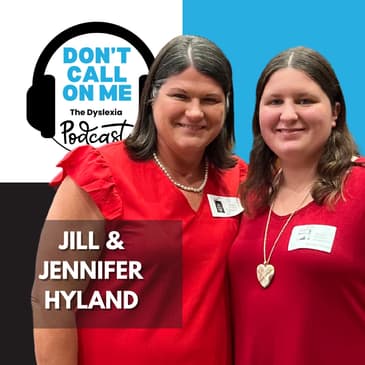
In this episode of the Don't Call on Me podcast, hosts Megan and Eryn sit down with Jennifer Hyland, a passionate advocate for her daughter Jill, who faced significant challenges before being diagnosed with dyslexia. Jennifer shares her family's journey—from missing early warning signs to navigating an ineffective 504 plan and ultimately finding hope through intensive remediation at a private school.
Listen to Jennifer recount how Jill's second grade became a turning point that led to transformative changes. Today, Jill thrives as a public school freshman with straight A's, but the road to success was anything but smooth. This candid conversation offers insights into the importance of early intervention, persistence, and advocating for evidence-based instruction.
Tune in to hear how determination can transform struggles into triumphs and provide inspiration to families navigating similar challenges.
-
Book a consultation with Megan to discuss CALT therapy.
-
Book a consultation with Eryn to discuss advocacy services.
With Love and Gratitude,
Megan, Eryn & The Don't Call On Me Team
[00:00:00] I did every single thing that follows in the dyslexia journey. I mean, I did every single one. And I would say, did everything wrong. But like you said, it wasn't wrong. I didn't know any better. But that's what brought me on the journey that I'm on is I went, I did every single one of these things and they were all the wrong thing to do. So now I'm committed to sharing with other parents, like, don't make these same mistakes, like jump immediately.
[00:00:30] Like you said, like if you're needing a tutor, like there's something bigger going on. This is Megan, owner of Dyslexia On Demand. And I'm Erin, owner of Advocate to Educate. And we are the Dont Call On Me Podcast. We are here to talk about dyslexia, to remove the stigma, to hear what families really go through and to share their stories.
[00:00:55] In both of our businesses and personal experiences on a daily basis, we listen to people telling their stories. Many of heartbreak, many of struggle, but most all have a silver lining, even eventually. It's all about the stories. The more we share, the more we realize we aren't alone and we are a community. Know, a tribe standing together.
[00:01:24] Today's episode is sponsored by Advocate to Educate. We help parents navigate through the confusing maze of special education in public schools in California. We support families starting as early as preschool through 12th grade, creating individual education plans to support the specific needs of your unique and amazing child. To learn more, go to our website, advocate2educate.com.
[00:01:52] Today's episode is sponsored by Dyslexia On Demand. Dyslexia On Demand uses only the highest trained dyslexia therapists, and it's all one-on-one and individualized to your child's needs. The best part is that it doesn't matter where you're located because it's all virtual. Visit us at dyslexiaondemand.com to learn more. All right. Hello, listeners. Welcome to the Don't Call On Me podcast.
[00:02:23] Today, we have Jennifer and Jill, a mom and daughter pair here to talk about their dyslexia journey. So I want to start off with, I think Jill and I have something in common. Dyslexia? You got it. Yes. So you're dyslexic, right? I'm dyslexic. And when did you learn that word dyslexia? Second grade.
[00:02:50] Me too. Literally, we're going to, it's going to be the, oh, that's my, is that my story? Okay. And can you tell me if you think back to a little bit before you found out you had dyslexia, what were your feelings about school? No, in first grade, it was kind of easy. So I felt fine about it, but I was always behind everyone else in my class. In all subjects and some, and anything in particular that you can remember? Reading and writing really.
[00:03:18] Okay. Do you remember when you're, you knew you were behind? Well, they had this thing where it was a reading level. So like I was on like level four while everyone else was on level eight or something like that. Okay. All right. So this is where I want to bring in Jennifer. So let's go back Jennifer to that kindergarten, first grade year for Jill.
[00:03:40] What do you remember of that time and, and your experience of picking her up and dropping her off from school and what you heard from her teachers? You know, it actually goes back a little bit before that we noticed in, in pre-K that she wasn't doing some of the things that her brothers had done at the same age. And just as parents thought, okay, it's just going to take her a little bit longer. You know, I had no idea. Never heard the word dyslexia in my life.
[00:04:11] And, and I probably wouldn't have suspected it even if I had, I mean, school was the highlight of her life. And in kindergarten, she also loved school, but it was weird at the teacher conference in the fall, they showed me her work and all of her pictures had frowny faces. Oh, and I was like, wait a second. What? Like it was, it was so not her normal personality. And I was, I was blown away. Cause I was like, I mean, she loves school. She loves coming every day. And she's so, you know, thrilled.
[00:04:41] Um, but I, you know, of course what I didn't know is that she was struggling. Um, and it's funny because it was a little private kindergarten. The teachers weren't certified teachers and, um, you know, at the end of the year they were like, well, she's been struggling with some things. And we looked this up and we think she might be dyslexic. And I was like, you're not teaching. Right. Like what? You know, and I, not in a mean way. Cause they were, they were, you know, you know, teaching her and being very kind and loving and all that.
[00:05:07] But, um, it just kind of sat with me like, that doesn't make sense. Like, how would you know? And so, um, but I did take her to a tutor that summer before first grade, a former teacher in the district who told me, no, she's not dyslexic. She just needs more practice. Okay. I do want to jump in really quickly and just say, cause I see parents post on Facebook a lot of times looking for a tutor for my kindergartner or whatever.
[00:05:33] And just so that, you know, if you have a kindergartner, first grader, et cetera, and you're looking for a tutor for them for reading, there's something wrong. Like, and dig in there versus getting a tutor and PS Jennifer, you didn't do anything wrong by doing that. You know, it's like our knee jerk reaction as a parent.
[00:05:52] Let me tell you, I did every single thing that follows in the dyslexia journey. I mean, I did every single one and, and I would say did everything wrong, but like you said, it wasn't wrong. I didn't know anybody, but that's what brought me on the journey that I'm on is I went, I did every single one of these things and they were all the wrong thing to do.
[00:06:17] So now I'm committed to sharing with other parents. Like, don't make these same mistakes, like jump immediately to, like you said, like, if you're needing a tutor, like there's something bigger going on. Anyway. So she told me that there was nothing wrong. She just needed more practice. She gave us tons of sight words to work on and you know, all that.
[00:06:37] So we go into first grade and she starts behind. Oh, don't worry. She'll catch up. She'll catch up again. The same, you know, the thing that all the parents hear and she didn't, you know, she didn't fall further behind, but she didn't catch up. She was always two levels behind. And so at the beginning of second grade, about three weeks into the school year, Jill came home on the bus and I went outside to greet her like I did every day.
[00:07:00] And she would normally jump off the bus and tell me what a great day she had. And on this particular day, she got off the bus with a red puffy face and I could tell she'd been crying and she was still sobbing. And I, of course, scooped her up and said, what happened at school today? What's the matter? And she told me I'm stupid. I'm dumb. Nobody likes me.
[00:07:21] And it's weird that those three phrases were her exact words. I mean, they've always stuck with me because, you know, as a mom, that just breaks your heart to hear your child say something like that. And so I immediately called the teacher and said, what happened at school today? Were the kids mean to her? Did she have problems? And she said, well, I think you should call the assistant principal. And so I did. And we set up a meeting.
[00:07:45] And then, you know, at the time I didn't know any better. And so I went in for the meeting. They agreed to have her tested. And within a month she was diagnosed with dyslexia and getting services from the school. You know, it's funny, though, because I think about it now and I look back and I think the reason that that went so fast was because they already knew.
[00:08:08] And until my daughter was broken and at the lowest point of her life, they weren't going to do anything about it. She had to break before they were going to do something. And at that point, I think that's why it moved so quickly, because it was they had known all along. That makes me a little bitter. I just want to elaborate. That is very common. The fact that you suspect that the school knew and, you know, waited till she showed it on the outside.
[00:08:38] It's awful. And it but it happens everywhere. And it's it's so sad that that is our system. And it's really unfair. And to add to that, I mean, and I'm not discounting your story at all, but the fact that we're talking and that you experienced that while she was in second grade, that would be considered a blessing for so many people.
[00:09:00] Because I've been in like court cases with families where it was clearly evident that they knew about this kid when they were in 10th grade, 11th grade. Right. But they still weren't doing anything. So that's just really to give shed light on the ignorance of the system and no way trying to discount your story and Jill's story.
[00:09:27] Oh, yeah. No. And that's and again, I'll I'll say again, this is why I have become vocal about it, because I know that we have the most typical story. We went through every single one of those things. Like when you read about the dyslexia journey, we went through every single one of them. And I, you know, and this is something that, you know, Jill and I have talked about is, you know, what we're doing right now is not going to benefit her at all.
[00:09:55] You know, she's already past that stage. But I feel like our journey was so difficult that I want to help other parents avoid having to face the same struggles. That is why we're doing this podcast, because at the end of the day, Megan and I hear from families over and over and over again, different names, but same story.
[00:10:18] You know, every obviously every family has a different cultural background, a different level of willingness to stand up to their administrators. Everybody has a different idea of whether school is a place where you can go to say, hey, I don't think this is working. Whereas some people are like, no, they know everything.
[00:10:40] Why would I come in and pretend like school should be a safe place and school should be a place where we have great memories like camp? It shouldn't be a place where we're getting traumatized. No. And that's really what ends up happening to us. It happened to me and it affected me later on in life because talking about that voice that's in our head, Jill, that says we're still idiots and we're still dumb and we can't do it.
[00:11:09] And we're not going to be able to finish that book or and or even having the patience to get through reading books like forget it. That voice comes back a lot as soon to be 42 year old. So I can tell you if you have it, let's let's kick it to the curb while you are young because it just gets worse. But we'll we'll get there.
[00:11:31] I just want to say to like too often that mama gut, you know, that you have or you had that something was wrong and you're following that. The school doesn't give respect to that because they say, oh, but the data shows that Jill's making great grades or whatever. What's the big deal about testing them? Right. I mean, it's a staffed LSSP.
[00:12:01] You know, I just don't even understand. But I just want to say that and give you credit for speaking up to. So let's go. Let's kind of fast forward a little bit or or summarize. So from second grade until getting through elementary school, tell us what was what was done, what types of interventions were being used at the school. If you remember, Jill, do you remember having to go and to get services?
[00:12:30] Did you hate it? Did you like it? I remember going to the dyslexia services with my teacher, Miss Edgar. I remember not really doing anything much like we would work on things, but never really felt like we were doing that like anything useful kind of in a way. And were you doing outside intervention also or just school based services? Just school at the time. OK. OK.
[00:12:58] So do you feel like they helped you with your dyslexia? Well, I actually went to a private school for fourth and fifth grade because I had a pretty awful third grade year. That was the year when we started having different teachers. So I had my second grade teacher who moved up to third grade. But then I had another teacher who I don't think she liked me too much. But so they would give us packets and I would always like never finish them on time.
[00:13:28] And I was like everyone else had finished theirs and I was still like only halfway done. Honestly, I didn't really realize at the time, but now I kind of realized I was just really sad. Like when I had to go to that class, like when I was in math and science, I was happy. But when I was in reading, I was always so sad. Yeah. Like an immediate wet blanket on you, like a cloud that's following you into that classroom, knowing what's coming. Yeah, it's called anxiety.
[00:13:55] I'd like to chime in here because as her parents, we saw that at home. And we knew that there was a problem. And I started actually before Thanksgiving looking for another solution for fourth and fifth grade. I felt like the intervention the school was providing was not sufficient.
[00:14:20] And the curriculum that they were using, I know now they're still using the same one is not a dyslexia curriculum. So we started looking before Thanksgiving and we finally made the move for fourth and fifth grade to a private school that specialized in learning. I know I'm not supposed to say disabilities, learning struggles, whatever you want to call it. And within the first four to five months, she was reading with fluency.
[00:14:50] And I knew that because her homework every night was to read out loud to me. And one night I was making dinner and she was reading and I was listening and I was like, wait a second. She's using like tone of voice and inflection and she's not struggling repeating, you know, letters. I was like, wait, I think she's reading. And so that was the code. Yeah, it was wonderful.
[00:15:15] It was so it made such a difference for her to to feel successful. Jill, do you remember that moment? I don't remember the exact one she's talking about, but I remember getting better and actually being able to like read a book in fourth and fifth grade. Yeah, that aha moment. And how lucky, you know, you were that you are in a family that could send you. And I'm not saying in any way that it wasn't a financial struggle because I promise you it was.
[00:15:47] And that you got in and there wasn't a two year wait list and all of the things. Because what your mom was describing at the public school is what I non and non affectionately call the illusion of compliance. When we've got it documented in the IEP that it's supposed to be X, Y and Z. And it's not those things.
[00:16:10] And they are forced to keep trudging along and fighting or just assuming that those trusting the school. So you're one lucky little girl, not a little girl anymore. So let's talk a little bit about how spelling and writing kind of grew, how that unfolded. I know for me, spelling is my greatest struggle and obviously writing.
[00:16:36] But spelling is just, yeah, no, let's just say like the whatever tutoring I got, it never stuck. So, yeah. Tell me a little bit. I want to hear from from Jill first. So I still struggle with writing. I'm not good at it. Don't ask me about commas. But when I first started writing, I was really bad at it. Like I could barely spell like what and does and like very basic words like that.
[00:17:05] And then when I got to fourth grade and fifth grade, like when I went to the private school, I remember every morning they'd have us do spelling. And like they tell us like what rhymes with this word. And I remember that just helped me get a lot better at spelling. So little tricks, little tricks. And let me learning little like what are they? What's a mnemonic device? Yeah. Yeah. Something that helps you remember something.
[00:17:31] Um, yeah, just because we're talking about the academic piece, like what are your feelings around having to read a book or having to write a paper? And now technology is obviously part of your practice. So you can use a Chromebook and stuff like that. Correct? Yes, I can. Okay. So do you have the, uh, I hate doing it still. Uh, for writing? Yes. For reading?
[00:18:01] Not so much anymore. I like reading. Oh, awesome. Awesome. What's a book that you can recommend? Another, another book that another dyslexic girl would read that you'd be like, okay, if you've never read a book, you should read this one. I'd have to say probably animal farm or, uh, Fahrenheit 451. Oh, because the words in there, they're not really complicated.
[00:18:28] Like they're pretty good descriptions of everything. Um, okay. So now you're saying reading, you're good. You'll read, but writing is not your most fun experience. Yeah. I, when it gets to simple words now I can spell them just fine. But when it's like anything like experiment or through, I have trouble sometimes. Uh, girl, I spell exercise wrong every time I write it. Like it's just, yeah.
[00:18:58] So I, I hear you on that. And luckily, you know, as you get older and get in the world of not having to be in school, you'll, you'll realize that everybody and everybody dyslexics and not use spell check and use Grammarly and all these apps. So more power to using them. And there's no shame in that at all. I give you, I give you permission. If your mom ever is like, no, you can't use it.
[00:19:27] Uh, call me, um, because I will have a, uh, I will have a chat with her. Um, yeah, that it, there's no reason at this point, right? At this point, it's all about just getting your thoughts out and getting what you know on paper. And that's it. It's not about whether you can spell words or not. No, it's not. And even adults, uh, who are non-dyslexic still have trouble with some of the words that you were saying.
[00:19:52] I mean, I still have to seriously think about February and, and, and Wednesday, like every time. Wednesday. Is it Wednesday? Wednesday, February. So it's okay. Like realize that you're with the norm. It's okay. Um, so let's, what, and, um, Jennifer, what is your kind of perspective on how things are going now? Um, I think she's doing great.
[00:20:19] I, um, once she started reading, I did go ask her teacher. I said, what, what have you done? Like, how did you do this? And she insisted to me that it was their spelling curriculum. So it's funny that Jill, that y'all talked about spelling and Jill mentioned that she's, it was a homeschool spelling curriculum. And she was like, um, and I, to me, it made sense that learning how to build those words then would help you deconstruct them to read.
[00:20:45] But when she, when she was ready to leave, I mean, you know, this was all in 2020 during COVID. And, and I will say her school still had school all day, every day online. She is logged into the zoom. They had, you know, their spelling class and their reading class. And then they would take a break, you know, for, to do a project or, and then they would come back and show it. And so, um, I, I did appreciate that.
[00:21:10] But then it was, we decided at the end of fifth grade, you know, that she had made all this progress and she was probably ready. You know, she, she needed to, to, to take the next step. And sixth grade seemed like the logical time to do it because that we were changing schools anyway. And I was terrified. And I told her dad, I said, the first time that we have a problem, we're gone. I'm like, I'm not putting up with anything because at that point we were now three years through all of this.
[00:21:38] And we had seen the good, the bad, and the ugly. And I, and, and I will tell you, this is something that, um, I, I think I'm proud of. I'm a totally different person now than I was before I knew this. Um, I always, like you described before, you know, they were the experts, they knew what to do. You know, I was just this, you know, person who was shepherding this kid through life and I didn't really have any standing.
[00:22:06] And, um, I learned that that's not true. And that, um, the only person who's going to do what's best for my child is me. And so I wasn't going to put up with anything when we went to middle school. And fortunately, um, we could not have had a more wonderful set of, of teachers. They had to redo her FIE when she came into sixth grade and they, um, said that she was ready to graduate out, which we agreed with.
[00:22:34] Um, and of course her, her private school teachers were like, do you want us to come fight for them? Because, you know, we'll, we'll just, we'll keep, we'll get her to stay on. And I was like, no, I think, I think they're right. I think she's good. And, and she had a great set of teachers and she really blossomed. And hold on. The first nine weeks she got the, um, language arts award from her teacher. So, oh, that makes me want to cry. Um, you know, so that was huge for us.
[00:23:02] Um, and, and it's just gone really well ever since. Um, you know, I think what we did was so important. Um, you know, and freshman year of high school, all A's like, I, I don't, I mean, I hate to say I wouldn't have expected that. She's so smart, but like she, it had to be unlocked. That, that code had to be unlocked so that she could be her smart self. And so, um, I don't know. I think she's doing great.
[00:23:30] And, um, I'm very proud of, of, of how well she's, she's done and, you know, everything that she's had to come through. That brings me to strengths. Um, so I want to know, um, what are your strengths, Jill? What are you good at? I'm very good at, uh, like math and history and things like that. Uh, and science. Do you, do you enjoy math? I do love math a lot. Yeah, me too.
[00:23:59] That, that was, I mean, not anymore. It's odd as an adult. I feel like I was, I really loved algebra. Um, and I just liked, I don't know if you can relate to this Jill, but I liked that there was one right answer. Yeah, me too. And there, it wasn't like 15 different ways to write a sentence, right? It's like, no, it's black and white. Like, yes, no. Is it right or wrong? Right. Yeah. I love algebra. Okay. And it all really interests you. Yeah. I love all of them a lot, actually. Girl. Okay.
[00:24:28] So I want to just bring this to the forefront because as we have evolved throughout your story or your story unfolds as you're this little girl in elementary school struggling and unhappy because of our school system. So you had to go through this experience and this trauma where it was all due to the design of the process of school.
[00:24:55] And then you go to a school that specializes in your needs and they help you. And it seems like getting you to a place where, and are you still at the private school? I'm at my local high school. Okay. Okay. So they got you to a place where you were kind of like, all right, I'm ready. I'm ready to go back to public school. And it sounds like you're doing fantastic. Yeah. I'm having a lot of fun.
[00:25:23] I do want to like swing to Jennifer for a second because there's more to the story we haven't talked about yet. I know that the story started with the, in the very beginning, you were starting to talk about your story, Jill, and her eyes started to tear up. And so it's like big T trauma for your mama watching that day that you got off that bus and you were crying.
[00:25:48] And that day that she went into your classroom and she saw all the sad faces on your picture. And as a mom, I know what that feels like. And that propelled her, she said, to be a different person. And your mom and you have done some things for our community. And I don't want to get too far where we forget to touch on that. So can you share some of that, guys? I'll let Jennifer start.
[00:26:18] Sure. I can talk about how we got started in it. I did want to say what you were talking about before about how education is set up is so true. And I think people forget that the foundation of every subject in school is being able to read. You can't do math word problems. You can't get the information you need out of history class. You can't read for science class. If you can't read, you can't learn anything.
[00:26:43] And so by not binding these kids, meeting them where they're at and giving them the skills they need, we are dooming them to a life of failure in school and then beyond. And so I think that I liked that you were talking about that because it's so true that it's the foundation for everything. And it's got to be there or there's really not much hope.
[00:27:10] But yes, so I will tell you about how we got started in some other fun stuff. I was, as part of going through this process, I was on a dyslexia, a parents dyslexia group for the district, which, you know, it was a little panel and we would meet four times a year and we would come up with all these ideas and they would do nothing with it. And so, but through that, I met some great people. Did you say, wait, your audio went out and you said, and they would do nothing about that? Yes, yes, yes.
[00:27:39] We had all these. Yeah, sounds about right. The typical district panel, yeah. Yeah. And so we, but I met a wonderful girl who was adminning a Facebook group and she asked me to take over from her when she moved. And I really didn't want to because I just didn't want to take on anything else. And I'm glad I did because I started running this Facebook group and it's one local to our area, but it's called Empowering Dyslexia for Spring Branch Houston.
[00:28:08] And because of that, a group reached out to me when they decided they wanted to make some changes to the way the state of Texas handled dyslexia and specifically dyslexia testing and providing services. And briefly, the short version is Texas was the only state out of all 50 states that was not following federal idea law.
[00:28:33] And so when parents suspected dyslexia, like me, even though I didn't know what I was doing and I asked for that FIE, they would say, oh, no, you don't need an FIE. We're just going to test only for dyslexia. In Jill's case, that happened. They told me, oh, it's not time for that yet. So six months later, I got a phone call to come in for a meeting thinking, oh, I'm just getting an update on how she's doing. They were like, now we want to do the FIE. And they found four more diagnoses. That's right.
[00:29:02] That's why we do this. That's why it's so important. And so because, again, I went through every single mistake that every parent makes, I didn't know. So I didn't push the issue. I said, you know, do what you need to do, you know, whatever. And so then I figured it out. And when they approached me about this, I was like, hey, that sounds familiar. And I decided to jump in. And in 2021, we went up to the Capitol a couple of times.
[00:29:31] We weren't super as involved as we could have been. But we were also kind of the outsiders. A lot of the other people already knew each other. And, of course, the bill did not pass that year. But then in 2023, they reinitiated it. And we were way more involved at that time. And we made so many trips to Austin that Jill got a truancy notice. But it was a wonderful experience. And Jill got to do some things, some hard things.
[00:30:00] And she was nervous about it. But I was so proud of her, you know, for, A, for knocking on those doors and speaking to all those people in the offices. And then she testified in front of the Senate Education Committee and the House Public Education Committee. And got to tell all of them her story, you know, about what she had, why this was important to her. Yes. That is so cool that we have, y'all.
[00:30:25] Because, I mean, I don't know, from, like, as a big dyslexia advocate in the state, like, just to be able to see and connect. And it's so amazing that you did what you did, Jill. Right? Like, let's put it on Jill. That takes some big, you know what, to get up there, knock on doors, to get in front of everybody. And what a change maker you are. It's huge. So cool.
[00:30:52] Yeah, at the time, I was definitely terrified and shaking while I was up there. Oh. Yeah. How, tell us, like, what was, what was that? What do you remember from, or did you kind of black out? Because you were so nervous. I just remember always, like, looking at them and just being terrified because they're all in business suits and stuff like that. But then they were pretty nice. So it was a lot easier.
[00:31:16] Well, that brings me to, like, I think your family, the Highland family, has some bigger plans for the future. What do you guys, are you guys involved in advocacy right now? Are you coming up with something? Tell us. Well, recently, we have, I've been working with some of the board members in the school district. And we have been able to get the school district to change the literacy curriculum that they are using to instruct the kids.
[00:31:45] After $7 million spent on Teachers College of Reading and Writing and, you know, not outstanding test scores. Over the last few years, you know, I really pushed the issue. And I was very fortunate that we had some board members who really believed in what I was saying and wanted to make that change. And so we are in the process of doing that right now.
[00:32:12] We will be deciding on the curriculum that we're going to adopt in the fall or, I guess, probably in December when the state comes out with their list. And I'm hoping for, you know, a huge, a huge improvement for the kids of the district. And, you know, it's, it's ironic is not the word. I don't know what the right word is. It's just funny. And this is what I told Jill, you know, every time she would get nervous when we were at the Capitol or, you know, whenever we talk about it.
[00:32:40] And I think people need to understand this. All of these kids that poured their hearts and souls out, you know, on behalf of this bill will not be helped. This is not for them. They're doing it because of what they experienced so that other kids don't have to experience it. And I, you know, I explained to Jill, you know, in our family, we had never heard of anybody with dyslexia.
[00:33:05] And after her diagnosis, she now has three more cousins who have been diagnosed. And, and one of my sisters is a school teacher and she didn't know anything about dyslexia, you know, and once Jill was diagnosed and her daughter was diagnosed, she had a huge amount of guilt. Like how many kids did I fail to help? And, you know, that's, that's the other thing that we're seeing is the teachers don't know anything.
[00:33:31] You know, they're not being taught what they need to know about dyslexia and even literacy. And so there's still so much that needs to happen, but, but I'm working on that literacy thing still with the district. And so for this fall for specifically for dyslexia, I reached out to a Houston city council member and we are going to get a dyslexia awareness month proclamation for the city of Houston from the mayor of Houston.
[00:33:59] And we are hoping I put in the request, but I don't know when I'll hear back about lighting city hall red for dyslexia awareness. And we're, I'd actually, I've talked to a couple of reporters and I'd like to, you know, get some coverage for it so that it makes it, you know, more widespread. I think the districts don't have a vested interest in, in spreading this information because that just brings more people who want more testing.
[00:34:23] But we, and we have to, we have to go about it another way to get the word out there about dyslexia. I mean, when, when it's the most prominent and, and often occurring learning disability you know, there's a lot of people who struggle through life without knowing why. And then their kids struggle, you know, and you probably know in Texas prisons, you know, 80% of inmates are illiterate and 50% are dyslexic. I know.
[00:34:52] And, and that's something that I just want to mention too. You're talking about all these things that you're struggling with in Texas. Texas is actually considered to be the dyslexia legislation leader in the United States. We are leaps and bounds ahead of other states. I know. Right. And so, but, so that's just like a snapshot of your experience here in Texas.
[00:35:17] And we, you actually have legislation behind you partly because of things like what you guys have done. Right. That is, that was part of the domino. I'll tell you, but let's now let's start talking about California. Now let's start talking about other places that need so much more work. And, and that's the larger percentage. So to sum it up, there is a system and a flow that needs to occur.
[00:35:45] And if teachers in classrooms, and I mean all teachers, I am not talking about special ed teachers. If all teachers and administrators and classroom aides are not being given the things to look for as far as identifying kids with dyslexia, that is the first step. I mean, I, I'm a former special ed teacher and I didn't learn anything about dyslexia. I'm still credentialed to teach. Do I know about it?
[00:36:15] Yes, because I have it, but I didn't learn about it in school and they don't need to learn how to teach a student with dyslexia. They need to know what to watch out for because the repercussions of the trauma that occurs, like Megan was suggesting, you know, you had two paths to go on. And luckily Jill, you have a family that could provide you with the support and this, this
[00:36:41] school, because that really gave you your platform to move forward on. But there are so many kids that end up finding out they're struggling like ninth grade of high school. And then they're like, all of a sudden they're like, I can't, I have a family that we tested. They were a senior in high school. And so I think that the, it's a ripple effect, but we have to start off educating the people
[00:37:07] that are responsible for identifying the needs. And it's so frustrating because there are simple changes that can be made. And when I talk about training, I'm not saying that they need this crazy expensive training. Watch a 20 minute video. Like it's not a lot of information. You know, it's funny because I, I'm sorry. I have been like the, you know, cause there's so many things.
[00:37:36] I have the perspective that the change needs to be top down. Right. So we need to be, it needs to be federal. Um, so that then the States catch up, you know, of course there, there's lots of nuances before anybody wants to comment. I do know, but a lot of times the, the charge has to be led nationally, federally. Um, and it just, and, and, and my head, I've been like, oh, how do I get the right lobbying
[00:38:03] or the funding to pay for the right lobbying to have education on high quality dyslexia training intervention, um, how we get that, uh, covered by insurance, for example. But really what you're saying makes so much more sense that if we did something more like, you know, how we have to do all kinds of like, you know, uh, PD on sexual trafficking, for
[00:38:28] example, and it's a 20 minute video and a little test that, that if every teacher, pediatrician, et cetera, and that's through their professional organization had to just do the checklist every two years, like you do with sex trafficking, what a change in the world it would make. So maybe I'm going the wrong direction. No, but in my thoughts. No, but you know, I have been begging the school district since I was on that dyslexia panel.
[00:38:55] Um, they had one, one year, I think they had it a couple of times, a dyslexia for a day. Um, and that, that is what broke me. Um, sitting in there and, and realizing how difficult life was for my daughter is what absolutely flipped the switch. Finally, like I was done waiting. I was done listening. I was now active.
[00:39:24] And, um, I begged and begged, please make every teacher in this district wash, do go through this thing just one time. Oh, well that's dependent on the principal. Oh, the principal has to bring it in. Oh, and I'm like, no, like make it like give them professional development hours. Give them something like they need to be exposed to this. It, we would not have had such a horrific third grade year if that teacher had understood any part of a learning disability.
[00:39:53] And instead she would just like be rude to my daughter, brush her to the side, tell her stop asking questions. And you know, if she had understood, I could write 15 sentences in the time that it took me as a dyslexic to write three sentences. There's a huge difference there. There is. And if anybody is listening to this and is a teacher or a parent or whatever, and you
[00:40:19] want to do what she's talking about, dyslexia on demand does it for free twice a year, virtually you can just log in, sign up and have a simulation. And that is a game changer for so many people to like walk a mile. Yep. I think I brought up earlier and Jill for, for you, does that, so your mom kind of described how, and, and what you thought when you were a child, do you still have a little voice in your head that tries to take you down?
[00:40:49] Only when I'm really struggling with something like when there's like a word that I just like can't figure out, like in any sort of way or something like that. Okay. Yeah. We got to smash that. Cause you got too much going on for you girl. Yeah. And, um, you know, I have the voice and it comes up and like I said, I'm going to be 42. So this is just a PSA out there that this voice will continue to follow you unless you do something about it.
[00:41:19] So we are big advocates for mental health support, whether it's therapy or coaching or whatever, because nobody deserves to walk around with this voice that the school system gave you because literally this is school system trauma and you had no control. You just, we're just going to school like a little girl should. And you went in as a happy camper and came out defeated because of the system.
[00:41:46] I want to hear from each of you, your top tip that you would give to another family struggling. Um, it could be a tip for, for a student. It could be a tip for a parent, but what tip do you have for them if they are going through this whole dyslexia journey? Um, for me, because of all of, um, the way that I have gone through this and kind of become
[00:42:14] an advocate and because I, you know, run that Facebook group, you know, most of my advice is focused on, um, the parents who are, are struggling with, with their students who suspect dyslexia and who don't know, you know, what to do. I think one thing that has really been driven home for me is that special ed is services and not a place. And I know that when we were growing up, it was a place and it was not a good place.
[00:42:45] Um, but now it's not that anymore and don't be afraid of the special education label. And I actually learned that because of her older brother who needed speech services. And they told me, oh, we're going to put him in special ed. And I was like, oh no, you're not. I was like, oh no, we don't do special ed in this family. I mean, I was, I was blown away and they had to promise me that the special ed label would go away when he was done with speech.
[00:43:12] And so because of the law that passed in Texas, um, dyslexia now works that way as well. And when you are getting the services, you will be in special ed and that is okay because that is how you ensure that you're getting what you need. Um, it gives the parents a say, you know, now that we're just on a 504, they don't have to include me in a meeting. They can make any decision they want about her education.
[00:43:38] And we're fortunate that just recently we had a new 504 coordinator come in because that was a huge problem in our high school for several years. And the district got to hear a lot of flack about that, but, uh, you know, special education is a good thing. And, and that is what your child needs to succeed. Do not be afraid of it. Yeah, it is for your protection and, uh, when it is not working to your benefit, it is what
[00:44:08] helps you to have a voice to kick the door down. I also, um, want to just add that not all States 504s are done without parent consent. So, um, I just want to not, Oh, sorry. Yes. Oh, you're fine. No worries. I mean, I didn't know that in Texas, so it's good to know. I absolutely love that advice. And you know what?
[00:44:32] It's the first time I've heard a parent say that, and it is so critical because there is an assumption that if you're in special ed, they're going to dump things down and they're going to make it, um, easier for the learner and then you're not going to learn anything. And really it just, it, with the right advocacy, you can just get into the, get the services that you need.
[00:44:58] And it doesn't mean that you're going to be in some class that's, you know, across the school with no windows. Like that's not what it is. Um, but that's, that is very, very good advice. Don't be afraid of the title. It's special ed, forget it. Just call it ed or special. I don't know. It doesn't matter. It does. It's irrelevant. And they should really just change that term altogether. I know. It would really help.
[00:45:26] Um, I want to thank you guys so much. It was lovely meeting the two of you. We want to hear more and stay in touch and stay connected. Please update us on any movement that you guys have in this journey. And I think we're wrapping up here today. Yeah. Thanks for spending time with us on Don't Call On Me. If today's stories touched you, please take a moment to follow us on social media and subscribe on YouTube.
[00:45:55] Extend the impact by sharing your story at don'tcallonme.com. Your experiences can foster understanding and strengthen our collective voice. Let's keep making a difference together. We look forward to having you back for the next episode. Thank you. Thank you. Thank you. Thank you. Thank you.