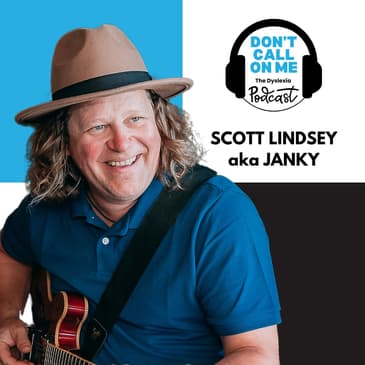
In this inspiring episode of The Don't Call on Me Podcast, Megan and Eryn sit down with Scott Lindsey—a creative powerhouse who has turned his dyslexic challenges into a multifaceted advantage. Growing up in a Louisiana school system that misunderstood dyslexia, Scott faced significant setbacks, from being held back to enduring ridicule in the classroom. Yet, his natural creativity became his saving grace.
Scott's path includes time in the advertising world, rising to lead successful campaigns and develop groundbreaking innovations. His journey includes success in coding, in developing his own business, and in music with Grammy-contending blues work under the moniker "Janky". Scott has also worked to uplift underprivileged artists through his nonprofit, The Blues Fund.
With honesty and humor, Scott recounts how dyslexia has shaped his life, from struggling with basic spelling to mastering complex coding languages, and how his upbringing instilled the resilience and work ethic that propelled him to success. Tune in to hear Scott's remarkable journey and his reflections on how dyslexia can fuel creativity and innovation.
-
Book a consultation with Megan to discuss CALT therapy.
-
Book a consultation with Eryn to discuss advocacy services.
With Love and Gratitude,
Megan, Eryn & The Don't Call On Me Team
[00:00:00] A normal person, they just go and read and that's what they do. But when you have dyslexia, you have this system in your brain, whether you know it or not, you have to kind of go around the roundabout way, which I'm going to go way over here across town just to get to this place that's right here where normal people don't do that.
[00:00:18] But the huge advantage is your brain is working just light years faster because you're doing all this stuff. So that now sets your brain up so that you can accomplish things, which the average person is just like going there. This is Megan, owner of Dyslexia On Demand. And I'm Erin, owner of Advocate to Educate. And we are the Dont Call On Me Podcast.
[00:00:46] We are here to talk about dyslexia, to remove the stigma, to hear what families really go through and to share their stories. In both of our businesses and personal experiences on a daily basis, we listen to people telling their stories. Many have heartbreak, many have struggle, but most all have a silver lining, even eventually. It's all about the stories.
[00:01:12] The more we share, the more we realize we aren't alone and we are a community. Know, a tribe standing together. Today's episode is sponsored by Advocate to Educate. We help parents navigate through the confusing maze of special education in public schools in California.
[00:01:35] We support families starting as early as preschool through 12th grade, creating individual education plans to support the specific needs of your unique and amazing child. To learn more, go to our website, advocate to educate. Today's episode is sponsored by Dyslexia On Demand.
[00:01:57] Dyslexia On Demand uses only the highest trained dyslexia therapists, and it's all one-on-one and individualized to your child's needs. The best part is that it doesn't matter where you're located because it's all virtual. Visit us at dyslexiaondemand.com to learn more. Welcome back, Don't Call On Me listeners. Today, we're so excited to have somebody that I personally know.
[00:02:25] His name that I knew him by is Janky, but I'm going to go ahead and let him introduce himself by his given name. Yeah, so my name is Scott Lindsey. I also am a musician and I play really janky blues. So I have the moniker of janky because I don't want the music to be perfect. I want it to have a little life to it. And so that's why I go by janky.
[00:02:51] All right. Well, why don't you start us out by telling us a little about your journey as someone with dyslexia? You know, things such as what age did you learn that you had dyslexia? Sure. When did you or maybe when you suspected it originally and your journey through school? Sure. So let me start kind of with the end, actually. So right now, my wife and I, we own our own advertising agency.
[00:03:18] I feel that I'm creatively, it's help, I guess. I guess what I'm trying to say is if it weren't for being creative, I have no idea what I would have done. And, you know, so back in the day when I was not testing well as a kid, they never said, oh, look what he drew on the desk. You know, they were so focused on test scores. But I've been very successful in the creative field. I primarily work in digital.
[00:03:45] So doing iPhone apps and websites. And, you know, I told myself back in the day I would never be able to code. And I know like three, three languages now, which it's interesting with dyslexia. Coding is sometimes easier because it has to be you have to open and close it. So it has to be paralleled in most cases. So dyslexia is actually advantage on coding like that. I never knew that.
[00:04:13] But if you go way back when I was a kid, I think it was fifth grade. I was at Summerfield Elementary in Shreveport, Louisiana. And, yeah, I guess tests were the big thing back then, you know. And so one day my mom said, well, they're going to we're going to go to this place and they're going to they're going to give you a bunch of tests. So we go here and I'm sitting in this room with other kids. And then I have the reading tests and, you know, who is the main character and what's his name and what does he do?
[00:04:40] And, you know, so some of like the names couldn't do it. Can't tell you. I can right now to this day, read a book and I will get the main character's name. Everyone around him, I have no idea what their name is, but I can tell you what they look like, their mannerisms, everything about these people, how they make me feel. But I cannot tell you their name. It's just the way it is. Same specifically with names. I always found that as I got older, the names weren't just like John and Jane anymore.
[00:05:10] They were names like I just I my son's really into Pokemon. OK, so it was as if these names were Pokemon characters. How do you pronounce it? No idea. And I would not that I read a lot of books as a child. Definitely didn't. But I would read a whole book without even knowing how to pronounce the name. But I knew that it was like a character. And and then, you know, I remember being in class and they would say, all right, so what did this character do?
[00:05:38] And they'd say the name and I'd be like, that's the name. No idea that that is how you pronounce whatever word that was. Yeah. All of it, man. You know, so go back to school. It's reading comprehension, you know, and so they pull my parents aside after all the tests and they say, Scott's slow. He's really slow. We're going to need to put him back in the day. They called them special classes.
[00:06:04] And so in order to kind of make this transition smooth, there is some irony in this to make it smooth. They moved me from the school that I went to and then I rode the bus to the school that's kind of far away. And check this out. We went by Gregory. So I went at this new school. I'm called Gregory. But I did learn. I learned a lot. I learned a lot. Number one, how to kind of go through the system with dyslexia.
[00:06:33] You know, and I talked about this before. I see it as kind of circumventing things. So what a normal person, they just go and read and they just that's what they do. But when you have dyslexia, you have this system in your brain, whether you know it or not. You have to kind of go around the around about way, which I'm going to go way over here across town just to get to this place that's right here where normal people don't do that.
[00:06:57] But the huge advantage is your brain is working just light years faster. And so they put me in, they helped me back a grade. So I'm in fifth grade again. And they put me in the 10 buildings and I've got good friends. I mean, there were some kids that definitely were special need kids. And so these were all my friends, you know, like one of the kids couldn't walk and, you know, he couldn't bend his knees. And then but I was kind of a popular kid.
[00:07:25] So I was friends with the normal kids and the normal and I'm doing air quotes. They were in the normal and they would come and start making fun of my friends. And I'm like, dude, like the guy's playing kickball. Like, what are you doing, man? He's having the time of his life. Like, don't make fun of him. You know, this is my friend. And so I was able to really understand at a more mature level, like relationships between kids and things like that.
[00:07:51] And, you know, I just believe that bullying and all that stuff, you know, I just wouldn't stand for it. Now I go to sixth grade. And so sixth grade, I kind of really started putting it together. And so much so that I think I probably started the testing and they were like, well, I mean, Scott's like acing all this stuff. Like, I don't know if he should be here. So then halfway through sixth grade, they pull me out and they put me in the normal classes.
[00:08:18] I think at that point, I kind of really started understanding what school was and, you know, what my role there was. Otherwise, I was just kind of this creative kid. So then lo and behold, by the time I graduate sixth grade, I'm on honor roll. This is in the normal classes. And I think I won the most, the wittiest award. And so it was having, but at this point, they're like, well, Scott, like, you don't really need to come. You're not in the special classes anymore.
[00:08:47] Dyslexic Gregory retires and goes back to the school that I was supposed to go to, which I was bused to at the time. And then I went back to being Scott because all my friends know me as Scott. I have some questions about, you know, in this 2024, we're not hearing stories of kids going to a specialized school for a year. Well, you were there to fit for two fifth grades. Okay. Okay.
[00:09:16] So you go to this school and you were talking about circumventing. And as you were talking about that, I was thinking about all the backwards ways I would try to execute the work that I had to get done. Specifically, I remember this in more in middle school where, you know, we were reading a novel. So I would watch the movie and then figure out, okay, how can I write an essay without really writing it?
[00:09:45] But I would need to have some written output and my essay would be based on the movie. But then I would have my best friend who loves to read, read the essay to make sure. And she'd be like, that didn't happen. I'm like, exactly. It happened in the movie, but I need you to tell me this piece. So that was my way of circumventing or like going around the system or strategically picking classes.
[00:10:15] And math was not a challenge for me. So taking higher level math classes that would kind of make me appear like I was smarter. It's almost like our, our strengths with what we're good at compensates. And we, Megan and I, in our professions, we talk about those, those compensations that certain kids are able to do. But I'm wondering if you remember, maybe you don't, but at this school, was there any type of explicit reading intervention?
[00:10:45] Do you remember learning to read or do you remember it just being a place where you learn to work around the issue? That's a great question because you are in a specialized environment, right? And you know, the teachers were not specialized. They were not, the teachers were not specialized. How was your instruction different in that portable as I think what I'm trying to say? So was it kind of, were we treading water? Were they not doing much?
[00:11:13] Did, did, did they try to work at least on skills? I would say they're more or less just kind of educational babysitters. Yeah, I remember, I remember those days. I mean, I was a special educator and it definitely evolved over my time from when I graduated undergrad all the way through much later, 15 years ago, when we are actually, it's more of a program, not a place, right?
[00:11:40] But I remember doing my student teaching in Louisiana in special education. And you're right, it's, it was very much of the time when it was a dumping ground. It was just kind of all the kids were placed in that same, and yours was a 10 building, mine's a portable. That's why I think in my head I'm visualizing where, where you were. Um, but there really wasn't much instruction going on as I'm looking at my teacher who I'm supposed to be shadowing.
[00:12:09] Well, the reason why I'm bringing it up is because I know now with what we know, we want to get these kids into intervention right away and as soon as possible. So they don't end up having this, all this emotional baggage and, and feelings of just being stupid and that sort of thing. I also now, um, I'm a musician and I play at church, um, on Sunday mornings and I'll do both services and we have to read what's called, uh, chord charts.
[00:12:36] But basically it has the lyrics and it has, you know, the chords over the words that they're singing and, you know, you have to follow it. And this is extremely, extremely challenging for somebody with dyslexia because I can't read music. I can't read music at all. I can read a chord chart and, you know, it's in the key of G and then you play and then the D and then the C and then the B minor or whatever.
[00:12:58] I'm just reading it, you know, but sometimes these directors, the sheet music, they just kind of assume that you know the song and you'll be able to just kind of, kind of flow with it, you know? And so I have a system. What I do is like, I always highlight the chorus in yellow on my iPad and I mark through it. So it's bright yellow because I have a, there's a lot going on here.
[00:13:21] I have a voice in my head when I'm playing and then you have a click track, something that's constantly clicking to keep the band in time. Everybody has the same thing. And there's a voice and she'll say chorus two, three, four. She's telling us to go to the chorus, but it's not going into the chorus on the paperwork after verse three or four.
[00:13:41] They have what you call Nashville numbers. So musicians in Nashville, you'll go into a studio and they will be, you know, George Jones was recording a song and the band would have this chord chart in front of them, but it doesn't have chords on it.
[00:13:58] It only has Roman numerals. Imagine me standing on stage and they give me on my iPad. They're like, okay, here's the sheet music and it's Nashville numbers. And they said, well, it's in the key of G. And I'm like, I literally go, nope, not going to do it, man. I can't literally, I miss my brain. Cannot do it because you have to know, you literally have to know the notes of the scale in every key that you're in.
[00:14:22] So Saturday night, I sit down with the sheet music and I look at it. And if they have Nashville numbers in there, I email them and say, can't do it. There is no way I am doing that on stage playing guitar. Because I don't even know these songs a lot of cases. I'm just kind of, I can blend in if I know the key. Then you also have a system that you can circumvent, you know, you can kind of accommodate.
[00:14:45] And that's what I do by highlighting the chorus. And then I put there because I know there's going to be a point, especially if I look up at the crowd and I am not fully understanding of the song. When I look at it, it goes. You know, the way that you're describing what you're saying, like that, what you have to do to circumvent, to play music, but you don't read regular music and you, I'm guessing can play by ear. Yes.
[00:15:12] Yeah. So what you're sharing with our listeners is that just because you're dyslexic does not mean you can't be a musician. You can't be a coder. It's that you have to allow yourself to use your creativity to work around the roadblock that if your mental health is not rooting for you, if you're not in support of yourself to break through these barriers,
[00:15:40] or you're not driven enough, you're just going to be blocked. But if you love it enough, you love music, you love what you do for work and you love it so much that you're able to use the workarounds and do it even better than people that are also in your same field.
[00:15:58] So that's probably the other gigantic point is creativity. So creativity for me has been a huge answer kind of to pretty much everything in my life, both music and art for me. It's, it's, it's a journey for yourself. And if you have creative abilities and you kind of see things, man, you can leverage that into a lifetime of joy. That's what I do as my job.
[00:16:24] So, you know, when I was in fifth grade, I was drawing these ads, you know, and then gradually as I go through school, I get to high school and, you know, I'm kind of that creative kid that's, you know, it's, I was kind of a trouble kid, maybe in high school. You know, I had a lot of things going on with, but I still stuck with creativity. And then, you know, I, it's funny that this is called don't call on me because I had that exact moment in high school.
[00:16:51] And I think about it all the damn time. And so I was in, I think it was an English class. I think his name was Mr. Landon. And he was, we were doing the reading aloud thing. And you're just, I'm like, no, please, please, please. He's like, let's call him. I'm like, no, no, no, no, please, please don't, please. Like, just can I get under the desk? Please don't. Scott, okay. You can continue reading.
[00:17:21] And I'm like, oh man. So I'm like, I'm sweating bullets here because I'm just reading and reading and reading and reading and reading and reading. Then I get to the word determined. I don't even know what that means. Determined. Oh gosh. Determined.
[00:17:43] I say, I say, it's D E T E R M I N E D. That is determined. So I said, determined. The teacher and the class start laughing. Oh, the teacher says some snar remark. And I'm just like, man, I'm crushed. And I just, I hated high school so bad because of stuff like that. And, you know, cause you got all these kids that are just breezing through.
[00:18:09] And yeah, here's the answer. I got the answer. And I'm like, I got nothing. I just want to get to art class, you know? Well, and, and, you know, what happened to in art class? Why, why isn't the teacher saying, Hey, who am I going to call on to show your drawing? And it, it like, and then you'd be like me, it's me. Look, look at my whole advertisement I made for Mercedes, you know?
[00:18:33] And back then, then you could have gone viral as a child doing right. All these creative advertising endeavors. But where is that? I was thinking about this last night about Tik TOK and how my husband always laughs at me whenever, and my kids, I'm the one that like allowed them to laugh. Okay.
[00:18:55] But whenever I say, Oh, I learned. And then everyone goes on Tik TOK and I'll be like a new recipe or I don't know a way to do my daughter's hair or whatever. Right. I started to get like defensive about it. And I started to think about how there does not need to be a hierarchy of elitist ableist type of judgment. That is the exact word on where we get our information.
[00:19:23] So I'm going back and forth with my husband last night, trying to say, why are you diminishing and laughing at where I'm getting my information? And, and I said to him, if you were to watch a video on Tik TOK or read a newspaper article, what do you think holds more value or, you know, what is seen as the better source? And he was like, of course, what's in writing. And it made me so angry because, but that is what people think.
[00:19:52] I would say in, in the general sense, people don't think there's a lot of judgment on getting information from these video sources. And the reason why I'm bringing this up now is that there was an emphasis on the literature class or, you know, reading in class as, as being important yet. Where is the importance put on the art class? Right. And that visual aspect of things. Yes.
[00:20:21] I had a reading ability to read the way that I can sit and relax and watch a video. If, if it didn't take all of my brain power to read something and it was as easy as watching a video, I'd read it, but it's not as easy. It takes so much more from me.
[00:20:41] If I were to ask my husband who is so far from being dyslexic, it couldn't be any more opposite than me. He would never do that. He would be reading on CNN. He would be whatever it is. He's a reader. I wonder how much of that is. And this is a good question for me to ask based on what I just said, but I wonder if that is culturally where we are because we want things quick and fast.
[00:21:08] But I also would love if we could dig deeper and ask and Megan, we can make this a point to ask the adults on this podcast to say, do you feel judged by getting by, by you loving more of a video outlet to get information? Because I can tell you, I feel actually judged that I, that I should be reading, that I should be reading the newspaper or something.
[00:21:35] I completely understand what you're saying because I do understand. For example, I was told, and Scott, you can tell me if this is wrong or not, but by a marketing professional, that TikTok is actually the second most common source after Google to actually find information. And at that point, I started a TikTok, I'll tell you, you know, just for the business.
[00:21:59] It was either TikTok or YouTube, but I think I was really surprised also because I do agree that there is, and I think it's probably more amongst our generation that there is a bit of a stigma about that because I also, you know, I love me a good deep dive into TikTok and I learned so much stuff also. But I'm also embarrassed a lot of times to admit that's where I got the information.
[00:22:26] Now, let me also say, though, I think that there are some movements, especially amongst educators of those with dyslexia, that, for example, we are trying to remove the stigma about audiobooks. You know, that audiobooks should start as soon as kinder for a child with any kind of learning challenge slash, you know, audiobooks that you're reading is reading.
[00:22:54] And we're trying to market that concept because it is important. So I think that we are going to see a big shift that's happening as more and more people learn little snack facts, like, believe it or not, TikTok is more searched for information than, you know, I don't know what else. Yeah, definitely YouTube is a go-to, man.
[00:23:16] Yeah. Oh, no. And I actually have started, instead of using Google for a lot of things, I am going to the TikToks and the YouTubes and I never did that before. Well, and ChatGPT. Yes, yes. To me, I see the content that you're consuming. I love TikTok short videos on art techniques, recipes. And there's also the craziness factor of it.
[00:23:40] You can learn a lot of crazy stuff, you know, but if you want to, like, really be able to consume a lot of information that you can have a tangible use for, like, you know, drawing the human figure. Like, there's guys that do it and it's like, okay, here, video number 56, we're going to draw a prism from whatever, you know, and they do it right there and just, I can tangibly use that. There's nowhere you can ever get that written down. Yeah.
[00:24:09] That is never going to be written. You know, draw a straight line, then draw a curve, then draw, you know, and put the color. Well, no, I, yes, and I guess I'm speaking more to the fact that I have this shame around getting my information from a video source that I've been doing since I was in middle school. Okay. That, that, that's just what I did to get around and, or to get by, I should say.
[00:24:37] And that is seen, and not that at that time, that was definitely seen as cheating. There's no question. And it would even say, do not read, or excuse me, do not watch the movie. Right. So I'm looking at it like that, that sense of reading is superior. And for those that reading comes so naturally, not me, but for others, just to be empathetic to the individuals that are dyslexic, can we drop the judgment?
[00:25:05] And can we look at them and say, wow, if reading was as laborious as, you know, they're explaining? Yeah, of course. I want people to realize that it's not because we're ditzes or it's not because, you know, we want the easy way out. It's because for reading, for us, it's taxing. It's draining. I fall asleep within four minutes of reading at past 7 p.m.
[00:25:34] I just, I can't do it. And also, I'd much rather have the visual so I can fill in all the comprehension and see it. That's the piece that I recognized last night, that there was a judgment that I am less superior because I'm getting my information through video.
[00:25:55] And I think that's real for a lot of people, especially because then that's connected to too much social media, too much phone time, too much of that. But ultimately, it's my newspaper. Tell us what dyslexia looks like in your day-to-day. How do you, you know, accommodate yourself? And what compensation tactics are you using to get to the point that you are doing business with Mark Cuban?
[00:26:23] And I want to see the picture of you all together because I'm sure you have one. His cube was right next to mine. And he would go in there and he would turn up gangster like rap and play video games. And then he would get on a call with somebody and just, hey, if you're not interested in this, I'll just move on to someone else. Someone else will buy it, you know. Wow. But on a day-to-day basis, obviously typing.
[00:26:45] I just noticed the other day that I constantly type the same word twice, especially like the, T-H-E, T-H-E. And I'll type and type and type and type. And then I'll go back and read. I'm like, that's weird. Why did I put the word in there twice? And so that's, again, my brain thinking so fast. I literally typed the word twice. And by the way, I'm totally self-diagnosed. This is just for me reading and figuring out. I'm like, that's me. That's what I do. I have dyslexia. So, right.
[00:27:14] Scott, if you want a diagnosis, I have offered this to Aaron also. You can come to Dyslexia On Demand. We will diagnose you for free or do the test and to see if you have earned your diagnosis. Yeah. My brain is like, dude, come on. So, like I said, if I write and I've got a big board back here, it's a canvas. And, you know, so now I do write a lot because it's like a big iPad. These are things that I use.
[00:27:39] So, it's a whiteboard basically, but it's just a big iPad and you've got your pencil and everything is visual to me. I will not get it unless it's visual. So, I've got that going, but I do the writing. And if I write the word drama, I'll do D, A, go put the R in, you know, and I notice that a lot. In reading, I'm definitely much, much better at reading than I used to be.
[00:28:02] I consume a lot of news and it's interesting that you're talking about the video because I do consume news. But if I know there's like a Twitter video or something, I'm just going straight to the video. I might read the headline and read the first sentence and I'm like, show me what I want to see. That's what I want to see. I can read it or I can see it. I want to see it. So, that's a big struggle.
[00:28:29] And, you know, something really weird that I have the worst time in the world. So, I have a daughter, my wife and I, and you have what's called downtime. So, with kids these days, they have iPhones and they're running around doing crazy stuff. And you're like, no, okay, put the device down. Like, you can't use the device. You know, it's just like, well, I want TikTok. I want TikTok. And you click this on your phone. You get on your phone and you can control her phone. Yeah, yeah. So, turn on downtime until schedule.
[00:28:57] So, that means that if you click it, if you click where it says turn on downtime, then her phone is on downtime. And then it says ignore downtime until schedule. I always, I literally have to look at it five times to go, okay, what does this mean? Because you're turning on the downtime. It's like they need a radio button. They need a radio button because I kept the fact going, okay, the radio button's on. Downtime is on, bro.
[00:29:24] You seem to have developed this at a really, really young age is that you kind of figured out what your strengths were and where to just kind of accentuate, like dive into those. I could be wrong, but you seem to have like, you seem to be the kind of person who had an innate confidence from like early on and just kind of owned who you were and you were okay with it. So, that's definitely like another strength.
[00:29:51] I always tell my kids that if you work hard, have a good attitude and are confident about whatever you're doing or at least fake it till you make it, you're going to be successful in life. And you really seem- Can't agree with you enough. You seem to have like known all that stuff from a pretty young age. And so, that's- So, my father is the soul, the reason for that. He was an extremely hard worker.
[00:30:19] And I fortunately grew up in a time that, you know, that was when you would help your parents with everything. I was 12, maybe 13. I wanted a motorcycle so bad. Wanted a dirt bike. Like KX80, KX80, Kawasaki, got to have a Kawasaki. I said, Dad, you got to buy me a motorcycle. All my friends got motor. He says, son, I am not buying you a motorcycle. I was like, Dad, all my friends- He says, can't afford it. It'll never happen, son.
[00:30:47] I was like, well, I've got to have a motorcycle. He said, well, get a job, son. Go make money and buy it. I was like, what am I going to do? And we had just moved out of a trailer park into a home. First time ever. And he said, son, he says, there's a lot of people with yards in this neighborhood. He said, what you can do is you can go around and you can mow these yards and make money. I was like, they'll pay me to do that? He goes, yeah, you go. You knock on the door, say, I'll mow your yard for $20.
[00:31:16] And he goes, you'll get a lot of work. I said, all right, that's cool. So I go and knock on all these doors. I come home one day and I go in the back. We had a little shed back there. And I get the lawnmower with my gas can. I'm walking through the backyard. My dad's out there. He goes, where are you going? I'm going to go mow these yards. He goes, not with my lawnmower. He says, no. He goes, that's my lawnmower. I mow our yard with that lawnmower. I said, dad, you told me to do this.
[00:31:44] He goes, go look behind the shed. I go back there. And I remember I looked at this thing. I was like, I come wrong. I said, dad, this thing doesn't even run. This is a piece of junk. He goes, I found it on the street. He goes, you're going to rebuild that lawnmower. I'm going to teach you. I'm going to help you. You're going to rebuild that lawnmower. That's your lawnmower. We sat down, took the motor apart, put it all back together, painted it.
[00:32:11] I painted it white and red, black on the motor. And then went to mow yards and bought a motorcycle. Being able to work with my hands, create things, fix things. Everything that I do now, every bit of this coding, every bit of this stuff, I literally learned on my own because my dad taught me how to learn, how to figure it out, reverse engineer it.
[00:32:36] And with dyslexia, reverse engineering, man, it is everything to me because I can, if I know it's good, I'm going to tear it apart to figure out why it's good. That even helps me right now in my music. And as of this year, I am a voting Grammy member. Oh, shut up. That's awesome. My last two CDs were Grammy contenders. So all I do is I find something good and I go, ooh, that's really good, man. I'm like, okay.
[00:33:03] So then I reverse engineer it and figure out what's good about it. I also do that with things that are bad. Yep. So why is it bad? Oh, no, no, no, no. Oh, no. I don't think it's bad in any way. No, no. If there's something that's bad, you tear it apart and go, why is that bad? And then you can go, don't do that. Don't do that. I thought you got the impression I was saying that it was bad. I was like, no, not me. No, no, no, no. All right.
[00:33:31] So one last question for you, Scott. So if you could craft your life again, would you choose for dyslexia to be part of the experience? I will say that I am kind of saddened that I didn't go to like a normal college where, well, I went to LSU and Shreveport for one year. And I'm like, Dad, what is Rush? Like, I don't understand what's going on. You know, I'm like, and I'm, by the way, I'm the first person in my family to go to college. Congratulations. Period.
[00:34:01] It's awesome. And so I do, you know, my wife, she graduated Northwestern. Her family, they're all Baylor. So I get to go to all these Baylor games. And that really does disappoint me that I didn't have the mentorship or the motivation to know that college was important. But, man, I love being creative. I just love it, man. I just, when you give me a challenge, I'm just all over it.
[00:34:31] And so I do like that. I would say I've learned a lot and I would love to help, you know, anyone that's especially on the creative side. Just learn how to learn. That is the most important thing. You don't have to read a book to learn. You don't have to. Just you figure out what the hell you're going to learn and just jump on it. And a mentor is a great thing as well to have, to learn a lot. But, man, learn how to learn.
[00:34:59] Just learn your way of learning. Yeah, there you go. Your way of learning. I think that's the perfect way to put it. So, all right. Well, thank you so much for taking the time to share your story with our listeners today, Scott. We really, I think, all enjoyed hearing all about it and just kind of everything that made you janky. Yeah. Dyslexic Gregory. Yeah. And just like janky slash dyslexic Gregory, a.k.a.
[00:35:28] Janky dyslexic Gregory or Scott. And I want to say that your story for all the artists that are listening pursue your art because the other areas that your parents may be on you to do better at or focus on, if you have a love for art, you need to follow that passion because that is what is going to make you feel complete at the end of the day.
[00:35:56] And we never know in what direction art is going to, are you going to be a coder? Because that's artists. That's an artist is a coder. Art doesn't have to be with a paintbrush. I hope that you really empower a lot of the people who are listening to this, who are letting their inner voice, I think, kind of stifle who they can be. So, we really appreciate you sharing it today. Thank you. Thank you. Glad to share. Yes.
[00:36:25] Thank you so much. Thanks for joining us on the Don't Call On My Podcast. If our stories resonate with you, connect with us on social media and YouTube. Share your stories on don'tcallonme.com and help us enhance understanding and support. Your story has the power to inspire change. Together, let's strengthen our community one episode at a time. Until next episode, keep listening and keep sharing. Thank you.