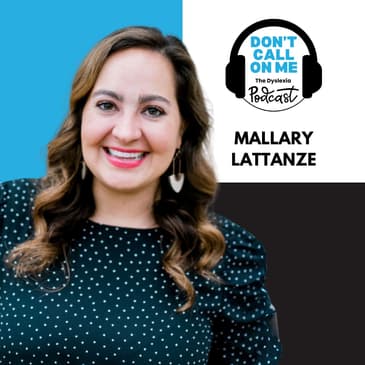
In this episode of the Don't Call on Me Dyslexia Podcast, hosts Megan and Eryn sit down with Mallary Lattanze—a certified academic language therapist (CALT), dedicated advocate, and leader in the dyslexia community. Mallary shares her personal journey as a diagnosed dyslexic, her experiences as a classroom teacher, and her impact on dyslexia education through both public and private schools. From developing instructional materials for Houston ISD during the pandemic to leading as the President of the Houston Branch of the IDA, Mallary has made a lasting difference in the lives of students and families navigating learning differences. Tune in to hear her insights on the evolving landscape of dyslexia support, the power of community involvement, and her passion for ensuring every student receives the education they deserve.
-
Book a consultation with Megan to discuss CALT therapy.
-
Book a consultation with Eryn to discuss advocacy services.
With Love and Gratitude,
Megan, Eryn & The Don't Call On Me Team
[00:00:00] I never told anyone in college and I never told anyone in my careers, especially my bosses, but the principals, that I was in special ed. When you look at me and you talk with me, you would never know, right? Like it doesn't have this outward appearance. Until after second grade, I was like, I want to help kids like me. And so that was the transition of going to Nye Health Education Center and starting my path to learn how to be a certified academic language therapist.
[00:00:28] I did have some very emotional moments going through Nye House's basic language skills because I truly feel like that is when I learned how to read. This is Megan, owner of Dyslexia On Demand. And I'm Erin, owner of Advocate to Educate. And we are the Don't Call On Me Podcast.
[00:00:50] We are here to talk about dyslexia, to remove the stigma, to hear what families really go through, and to share their stories. In both of our businesses and personal experiences on a daily basis, we listen to people telling their stories. Many of heartbreak, many of struggle, but most all have a silver lining, even eventually.
[00:01:14] It's all about the stories. The more we share, the more we realize we aren't alone and we are a community. No, a tribe standing together. Today's episode is sponsored by Advocate to Educate. We help parents navigate through the confusing maze of special education in public schools in California.
[00:01:39] We support families starting as early as preschool through 12th grade, creating individual education plans to support the specific needs of your unique and amazing child. To learn more, go to our website, advocate2educate.com. Today's episode is sponsored by Dyslexia On Demand.
[00:02:00] Dyslexia On Demand uses only the highest trained dyslexia therapists, and it's all one-on-one and individualized to your child's needs. The best part is that it doesn't matter where you're located because it's all virtual. Visit us at dyslexiaondemand.com to learn more. Welcome back, listeners, to the Don't Call On Me Podcast. Today we have Mallory as our guest, and we are super excited to introduce her.
[00:02:29] So Mallory, can you tell us where you're from? Hi. So I am in Houston, Texas, but I'm originally from the metro Atlanta area. I've lived in Houston for about 12 and a half years. I am the director of admissions at a dyslexia private school and for a school for kids with intellectual disabilities. So we're two schools, and I've loved it here. Houston is home. Awesome.
[00:02:53] So let's start with why you want to be on this podcast and a little bit about your story. How can you relate to the name Don't Call On Me? Well, because I didn't want to be called on. So I'm someone with dyslexia.
[00:03:08] So not only do I know Megan just from volunteering and the wonderful dyslexia community, but when I heard about this podcast, I was like, what a creative name that's going to really reach such a big audience because I know exactly how that feels. It's something so simple, right? And I think it gets overlooked as the why behind it. But my story really starts when I was really young.
[00:03:35] I'm the oldest of three girls, and so my mom didn't have any kids, other kids to compare myself with. But teachers were just saying, like, she's special. There is something. And so long story short, I got diagnosed in second grade after my mom, who advocated. I got tested in the public schools. But because Georgia did not say the word dyslexia, it came out as specific learning disability and reading.
[00:04:00] Now, everything that I know now, I look back at, like, my IEPs and scores. And it's funny because back then, it was the pink carbon coffee that came. Oh, my gosh. That's great. And you have to look at it really carefully. And there was even a note, like, from a teacher, from, like, a report card that said, like, you know, if you take the words out of the math problems, Mallory can do it. I'm like, if that doesn't scream dyslexia, I don't know why. Right.
[00:04:29] So let's – I want to go back to – and our listeners really gravitate towards the emotional side of things. And that's something that's near and dear to Megan and my heart. We really want to shed light on the experience and the emotional experience of that little second grader. So tell us, what did little Mallory think of herself? And share with us what was – what did school feel like to you when you – for as far back as you can remember? What did it feel like?
[00:04:59] So, first of all, Mallory in second grade is definitely not the Mallory like I am today. So I threw up every single day for the first week of school from first grade to fifth grade. But back then, I got my accolades from being the good girl, by being the golden child. And so – because I wasn't going to get my accolades from academics. And that's why I had so much anxiety that first week of school because I was going back to a place of failure.
[00:05:29] Now, I will say I didn't associate the word failure. It was just like this – like I became very close with – or I guess like a homebody where I was very close with my mom. And like some people probably would have said it was separation anxiety. But they didn't understand that it was school. It was academics. And, you know, still to this day, like if a child like, you know, throws up or something, you have to call mom, right? And that's usually you have to go home.
[00:05:58] My mom made really good friends with the nurse and the counselors like she's going to be okay. Then I was on a behavior plan for my anxiety. And so I became really close with the counselors. And the behavior plan was how to keep Mallory in school because of my severe anxiety. So my youngest sister and I are six years apart. I would take a little picture of my baby sister with me.
[00:06:26] And the plan was is that I put it on my desk. And they told me just think about what you're going to tell your baby sister about your school day. And I will never forget that. So I just held on to her baby picture. And that was like part of my like behavior plan. I put it in quotes because you have to consider that all behavior plans are not based off of negative, like violent, aggressive behavior. Oh, of course not. Mine was anxiety.
[00:06:53] And they weren't actually treating the anxiety and looking at, hmm, I wonder why. Yeah. They're like, let's just hold her hair back while she vomits. Right. And then scoot her, like pat her little tush and say, look at your baby sister. Swallow that. Like, okay, you brought it out. Swallow it. And like, how would you, how would you keep a calm, collected face when you have to go home and tell your baby sister and be a role model for her? Right.
[00:07:21] Like that's, oh, that makes me so angry. And clearly it's just so disheartening to hear that your anxiety was so triggered as a result of the having to face that mirror every single day in your classroom with the kids. And I mean, we all know that's really what the core of it all was. So it's just so sad that you had to endure that. It was a snowball effect is the best way I can explain it.
[00:07:45] So like I would go to a party and if it was like a spend the night party, like as I got older, like third, fourth and fifth grade, I would then leave right before everyone would go to bed and I would be sick. And then also field trips. I remember like going to the Chattanooga Nature Center because we were really close from Atlanta and not wanting to participate in anything and holding my teacher's hand the entire time. So it just, it just got really bad and like, yes, Megan knows me.
[00:08:13] And for anyone who knows me, like I've lived, I've lived overseas. I've lived by myself. Like I am not the person that's sick and green. Yeah. Yeah. You were in survival mode. I mean, and, and also being coached really inappropriately. So, you know, it's, it just goes to show what happens in our schools, unfortunately. Um, and that they're not even sophisticated enough or weren't at the time to be like, Hmm, I wonder what's going on.
[00:08:41] Well, I was going to say, I do recall having only good memories of my teachers. Like I do know that there's some kids and some adults that have negative experience. Like their teacher called them lazy or dumb. I never had that. It was just, they were untrained. Like they had no idea. So like you said, they're like holding my hair back. They're like patting me on the back saying like, it's going to be okay.
[00:09:05] So I did, I've never had a mean teacher or an instance where I felt belittled, but they just had no idea. But I think that's the core of what we actually try to say and communicate in this podcast all the time. And that is that, you know, teachers are paid dirt. They are there because of the fact that they have a passion and a love for your child. The entire reason that they are there is because they have a passion and a love for kids and they love your babies.
[00:09:35] The problem over and over and over that we see is they are just not educated in dyslexia. And really not just dyslexia. I could go on and on structured literacy. We could go on and on. But at the core of it, they love your child and they are trying to do their best. The problem is their best isn't fitting into the box that it needs to be.
[00:09:57] And so that's kind of where that problem is, is that so many, you know, I just think that that's a common theme and theme. And it's not the teacher that we're supposed to be pointing at a lot of times who is at fault. It's really the bigger system. You know, you're exactly right. I mean, I would ask my mom, like, you know, when she would advocate, like she didn't know the word dyslexia.
[00:10:21] However, she learned about it because if anyone knows about the city of Atlanta or Metro Atlanta, there's actually a lot of dyslexia schools. And there was one down the street from me. But my parents didn't have a lot of money when I was first born. Like that came later in life. Like my dad did well. But so there wasn't that wasn't an option. But she started to kind of make the connection, like the kids that go to those schools, I think are like my daughter. But because we had this formal diagnosis that didn't say the word dyslexia.
[00:10:50] And she didn't have the knowledge or, you know, someone to go to to say, what does specific learning disability dash reading mean? You know, like, is she just and also I forgot to mention this. They would label me as a late bloomer because I was really petite. And so they were just like, oh, she's just a late bloomer. She tries really hard. Just wait. Just wait. Just wait. And it's like, I can't remember who said it.
[00:11:17] One of you said, you know, it's almost like the wait to fail method. And again, they didn't have like they didn't look at it as like we're going to wait for her to fail. It was just like, let's just give her more time. But now we're more educated on how negative that waiting time is. Our kids can't wait. And I always say like adults need to get their, you know what, together because we can wait, but our kids cannot. Right. And really what we're referring to isn't second grade. We're even referring to first grade.
[00:11:48] Like that intervention has to have started earlier, like kinder early first, because we have a lot of research that shows that if we don't do it, then they're still going to be struggling in fourth grade. So Mallory, let's go back to the so you're obviously in panic mode, anxiety mode. You are in a place of kind of vending for yourself.
[00:12:13] And what was, if you know, what your parents were going through at the time, like you having all this anxiety, were they in the camp of like listening to the educators at the school? And that was their guidance was what the school was having you do to cope? Yeah. Yeah. So I'll break it down to my mom and my dad, and then also my sisters. So my mom, she was a stay at home mom.
[00:12:39] So she was PTA president for civil years, did book publishing at my school. So she was a district, she was a district translator. So all to say she was very involved. So yes, she would, she really trusted my teachers. And because I didn't, because I loved my teachers, I didn't have a negative experience. Like she just took to heart, like what they're saying. And she actually has more memories than I do about so-and-so teacher did this for you.
[00:13:04] And like, they recommended this tutor and the tutor that I had, she, Ms. Hoffman, like she, which I love to death to this day and still keep in touch with her. She wasn't trained formally in structured literature or dyslexia or anything like that. But she knew how to give me tricks and tips. And now I understand as like a dyslexia therapist, like the correlation of someone who doesn't know their math facts well, that's on the language side of the brain.
[00:13:33] And so I, so she would give me tricks to learn my math facts. And so again, a lot of people like, see, that's not reading. It's like, well, no one knew that it was like, you know, there was like a correlation there. So between like the teachers and like that tutor, my mom, that was my mom's source of information. And then for my dad, my dad was just that very traditional, like telling my mom, like, you know, just tell me what I need to do. Like I need to pay for a tutor. Okay.
[00:14:00] I'm going to work, work hard and I'm going to pay for these services for my child. Like, just, just tell me what I need to do. So I always remember him, you know, as an adult, I see the sacrifices that they made so that I could get all the extra help because I also had speech services when I was little. And then I had a tongue thrust. So I had to go through myofunctional therapy. I, I was, I was special. No, you were the perfect storm.
[00:14:27] And there's no, yeah. I mean, we are, we are what we are and we're beautiful creatures. And unfortunately some just need more than others. So, okay. So when did, when would you say your insecurities were at its worst with this experience? Of course, middle school is like a whole new level. And then there's another layer when I got denied services going into high school.
[00:14:57] So they, in eighth grade, knowing that it's transitioning to high school, they denied a reevaluation, but it says due to the mother speaking another language, it would provide Mallory an unfit testing environment. So we're denying a reevaluation. And I asked my mom and I was actually tearful, like calling her up. And I was like, how did you respond to that? And she said, that was them telling me, we don't know how to help your child anymore in high school. Like we, we don't know what to do. And that was their loophole.
[00:15:25] Now, of course, that's like a huge lawsuit. But my mom was just like, you're, I mean, what am I supposed to do? Fight for something you don't have or you can't provide or you would make it up and make it worse. So I had no accommodations. And so you guys talked about survival. I cheated in high school. Like I, I literally had to survive. We'll tell you all about her cheating in high school. I mean, I have some, oh girl, I have some, the craziest, like, okay, let me see if I can top you real quick.
[00:15:53] Did you climb on top of a two story building and climb into the hatchet and go into your Spanish class? And I was best friends with the USB president who, who had all the keys to the campus too. So thinking back, I'm like, why did we climb through the roof? That being said, whatever. But yeah, I mean, that, that's, I would go to jail now if I did that. Yeah, seriously. You'd be on the news right now. Yeah.
[00:16:24] A hundred percent. A hundred percent. So great links. And I also, my best friend is an avid reader to this day. And I would write papers on the movies of whatever books it was, because I was never going to read the book. And then my best friend would read my paper right before I had to turn it in. And she'd be like, this didn't happen. And I'm like, I'm turning it in anyways. I'm just doing it. So I, I've been there, done that.
[00:16:49] So some similarities, one, never climbed anything, mostly put in the cellulipro height. So I'll blame it on that. But it was Spanish. Spanish was the class, which is ironic because I had a bilingual mother. But so it's funny because now, you know, just reminding myself, I'm on a podcast. I've always said, I'll never share my secrets because I still help kids. And I'm like, don't do this. But I will say this. It was Spanish class because I, you know, of course now it's like, I'm trying to learn English.
[00:17:19] How do you think I'm supposed to learn another language, foreign language? And that's honestly one of these, you know, characteristics of kids who are not identified. Like, how are they struggling with foreign language? So I, I, mine was more of, I'll just say writing it on my armor desk and ways of hiding like words and stuff because, you know, I know that there's some actors that are dyslexic and they are good memorizers. That's their coping mechanism. That was never Mallory.
[00:17:47] That, that memorization was actually very difficult for me. So memorizing spelling words and vocab and Spanish and like grammar rules and stuff like that. That was always hard for me. Again, that's why I had a tutor that was really good about tricks and stuff like that and songs to help me. But I also took advantage of every extra credit. And I remember there was this English teacher who was like, okay, for your final, whatever
[00:18:13] you can fit on this, you know, four by five, like, you know, index card. And I remember like spending hours like with a ruler and like writing everything now. And I'm like, okay, I spent more time doing that. Like, and now I can't even read it within like, yeah. In college, I failed. Like I failed biology and I learned quickly take the hardest classes in summer school. So my history, which I love history. I like learning about history, but that's a lot of information.
[00:18:42] A lot of like, like country names and people's names and dates to remember. It was so much to not only read, but then to retain. And my working memory just wasn't the best. So I just, I had to figure it out. And my parents were very supportive of it. But yeah. Of cheating? No. So they actually didn't know I cheated until like a few years ago. I can't remember. It wasn't like a podcast, but I got asked to like share my story.
[00:19:12] And I mentioned that. And I remember calling my mom. I was like, before you see this, like I should probably tell you. And, um, and they weren't surprised. Like they were like shocked in like the first two seconds. And then they're like, makes sense. Yeah. Well, you, you, we have interviewed so many people who all confessed to have cheated in high school. And honestly, when I heard Erin's story, I thought that she, not an anomaly, but I didn't realize the prevalence of it. And it's a, it's a survival skill.
[00:19:41] It's a coping mechanism. And you know what? Like, um, you know, it's a workaround, uh, not the best workaround, but at the same time, you know, there's a lot of saving face that people with dyslexia have to do a lot of times. And that is why that's the root. Talk about the antecedent. That's the root right there. Yeah. And when I train teachers, I tell them like, especially if you're a secondary teacher, if you have a child or a student who is cheating, especially if they're not diagnosed,
[00:20:10] please don't let your first reaction to be, Oh, they're just lazy. They're trying to take the easy way out. Like consider the fact that they are someone struggling and this is survival. That word survival. Like why would they go to that extreme resort? What I will say is whenever a child cheats, I would say 99% of the time they're covering up for whatever's going on for them.
[00:20:35] And God forbid there would be a class that took the whole freshman year to teach study skills and not a class called study skills. Listen, when you're tempted to cheat, you need to look at all of the reasons why you're tempted to cheat and you need to go to your teacher. I wish we lived in a world where they could go to their teacher and they could say, listen, I'm so tempted to cheat because honestly, I am not, I'm not prepared.
[00:21:03] I don't know how to retain this information. I can't do it the way that it seems like X, Y, and Z, or these people can do it. Help me. But we don't create school systems that give children that openness to be able. Exactly. That safe space. That safe space. So going back to your high school years. And one thing that I didn't hear in all of this is intervention. So did you get intervention? No.
[00:21:33] So I got resource. So, um, again, the word dyslexia was never said. I was in special education. I was in resource class. So I went to resource for reading, but they did not do it by ability group. So there was this actually, I remember very vividly in my elementary years, this big room and they had like single desk and they would put us in a circle. And there was kids that were, I will just say closer to the intellectual disability side. Yeah. And I knew that I was like, I am not like that.
[00:22:03] Um, and so they would just get packets and they thought more practice. This child just needs more practice. And not again, like she doesn't know how to do it. Like she needs the, yeah. And again, some may be tricks and, you know, stuff to mask it. And that were temporary. You know, I always say like kids in, in like a regular school, like public school, even private school, like they have different teachers every year. So that one teacher is like, oh, she did it.
[00:22:29] And then, but the longevity, like that was such a short term, like support. And then I was in resource for math because second grade, then you go into third grade and it's more words in your math problems. And again, that's why it's so like ironic that that one teacher wrote in the, my report card, if you take the words out, Mallory can do it. And it's like, but no one else made that connection. So they're like, now she's in resource for math because she can't do math.
[00:22:57] And then no one ever thought about the supports I needed in science or social studies and everything else. So there was no intervention. And then in high school, like I said, like in eighth grade, they denied the re-eval, which means I had no more IEP. I only have IEPs from second to eighth grade. And then that became a problem with me going into college. No one told my mom that I needed a 504 plan or any supports going to college.
[00:23:25] So I go off, almost fail my freshman year with like a two point something. And I go my first semester, I go to the office of disabilities because at that point, I'm like, I have to self-advocate. And like, so I go and they're like, sorry, we can't do anything for you. And that was it. End of discussion. Yeah, because you didn't have a re-eval. You didn't have, now we don't have anything. And that's always, that's so scary that whatever you had before just completely went away without
[00:23:54] any documentation and not knowing to fight for it at that time too. So I want to ask you, because I know what you do as a profession now. So she is a dyslexia therapist. She's a certified academic language therapist. Did that experience everything that you went through in life? I would assume that is what made you choose your path. Did you know that always?
[00:24:22] Was it through some trial and error? How did you get there? And is that once you learned all of, you know, structured literacy and everything to do with being a count, is that, did that help you with your kind of self-intervention? Yes. So my fifth grade teacher, so Mrs. Warner, shout out to you, Mrs. Warner. I did not know this until later in life. I went to her house and she was like, so we kept in touch. Like she always knew every like big milestone.
[00:24:51] And so she said, I want to tell you the real reason why I became your fifth grade teacher. And I was like, okay. And she said, it was not said to any of the families, but we knew that there was a group of special kids like you that needed a kindergarten teacher. And so they took her from kindergarten and made her a fifth grade teacher to help with foundational skills and that very nurturing and compassionate way that she is.
[00:25:17] Not to say that fifth grade teachers are not, but just knowing that like that kindergarten knowledge, instructional like knowledge, but also like the heart that she has for fifth grade. So, so yeah. So now I'm like, oh, my friend in fifth grade, like you may be like, it's funny now because now I'm like rethinking. But she is the reason I knew from fifth grade, I want to be a teacher. That was it. I knew I want to be a teacher. So fast forward, I go to college to be an elementary school teacher and we didn't, we
[00:25:47] didn't learn about like learning differences or anything like that. But then I start my career and I'm a really, really good kindergarten teacher. And I'm like, wow, I got something. But of course I still taught some parts of balanced literacy, but I also taught or investigated, like I was asking questions. So taught kindergarten, taught first, I taught second. I was like, wow, I'm really good. After teaching second grade, I had a class of kids that, that had learning differences.
[00:26:17] And I said, you know what? I'm someone like I was very, I didn't tell people as an adult that I had, I probably should have started with that. I never told anyone in college and I never told anyone in my careers, especially my bosses for the principals that I was in special ed because I don't, you know, when you look at me and you talk with me, you would never know, right? Like it doesn't have this outward appearance for dyslexia until after second grade, I was like, I want to help kids like me.
[00:26:45] And so that was the transition of going to Nye House Education Center and starting my path to learn how to be a certified academic language therapist. And I, I did have some very emotional moments going through Nye House's basic language skills because I truly feel like that is when I learned how to read.
[00:27:10] So in my early thirties, like things started to click and I was like, I feel more confident in my spelling. I feel more confident reading like scientific books. Um, I, I can read articles now without like, you know, and so, and still I do to this day, get nervous, um, on a reading aloud. So like, it doesn't happen a lot, but like staff meetings, like, you know, they'll give us an article and like, they'll do like the round robin. Like, why do we still do that by the way?
[00:27:38] And I would be like, okay, so that teacher and then me, okay. I'm the fourth paragraph and I'm like not listening. And I'm still in my thirties rereading my paragraph and to hope to God that I pronounce these words right. So, um, so again, that does not go away. So hearing you say that you're dyslexic, now you're a Celt and clearly the whole process of being a Celt, you know what you're doing.
[00:28:07] Like I have looked into that for myself. I know that you know what you're doing because you can't be a Celt without knowing, right? So I'm curious when you jumped into it and you started eating up the training, what levels were you at as far as your reading, writing, and spelling? Like, obviously you're already at in the college world, but where did you find yourself coming in?
[00:28:34] Like, were you starting from the basics of like silent E and you were like, oh my God, I, you know, of course I'm, and maybe not the rules in particular. Like maybe you didn't know why the silent E does what it does. But like, where were you? Because I had already so much experience teaching lower elementary. Like I'll give you a story. I did not know about the nasaled like vowels, like that come before an N or an M.
[00:29:03] However, I took a training in my second year of teaching, second year of teaching. And someone was teaching us about this reading program. And there, and I asked, I was like, but why does this vowel say this? And they're like, oh, it's just because. The trainer. Because they don't know. Yeah, they don't know. And they're like, it's sometimes our accents. And like, I was teaching in Charleston, South Carolina then. And I'm like, okay, even, but it's really strong as a Southerner. Yes. But like, anyways, it never made sense.
[00:29:33] So again, I was inquiring all these patterns and you know, what we know is patterns and rules. And I'm like, there's gotta be a reason why. So I had this awareness going into my house of like, why does this say this? And why is this an exception? And why does it, like, I, I, I had that awareness. So then when I learned it, it was like all these aha moments. But then there were some things where I'm like, I do feel dumb that I never knew this.
[00:30:00] But also I went through this with other like-minded people. Maybe they weren't dyslexic, but that was something that was also beautiful knowing that I had like this diagnosis and my brain was different. There were non-neurodiverse people that were like, I can't believe I never knew this. Well, and I, I want to back that up too, because I've gone through this also. And I always say, you know, I was a veteran educator, special educator. I was teacher of the year.
[00:30:28] I was ashamed when I trained to become a couch that I didn't know any of that stuff. And I'll tell you because you have a caseload and I was in a smaller school. So I had some of the same kids. I was at that school for like five years over and over. And I knew they had dyslexia, but I didn't know how to get through to them. The moment that I started putting them through, I was doing my clinicals with these kids, diagnosed or not diagnosed.
[00:30:56] All of a sudden I moved the needle for all of these kids. But I was also ashamed. It is not your fault because that is not part of the curriculum of elementary education, university programs. And it still is not. There is some change that is happening. So it's not just you, you know, I think we all felt like that. So that like kind of, I guess, humbled and like took the anxiety off of me, knowing that like we were all kind of in the same boat.
[00:31:26] And even now, like being like I train and give webinars and stuff. And there's still those veteran teachers and really good teachers. Not only are they teacher of the year, but like they've gone on to like really do great things with their kids. And they're like, oh my gosh, I can't believe I did this for like 20 years. The wrong way. And it's, you're right. It's not their fault. But I got emotional as far as like, I knew that this was the pathway that I, like I was
[00:31:56] meant to do this. I was born to do this. This is what God told me I needed to do. Because then when I started doing my clinical hours and working with kids, I, I did feel a sense of like, because I'm dyslexic makes me even better. It does. I saw myself in these kids and, and they would say things and they would do something like, I did that. And then I almost knew like how to get them through it. Um, I don't want, don't want to say like quicker or faster than someone else.
[00:32:23] I don't want to take that away, but I was just more connected. I also think that there's a lot of conversations that need to be had about the differences between performance anxiety and then like other types of anxiety. For instance, like our kids have a lot of performance anxiety, but can it manifest into social anxiety? Like where I had, like, I didn't want to go to spend the night parties or field trips. Right.
[00:32:52] And so understanding that there's so many complexities and layers to all that, but also for the parents sake, that, that doesn't mean they're going to be like that forever. Because then when I just first, you know, as I evolved and started to really self advocate and like become my own of like, okay, I'm going to be an educator for these kids. I started to adventure out and it blew people away. Like everyone thought I was going to be like this, this girl who like went to a community
[00:33:21] college or a school, like within like driving, you know, small driving distance. And then I like go out of state and then I move and like lived in New Zealand and then I moved to South Carolina and then I moved to Texas. And like, no, if you then look at like who I was the first, like, you know, 10, 15 years of my life, I was, no one would have predicted that. Well, I want to agree that you are the best person to do this intervention with kids.
[00:33:50] And I am so jealous that you jumped off the cliff essentially and said, I'm not going to let my own experience stop me because I can tell you it stopped me. And it, I definitely said and continue to say, I'm not the best one for this. Now I obviously in my professional career as a special education advocate, I help in other
[00:34:19] ways, but I will say that that's still something for me that I fear. It's kind of like in my field, there's a lot of like, Oh, just go be a lawyer, go back to law school. And in my head, I'm like law school, like what, what? Oh, I don't even know. And, and let me tell you, my own dyslexic father has been like, you're not passing the bar. Are you crazy? And it's like those conversations where it's this fixed mindset yet. I know.
[00:34:46] And despite if I said, I'm going to law school, I don't care what you say, dad, I'm going to do it. He would change his tune around and be like, of course, yes, you can do it. Of course you can do anything. That being said though, our initial instinct is like, no, let's do something else. That isn't going to be like dragging myself through the mud with that backpack of rocks. Like your, your body is going to try to protect yourself. Mind and body is going to try to protect yourself.
[00:35:15] And I definitely had, my parents didn't make my SLD dyslexia or SLD reading because it, you know, wasn't dyslexia. Not that big of a deal. Like when I say that, it's like, they definitely helped me, but like, they didn't give me, they didn't add to the anxiety. They were just like, you're my daughter and you're smart. My dad for years in front of my other siblings, like you work the hardest.
[00:35:43] So, and he still says it, but talking about like giving up and like, like there was a point of like extreme failure for me. And it's still one of like the worst moments of my life. So in college, I had to take like a Praxis three or Praxis two. I don't know, whatever. It was like some writing and multiple choice test. And that was to certify you as a teacher. Like if you don't pass this test, you can't go into your final internship. The first time you fail it, nothing happens. So I failed it. So we take it again.
[00:36:12] The second time you fail it, you have to take a semester off. I failed it a second time. Oh, that was seeing everyone in my cohort move forward except me was one of the most embarrassing moments of my life because there was no hiding it. And so my dad had done well and he goes, I'm going to pay for you to go because I think he knew that me taking a year, a semester off would be more detrimental to me.
[00:36:37] And so I still went to college, but I was going to be a semester behind. So here's the pressure. If you fail it a third time, you have to change your major. So it was pass it or I don't get to be a teacher or I have to start all over. So the amount of pressure that I was under was so immense. And so go back to Ms. Hoffman, my tutor, who I literally have had from second grade till my last day of college. That's how important she was to me.
[00:37:06] She did the best that she could. And I remember like, so I went to University of Alabama and so that's in Tuscaloosa, but the test was in Birmingham. And my dad's like, I'm putting you up into a hotel so you can relax, take a bubble bath, go to bed early, order, you know, room service. We love him. Oh my God. So he knew my anxiety would start to take over. He didn't want me to drive 45 minutes super early in the morning. So like, I remember like that of course did help.
[00:37:35] Like, I'm so glad my dad offered that and did that for me. But going into that test, knowing this is going to change, this is going to change the rest of my life. If I fail it, I have to figure out where do I go from here? So I passed it. Thank the Lord. And, um, you know, I'm a Christian girl and I would say like, like Jesus was like, I'm going to give you a break now. You're going to pass it. Um, because it was never about me not working hard.
[00:38:04] And that was, and so I would tell people, I would say, I always had a backup plan. So for any tests I ever had to take, like when I changed states, I had to take their dumb teaching test. I would say, well, if I fail, if I take it now and if I fail, I still have time. And people would be like, why are you being so pessimistic? It's like, because this is my reality. Like, it's not about me not preparing myself and I know how to be a good teacher. It's this dumb test. So I was smart.
[00:38:32] And like, if I take it early, then I don't have that pressure of trying to make it up because guess what? I had to retake tests multiple times for different states and different things. And so, um, and so it was a balance of being positive, but also being realistic. Well, the realistic, yeah, the realistic piece. Is what it goes back to. If we actually taught our kids in, this is how your brain works. This is how you need to study and be practical about it.
[00:39:01] If we were telling kids, listen, it's going to take your sister an hour. It's going to take you four. So just prepare yourself. And you might want to be upset that it's not fair and this, that, and the other, but there's going to be other things that are going to come much more naturally to you. Then, then we'll come naturally to your sister. If we gave our kids that comparison and not just blunt advice, it would be in a much better position.
[00:39:27] Now talk a little bit about what you do professionally now and the different settings that you work in and what advice you hear yourself giving the most often, um, in your professional journey right now. So, um, I am a certified academic language therapist, licensed with six day therapist. So I have kids that come to my home or I've seen them on zoom, but I don't do intense intervention because I do have a full-time job.
[00:39:56] Um, and so I do a lot of progress monitoring. And honestly, I like working with the older kids. Um, uh, because I do like, like we talked a lot about study skills, like truly teaching, not providing this like extended time to just do your homework. Like here's how to break down something. Here's how to understand it. So I really have like that. Um, so I do that and that gives me my like time with actual kids.
[00:40:22] And then I am the director of admissions at the Briarwood school and the Tuttle school. And I absolutely love that. And what makes me really good at that job is we have to do an evaluation review. And so when I look at these evaluations, I can almost like, I guess, read between the lines and like understand the interpretations from the evaluators and really see them as a person. I will say like the biggest compliment I get is when parents call me and they're trying
[00:40:51] to navigate like how to obtain an FIE through the public school, or they don't understand like their own child's disability. There's some misconceptions that it's not their fault. Right. Um, and we'll hang up and they say, I have talked to so many people. And for the first time, I feel like you've really, truly helped me. Yeah. That's like the biggest compliment. And I really, truly think it's because I have the personal like background, the lived
[00:41:17] experience, but also as a classroom teacher and then as a therapist, because yes, there are adults that have never taught. And I'm not saying that they're not as good, but I just have different experiences to help me to understand. But to, to know that I'm the, I'm one of the first people to say your life's about to change for the better is like amazing. All of your life experiences all led to that.
[00:41:44] And it's funny, Mallory, I don't think that I've ever had this direct conversation with you, but I feel the exact same way. I love being the frontline of defense for that parent and helping to walk them through and making them say, look, I got you, you know, and I will help you to understand whether or not you work with us or not, I don't care, but I just want to help empower you to understand your kid, to understand the experience.
[00:42:13] So I love that you're in that position there and that you do that for parents. I think it's awesome. So at this point, you've shared so much about how you engage with your parents and students that you're working with. And I can't thank you enough for continuing to push forward in this world and advocate for our families. If there was one lasting message you would like to get out there to our listeners, it could
[00:42:43] be for the children that are listening. It could be for the parents. What do you want them to know? So I'll just say if the, if it's to the family itself is to really lean on each other. Like when I think about my family, my dad played a specific role. My mom played a specific role. My sisters played their role and then myself and then everyone else. So, and again, and also like I'll extend that. Like it does take a village to raise this child.
[00:43:12] So you're, you need to be support. You can't be a silo. I think there might be some dads out there that think like, I don't know how, like, what am I supposed to do? You do have a role in this. And moms that are like, I don't, I'm not equipped to know. Well, then you have a community that you can reach out to. So I think just like strengthening your, your immediate family and then your community as a family, you know, because I think that's what my mom did. She did the best she could. She trusted my teachers and they were so loving.
[00:43:41] Like I said, I have no bad memories, but you know, it just, it is what it is, but it made me get stronger as I got older. And then for the, the individual with dyslexia, there is a community. And I love the fact that now we're in a day and age with technology that have podcasts, podcasts that even like young kids can listen to and be like, oh, I'm not alone. So I just think family is in like leaning on each other is so, so important.
[00:44:09] And I think everything just kind of like falls into place because you're not alone and you need to be able to speak up and say, yes, I'm someone with dyslexia. I need help. And also, Hey, I'm someone dyslexia and I'm still really smart. I love your advice about building a community, both internally and then externally too, because there are so many resources out there and there are so many parents and children and individuals
[00:44:36] walking that same walk and connect into them to realize that you're not alone, which is obviously such our mission here. But I think I also love your advice because it's different. It's not, this is the first person who has said that. And it's, it's not unique necessarily, but it's just, I think something that everybody needs to hear, but it's not the first piece of advice that like I've commonly shared. So I think it's so strong.
[00:45:04] And I just want to quickly add that, you know, as a family unit, no matter what your unit is, whoever you're coming home to on a daily basis can make or break and add to the experience negatively or positively. So it's important that siblings understand what the child is going through in a way that makes sense to them. So they are not teasing them when the child's so stressed out about homework and a dyslexia
[00:45:33] simulation can be great for your entire family. So if you're listening and your whole family needs that simulation, reach out to us. We will provide it. Just so everybody knows dyslexia on demand has two free ones per year, usually in February and October. And we also have a video it on YouTube. I will tell you, that's probably our highest viewed video because a lot of people are watching that to, you know, even if you don't do it live, you get the gist of it when you watch
[00:46:03] that experience. But I think doing it in person is like so, so powerful. We've had so many parents cry, actually. Like I didn't realize how hard this was for my kid. So it's definitely a pivotal moment. But thank you, Mallory, so much. I think you have given so much great insight. You have fabulous charisma.
[00:46:27] I think that I appreciate so much that you are in the role that you are. You are who you are and all the advocacy work and support you're doing for parents. So thank you so much. Yeah. Well, I appreciate the two of you and giving like having this platform to hear more voices and like you are strengthening that outer, you know, the outer family, like the community. And so thank you to you both.
[00:46:56] Thanks for spending time with us on Don't Call On Me. If today's stories touched you, please take a moment to follow us on social media and subscribe on YouTube. Extend the impact by sharing your story at don'tcallonme.com. Your experiences can foster understanding and strengthen our collective voice. Let's keep making a difference together. We look forward to having you back for the next episode. We'll see you next time. We'll see you next time. Thank you.