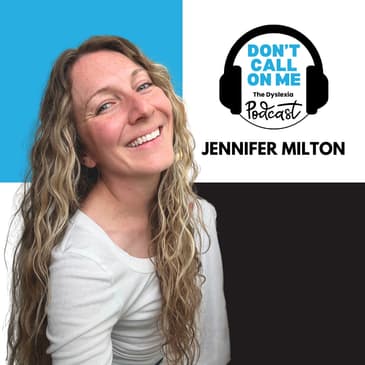
In this episode, Megan and Eryn sit down with Jen Milton, a homeschooling mother of four who has been educating her children at home from the very beginning. Jen shares her unique journey as a parent of two children with dyslexia. Her first child was diagnosed in 2021, and since then, her family's approach to education has evolved. Jen talks candidly about the transformative power of consistent dyslexia therapy, the impact of a structured curriculum taught with fidelity, and how her family found the courage to connect with others facing similar challenges. Whether you're a homeschooling parent or navigating the world of dyslexia, Jen's story will offer valuable insights and encouragement for anyone on a similar path.
LINKS + RESOURCES FROM THIS EPISODE:
Jennifer Milton
-
Book a consultation with Megan to discuss CALT therapy.
-
Book a consultation with Eryn to discuss advocacy services.
With Love and Gratitude,
Megan, Eryn & The Don't Call On Me Team
[00:00:00] If your child is brave enough and they're ready, because eventually they will be ready, but if they're ready, or if you can talk to them, to have them share with their friends that they have dyslexia.
[00:00:11] And to have them share with their friends that they are in a dyslexia therapy program or they're getting tutoring or they're doing this or that.
[00:00:19] And to have them share their struggles because it's been really freeing for my son or his friends to be able to understand, hey, this is what my journey is and you can like me the way that I am.
[00:00:34] This is what I struggle with.
[00:00:37] This is Megan, owner of Dyslexia On Demand.
[00:00:40] And I'm Erin, owner of Advocate to Educate.
[00:00:44] And we are the Dont Call On Me podcast.
[00:00:47] We are here to talk about dyslexia, to remove the stigma, to hear what families really go through, and to share their stories.
[00:00:56] In both of our businesses and personal experiences on a daily basis, we listen to people telling their stories.
[00:01:04] Many have heartbreak, many have struggle, but most all have a silver lining, even eventually.
[00:01:11] It's all about the stories.
[00:01:13] The more we share, the more we realize we aren't alone and we are a community.
[00:01:19] Know a tribe standing together.
[00:01:25] Today's episode is sponsored by Dyslexia On Demand.
[00:01:29] Dyslexia On Demand uses only the highest trained dyslexia therapists, and it's all one-on-one and individualized to your child's needs.
[00:01:38] The best part is that it doesn't matter where you're located, because it's all virtual.
[00:01:44] Visit us at dyslexiaondemand.com to learn more.
[00:01:48] Today's episode is sponsored by Advocate to Educate.
[00:01:52] We help parents navigate through the confusing maze of special education in public schools in California.
[00:01:58] We support families starting as early as preschool through 12th grade, creating individual education plans to support the specific needs of your unique and amazing child.
[00:02:11] To learn more, go to our website, advocate2educate.com.
[00:02:17] All right, everybody.
[00:02:18] Thank you for joining us today.
[00:02:20] Again, we're so excited to have Jen Milton with us.
[00:02:25] I know from lots of parents out there, lots of you guys are or have chosen to homeschool based on your situation.
[00:02:35] So loving that Jen is going to tell her story today.
[00:02:39] So thanks so much for joining us and go ahead and introduce yourself.
[00:02:44] Tell everybody who you're about.
[00:02:46] All right.
[00:02:46] So my name's Jen and I am a homeschooling mom.
[00:02:50] I've got four kiddos.
[00:02:51] I finally have all four in school.
[00:02:54] I just finished our kinder year with my youngest.
[00:02:57] I've always homeschooled.
[00:02:59] We just joined a ALE, which is an alternative learning school.
[00:03:04] That's a public school.
[00:03:05] And we are loving that because it gives us access to different things and opportunities.
[00:03:10] We just finished our first year this last year and we're going to return.
[00:03:14] So it's exciting.
[00:03:15] I have two kiddos that have dyslexia and I just recently discovered the one that my son we found out in 2021.
[00:03:28] So it's definitely a journey and I'm just here for all of it.
[00:03:32] I actually love to advocate and I love to have a voice for kids with dyslexia.
[00:03:39] I love to be a voice for families and try to join people together when they're isolated because I feel like that's really important.
[00:03:47] 100%.
[00:03:48] And you definitely like have a spark and a charisma and a passion about you.
[00:03:53] I remember the first time I met you and just like just loving that about you, how you just kind of ooze that.
[00:04:00] So I think that I'm so happy that you're here to tell your story because there's something about you that is like very, it's like, what is the word?
[00:04:11] I don't know.
[00:04:12] Like attractive comes off completely wrong, but where people are drawn to you, you know what I mean?
[00:04:18] Because you just have that natural like interest and willingness.
[00:04:22] And, you know, so I think that your story is going to be like really beneficial.
[00:04:26] So, so just kind of segue a little bit into your dyslexia journey as a homeschool mom.
[00:04:33] Like lots of moms kind of jump ship from school and choose to homeschool.
[00:04:40] You started as a homeschooler, which is, I always say, hey, that is like the most, it's so respected.
[00:04:47] Honorable.
[00:04:48] From me.
[00:04:49] Honorable.
[00:04:50] Honorable.
[00:04:51] Thank you for being my words, Erin.
[00:04:52] And I'm sure I told you this when I met you, but I thought I was like, I am the black belt of reading and spelling.
[00:05:00] And not only that, I've been in education for so many years.
[00:05:04] I am the perfect person to homeschool my children.
[00:05:08] And literally, I don't even know if they got half of a year of an education from me.
[00:05:14] And they were enrolled in our local public elementary school right after.
[00:05:18] I think it takes a really special person.
[00:05:21] But tell us about your journey, just in general.
[00:05:25] So, you know, and it could be with both kids either way.
[00:05:29] Yeah.
[00:05:30] So our journey with dyslexia started actually at the optometrist office of all places, which is really interesting.
[00:05:39] Now, our journey is a little different because we didn't have public school testing.
[00:05:43] And we didn't have anyone from the outside giving perspective.
[00:05:48] You know, as a homeschool mom, we were in co-ops.
[00:05:51] But one thing I really wanted to share today that I feel like is so important is something really interesting in the homeschool community.
[00:06:01] So for those who are homeschooling from the beginning, one thing that's really interesting, and I won't say that it's wrong, but I will say that it's concerning.
[00:06:11] And what I'm saying is there's this narrative that children don't need to read right away.
[00:06:15] Oh, my God.
[00:06:16] I was hoping you would say this.
[00:06:17] Yes.
[00:06:18] Yeah.
[00:06:18] So there's a narrative that kids will take their time and that it's just fine if they wait a while and that there's nothing wrong with them if they don't read early.
[00:06:30] And I listened to that narrative because it was gentle and kind, and I really appreciate the gentleness of it.
[00:06:37] But I also feel sad that I didn't question anything and that I just kind of assumed that my son was a little bit different in the way that he was wanting to learn and that he was going to take his time.
[00:06:52] And that partially it was my fault that he wasn't learning and partially that I was doing everything wrong or maybe that he was lazy and that he was just ornery.
[00:07:03] And those were all incorrect.
[00:07:05] Those were all incorrect.
[00:07:06] He wasn't going to learn in time how to read.
[00:07:09] He wasn't going to learn.
[00:07:10] And I wasn't doing anything wrong.
[00:07:12] And there was something wrong.
[00:07:15] So my new motto as a mom, not just with dyslexia, but everything in the circle of motherhood, is that if you think something's wrong, you're probably right.
[00:07:28] And I think that in the world today, we are very much dismissed a lot of the time as mothers.
[00:07:36] Even though it's 2024 and we are as encouraged as ever as women to be strong in the workplace and all these different things.
[00:07:46] But for some odd reason, when we think something's wrong, I think we're continued to shush.
[00:07:52] And I knew something was wrong.
[00:07:57] But I just couldn't manage to get past that narrative of, well, it's just going to take a little bit more time for him.
[00:08:03] And he'll get it one day.
[00:08:05] And there's nothing wrong with him.
[00:08:07] He's just on a different pace.
[00:08:08] And so I'm really glad for my optometrist, which is just wild.
[00:08:12] What a funny place.
[00:08:14] But she's a really intelligent woman.
[00:08:15] And she said, you know what, Jen?
[00:08:18] He's not identifying any letters whatsoever.
[00:08:20] He has zero interest.
[00:08:22] I think he has some processing disorders.
[00:08:25] And you might want to get him evaluated.
[00:08:27] And I'm so glad that she said that to me.
[00:08:30] It was the beginning of my eyes opening.
[00:08:33] But at that point, I had really young kids.
[00:08:35] And I was a little bit over my head.
[00:08:38] And I was still hearing the narrative that we needed to wait because he would figure it out.
[00:08:43] So that's how our journey began.
[00:08:45] We didn't actually figure out that he had dyslexia until way later.
[00:08:49] Mostly because I didn't know how to get information.
[00:08:52] My regular doctor for my son, I had mentioned it.
[00:08:55] He didn't know where to point me.
[00:08:57] We didn't have a school resource.
[00:08:58] I didn't have anyone in my life that was open and honest about this disability.
[00:09:02] So I had no idea that anyone had anything wrong.
[00:09:06] I also didn't really know what was wrong.
[00:09:08] So in 2021, we had him tested privately by a special ed principal who was actually locally here
[00:09:16] testing kiddos privately.
[00:09:19] Paid a ton of money.
[00:09:20] Bless our souls.
[00:09:23] And discovered that he is severely dyslexic and that his likelihood of reading was very low.
[00:09:28] So, yeah.
[00:09:31] So just about the comment that you made that I think is just so important and powerful
[00:09:40] about the homeschool community.
[00:09:42] And it actually also translates to the Montessori world.
[00:09:47] So I like so, so get it.
[00:09:51] I get it.
[00:09:52] It's like that gentle kind of approach.
[00:09:56] And I could be wrong.
[00:09:59] But the Charlotte Mason like approach, right?
[00:10:01] Of like they don't need to read.
[00:10:03] Let them play.
[00:10:04] Let them watch.
[00:10:05] And then at that point in which their brains are ready and developing, then we start to
[00:10:10] push reading.
[00:10:12] And I get it.
[00:10:13] And I can understand where that's coming from.
[00:10:15] And I'm not a Montessori hater.
[00:10:17] I'm not.
[00:10:17] Because I think that for a lot of kids, it's a fabulous environment.
[00:10:22] But the problem is that when we have a child with a learning disability, then we don't discover
[00:10:28] it.
[00:10:29] And it's not that it's too late to discover it at eight, right?
[00:10:33] But we have lost this amazing window of time in which we can do that early intervention
[00:10:40] for their brain and completely change their life.
[00:10:44] And we just don't identify it until it's a little bit too late.
[00:10:48] And then so, and not just that, if we're in the Montessori environment, likely just like
[00:10:53] you, we don't have a school resource that is going to test them.
[00:10:58] Or, you know, I'm not to say that the school knows everything about literacy instruction,
[00:11:04] but, you know, just people are a little bit more.
[00:11:07] There's like a system.
[00:11:08] There's a net that in theory is supposed to catch them.
[00:11:12] Right.
[00:11:13] So it's just, it's a hard, that's a hard one.
[00:11:17] And every parent that comes to me too, that I talk to who's done the Montessori, you know,
[00:11:22] it's like, it's the Montessori route too.
[00:11:24] Um, and there just isn't a lot of explicit instruction in that one too.
[00:11:29] And you're right.
[00:11:30] Some kids are just going to naturally kind of pick it up and, you know, studies show that
[00:11:36] it's about, you know, 35% of kids who are just going to naturally get reading with just
[00:11:41] a little bit of exposure, but the majority that doesn't work for them.
[00:11:46] So, yeah, I, I, I wanted to just add something as a, as the, as, as an opportunity, as a homeschool
[00:11:54] parent and getting information when your kids are young and you're actually, you know, in
[00:12:00] charge of what curriculum you're using.
[00:12:03] If you're not using one of the like homeschool online curriculums that sends you everything
[00:12:08] and being able to start from the beginning with the approach that will work for your child.
[00:12:14] I think that that's the gift that Megan speaking of when she's talking about, that's the biggest
[00:12:18] gift you can give them because if they were to start school somewhere else and just be thrown
[00:12:23] into the curriculum, it could very well be the wrong curriculum.
[00:12:27] The other thing that I wanted to bring up is an eye, the eye doctor in general, because
[00:12:31] I'm always fascinated when I go with my kids to the eye doctor and you know why there is
[00:12:37] not a box, like just something on their chart that, you know, around the ages four, five
[00:12:45] and six, and definitely past that, you know, once you get past that, it's a definite when
[00:12:50] they ask, I mean, this is what our, our doctor asks, do you want pictures or letters?
[00:12:56] And number one, I wish all eye doctors did that.
[00:13:01] Ask the child, do you want pictures or letters?
[00:13:05] Because if they don't, it's another potential risk for kids to get embarrassed.
[00:13:13] And I remember being at the eye doctor as a small child being like, is it that I can't
[00:13:19] see the letters or did I say it wrong?
[00:13:21] Because it's a D and not a B.
[00:13:23] So they have a real opening for kindness and an opportunity to make a child feel number
[00:13:31] one, that they're safe to come back to that environment.
[00:13:35] And number two, that, you know, that, that they don't have to be put on the spot because
[00:13:41] it's like reading out loud, technically when they're saying name these letters, right?
[00:13:46] And my kid wasn't ready.
[00:13:47] The first go around, thank God shapes weren't an issue of, of concern.
[00:13:53] And for him in confusion, which some it is too.
[00:13:56] So that's, that's something that why not on the chart?
[00:13:59] Do they just keep track of that?
[00:14:02] So maybe they go in at four and they're, they want the shapes.
[00:14:05] And then what happens the next year at five?
[00:14:08] Oh, are they moving on to letters?
[00:14:09] And then that could be like another tracker for them to say, you know, hand a, hand a card
[00:14:16] to a parent that says, you know, look more into this because it's, it's like a pediatrician
[00:14:23] as well.
[00:14:23] You know, they make them do, at least ours did made our daughter like draw a star and a triangle
[00:14:30] and like things like that.
[00:14:32] And then they do like the vision thing there too.
[00:14:36] Like go stand behind the line and say the letters.
[00:14:39] They have a real opportunity to a be identifying early.
[00:14:44] And it could just be that they didn't get the right.
[00:14:47] And I'm not saying that every child that walks in that doesn't have their letters is dyslexic,
[00:14:51] but it's another opportunity for us to get innovative about how we are identifying these kids.
[00:15:00] Megan, I like side note here, like that in itself is like a business, like a kit to send
[00:15:06] to doctors offices and optometrist offices that give them just that little bit of information
[00:15:12] that says if they answer yes to five of these questions, send them our way.
[00:15:17] We will for free tell them what direction they need to go in.
[00:15:21] Because they don't have the information and it's, it's maddening how I remember being
[00:15:28] embarrassed at my pediatrician's office and that is like, that's so sad.
[00:15:32] So anyways, I digress.
[00:15:34] Yeah.
[00:15:35] And our pediatricians don't know about dyslexia.
[00:15:37] So, no, no, no, not enough.
[00:15:40] So Jen, like keep going.
[00:15:43] I know that you've probably had a lot of hurdles like as a mom in this situation.
[00:15:49] Yeah.
[00:15:49] Yeah.
[00:15:50] Well, I was just going to say, I think teachers need a tiny packet as well.
[00:15:55] Well, yeah, they should have had a whole training on it in college, but they don't even teach
[00:16:01] reading.
[00:16:01] No, but it's more red tape.
[00:16:04] That's the reason, you know, the red tape behind that is way harder to get past.
[00:16:10] And I actually do feel after, I mean, I know some pediatricians, I actually do feel like they want
[00:16:16] the information.
[00:16:17] They do.
[00:16:17] But unfortunately, our pediatricians are so swamped, just like educators.
[00:16:24] So it's almost like we just need to give them something quick and easy.
[00:16:28] And, you know.
[00:16:30] Yeah.
[00:16:30] Infographic.
[00:16:32] Infographic.
[00:16:33] Infographic.
[00:16:34] Real quick.
[00:16:35] We need to come up with like a hotline.
[00:16:37] Just a 1-800 number.
[00:16:39] Like, are you concerned about potentially dyslexia?
[00:16:42] Call this number.
[00:16:43] And it just be ourselves.
[00:16:45] That's awesome.
[00:16:45] So where were we?
[00:16:46] I totally forgot.
[00:16:47] So, yeah.
[00:16:49] So he was tested.
[00:16:50] And then I think the other hurdle after you get tested is what do you do now?
[00:16:55] You know, I had experience teaching as far as I've already, I'd already taught one of
[00:17:02] my kiddos how to read.
[00:17:04] And I tried all the different curriculums because, of course, the internet helps you find everything.
[00:17:10] And nothing was working.
[00:17:11] And I think one thing that has clicked since is that we jumped the ship way too many times
[00:17:18] for my son.
[00:17:19] So, you know, when you have dyslexia, your brain is not as much of a vending machine as everyone
[00:17:27] else's is.
[00:17:28] You know, you put the dollar in and the candy bar never comes out.
[00:17:32] And so you think you need a different, you know, you need to press different buttons or
[00:17:36] you need to put in more money or you need to work more magic or shake the machine, you know.
[00:17:42] And so I always tried something new for him.
[00:17:46] And I think I had talked to you about this, Megan.
[00:17:48] And it was so tiring for him.
[00:17:52] And nothing was working.
[00:17:55] And we were just both frustrated because I didn't understand why he couldn't understand.
[00:18:02] And he didn't know why I couldn't understand because, you know, I really couldn't understand.
[00:18:06] I think the bigger failure was me not being able to understand how he felt having that struggle.
[00:18:12] And it's just amazing that we have gotten through all of this.
[00:18:18] And he and I are still a team because it's been really hard, especially as a homeschool
[00:18:25] mom, being his only mentor and having him see how hard we've had to struggle.
[00:18:31] His first initial feeling of failure and his first initial embarrassment over having dyslexia
[00:18:40] was actually at a co-op.
[00:18:42] And so I'm grateful that he didn't have any of that until then.
[00:18:48] And the reason I mention it is because it's similar to a classroom, right?
[00:18:51] Like, I mean, that's why I think homeschooling can be really helpful is that you can grow
[00:18:55] in your own time.
[00:18:56] But the co-op definitely was where he started to have anxiety and he didn't want to go anymore.
[00:19:03] And I just realized, you know, we've got to do something different.
[00:19:06] So he was in the co-op and then we decided to go to this ALE program.
[00:19:12] And in Washington state, I don't know what you guys have, but in Washington state, we have
[00:19:16] these like hybrid schools.
[00:19:18] And so we jumped over to that because I actually had a connection there.
[00:19:24] I knew the dyslexia teacher there and in our school district, she is the main person who
[00:19:31] does work with kids with dyslexia.
[00:19:33] In the district, they actually sent me to her after I was already with her, which is funny
[00:19:39] because they don't have any other resource.
[00:19:41] So it's her.
[00:19:42] And anyways, he's had some great opportunities there.
[00:19:46] We were still not quite grasping what we needed to for him until fidelity happened.
[00:19:55] And I know Megan, you've talked about this, but I was always taking the opportunity to change.
[00:20:02] Like I said, change what we were doing because I wasn't seeing progress.
[00:20:06] And then Graham was able to rest his poor heart and finally have consistency.
[00:20:15] And, you know, I think dyslexia runs alongside ADHD sometimes and definitely always that's
[00:20:22] my family.
[00:20:23] Hi, it's me.
[00:20:24] I'm the problem.
[00:20:24] It's me.
[00:20:25] It was me, you know?
[00:20:26] And now that I don't have to analyze and critique, well, is this working for him?
[00:20:32] I'm just able to trust the process.
[00:20:34] And the process is successful.
[00:20:37] Today, he wrote a shopping item on the shopping list.
[00:20:41] And I know what it said, you know?
[00:20:44] Yes.
[00:20:45] And he's not a professional seller and that's just fine.
[00:20:48] But I could read it, you know?
[00:20:51] And he could write it.
[00:20:52] And that is what we're going for here.
[00:20:56] Because as you move along in the journey of dyslexia, you realize that, yeah, a lot of
[00:21:02] dyslexic people can compensate for their disability, but they're not ever going to have the same
[00:21:08] brain that we as a non-dyslexic person have.
[00:21:11] And they like to fool us.
[00:21:13] Yeah.
[00:21:15] You know?
[00:21:15] Because it's a hard thing to go through.
[00:21:18] But it makes it confusing because I'm like, well, you're so good at reading.
[00:21:22] What do you mean you're dyslexic?
[00:21:24] You know?
[00:21:24] Or I can't tell.
[00:21:26] You text me all the time.
[00:21:27] Or, you know?
[00:21:28] And so it can be misunderstood because I think, from what I know, dyslexic brains are so beautifully
[00:21:38] adaptive that they find another way, even if it's a really long way, right?
[00:21:45] I think that that's a strength.
[00:21:47] I love that about my son.
[00:21:49] And I love that about all the people that I know who have really hurdled 20-foot-high hurdles
[00:21:57] in the track race, you know?
[00:21:59] And they just keep going.
[00:22:00] And I think it's amazing, right?
[00:22:03] It's amazing to be that way.
[00:22:05] It definitely puts you into perspective how hard he has to work every day to gain what he
[00:22:13] has gained.
[00:22:14] I'm just super proud of him.
[00:22:16] So, like there is just this unifying bond of like empathy and resilience that I often,
[00:22:24] often find.
[00:22:25] Now, look, I'm not going to tell you that every single situation out there looks like
[00:22:29] that.
[00:22:30] But I think that one thing I would say, one part of the brain is weak.
[00:22:35] Another one takes over, right?
[00:22:36] Or the brain is a beautiful thing that learns how to process it a little bit different.
[00:22:40] Like exactly like what you're talking about.
[00:22:43] But such like an empathy too that comes along with that of understanding a struggle and being
[00:22:50] able to identify that feeling and apply it to others is that's a, that is, I mean, I know
[00:22:58] we can be really careful about like the gift of dyslexia, but I do think that that is a gift
[00:23:03] that comes with so, so many of these kids.
[00:23:08] Yeah, I do agree.
[00:23:10] I think that it's a double-edged sword, you know, and, and that I don't, I don't know if
[00:23:17] my son would choose it.
[00:23:18] If he had to choose it, I don't think he would.
[00:23:21] Yeah.
[00:23:23] But there's a lot of strengths.
[00:23:25] Yeah, of course.
[00:23:26] And being able to play to those are so important.
[00:23:29] And you do, you have that opportunity.
[00:23:32] I mean, I just think that like that moment when you were like, we have to take him out
[00:23:36] of the co-op, you have given him a gift too though, you know, like recognize that that
[00:23:42] feeling that he had in that co-op.
[00:23:44] And we don't all have this like amazing ability to do what you're doing.
[00:23:50] Right.
[00:23:50] And I recognize that not everybody has this opportunity, but the fact that that happened
[00:23:57] when it did, which was probably a lot later than it would have if he was in like a traditional
[00:24:05] classroom that everything that you have done, regardless of whether or not you fell and then
[00:24:13] had to get back up, you've gotten back up and you found what he needed.
[00:24:17] And he has gotten and gained so much from that dedication and that opportunity.
[00:24:24] I mean, so many parents have to pull their kids from school because it is the co-op every
[00:24:30] single day.
[00:24:31] And it is just completely screwing up their heads and how they see themselves.
[00:24:37] And you gave him that opportunity not to have to face that every single day.
[00:24:43] Right.
[00:24:43] And I am really grateful for that.
[00:24:45] And I do, I don't, you know, take it lightly.
[00:24:49] And I do have a lot of heartbreak for the kids who can't, who don't have that choice for
[00:24:54] sure, which is why I want to advocate for more than just my son and my daughter.
[00:25:01] I really want to see more support for all of these beautiful kids who should be given just
[00:25:08] the same amount of opportunity.
[00:25:10] Right.
[00:25:10] And you can't leave them behind just because of this one thing.
[00:25:15] Like we have so much neurodiversity and school has to be a safe place for everybody.
[00:25:20] Yeah.
[00:25:21] Yeah.
[00:25:22] Yeah.
[00:25:22] I was, I was going to ask because this is, this is like in that moment when you were just
[00:25:29] talking and I could, it's like, I know exactly what, like I was almost like as if I was in
[00:25:36] your body, but not in a creepy way.
[00:25:39] In the sense of like, when you got choked up in that moment of, of like, what was, I'm
[00:25:46] going to circle back to that because I don't like to let those moments, even if it makes
[00:25:51] people cry, I think crying is like a beautiful thing.
[00:25:55] What was the pain in that moment that you were maybe feeling or what, what was that?
[00:26:03] That is what other parents need to know.
[00:26:05] They're not alone feeling.
[00:26:08] Yeah.
[00:26:08] Well, before I say anything, I'll say that.
[00:26:11] I think that the only way to get through that pain is to have somebody understand you in the
[00:26:15] way that you experience it.
[00:26:18] And so I think having a friend who, whose child has dyslexia or having a friend for your
[00:26:25] child who has dyslexia, I think that's a really good way to get through that pain.
[00:26:33] Um, I think there was a lot of healing that happened for me when we were able to meet other
[00:26:38] people who understood the struggle because it is such a struggle.
[00:26:43] It was very stressful seeing his face when he was in the classroom.
[00:26:48] I was actually with him in this co-op and he would just look up at me and basically like he
[00:26:56] was drowning, you know, and because it feels like drowning when you don't know what you're
[00:27:01] doing, when you can't process what everyone else around you is quick and speedy to process.
[00:27:08] And you are alone and there's no one else there to see what you see.
[00:27:16] Um, the only thing that everyone else sees is that you're not smart.
[00:27:20] Yeah.
[00:27:21] That just takes your confidence down to a zero in a really quick way.
[00:27:29] And it was heartbreaking to see the children.
[00:27:33] They were kind as much as they could be kind.
[00:27:37] They were kind.
[00:27:37] And I'm really grateful for them, but they did leave him out on accident because they knew
[00:27:45] he couldn't do it.
[00:27:46] Right.
[00:27:46] Yeah.
[00:27:47] And I think there's a sort of confusion when, uh, your child has dyslexia and their friend
[00:27:56] doesn't, you don't know, and you don't understand.
[00:27:58] And so you'll never be able to fully grasp the struggle.
[00:28:02] And I think you almost shy away from it maybe.
[00:28:07] And so one thing that now knowing that my son has dyslexia, that I'm so proud of him and
[00:28:12] that I was actually thinking of this earlier that I would really suggest is to, if your
[00:28:20] child is brave enough and they're ready because eventually they will be ready, but if they're
[00:28:24] ready or if you can talk to them to have them share with their friends that they have dyslexia
[00:28:31] and to have them share with their friends that they are in a dyslexia therapy program, or
[00:28:37] they're getting tutoring, or they're doing this or that, and to have them share their struggles
[00:28:42] because it's been really freeing for my son or his friends to be able to understand, Hey,
[00:28:49] this is what my journey is.
[00:28:51] And you can like me the way that I am.
[00:28:54] This is what I struggle with.
[00:28:56] And I think it surprised me that in the homeschooling community, and especially in the co-op community,
[00:29:03] how little mothers voice that their children have dyslexia and how little people share that.
[00:29:13] And I, I want to be gentle because I know that having a disability must be a fragile thing
[00:29:23] to share.
[00:29:23] Right.
[00:29:24] But also how many more people can know and be understood and have community with you if you
[00:29:33] share.
[00:29:34] Totally.
[00:29:35] Yeah.
[00:29:36] And you never know.
[00:29:38] And then you never know.
[00:29:41] Yeah.
[00:29:41] And so I have been really, um, I've been really shocked because in using my voice,
[00:29:48] I have heard some strong leaders in our community who, and in the homeschooling community, but
[00:29:53] in general, in our, in our city that have said, Oh yeah.
[00:29:57] And I have a child with dyslexia.
[00:29:58] And I said to them, why didn't you ever say anything?
[00:30:03] Because I would have left to have your support earlier, you know?
[00:30:07] And so I just, I hope that people can understand my, my goal in sharing that is just so that
[00:30:16] because I said community is like the only way we got through the pain.
[00:30:21] Yeah.
[00:30:21] Does that make sense?
[00:30:22] And so with that community, we felt so much relief.
[00:30:27] Oh my gosh.
[00:30:28] So I, two things.
[00:30:30] One, I'm thinking back to the moment that you described watching your son and feeling like
[00:30:35] you were like watching him drowning and something dawned on me how, you know, you know, when
[00:30:44] you see your kid get teased or humiliated or something in your heart, just like breaks, but
[00:30:52] you're there.
[00:30:53] Right.
[00:30:53] So you're still the presence of being there.
[00:30:56] And your, your child knows that you saw what happened.
[00:31:00] Right.
[00:31:00] I was thinking about how excruciatingly lonely these kids feel in public schools.
[00:31:09] Their parents aren't there.
[00:31:11] And it's one adult who's probably doing the wrong thing and causing the shame or the, whatever
[00:31:18] it is that feeling and all the kids and how lucky your son was that you were there.
[00:31:25] That, that is just because I was that kid that I was, would, I mean, I, and I think about
[00:31:33] my second grade year.
[00:31:34] That's the year that stood stands out to me the most.
[00:31:37] It's really when I learned I was really dyslexic.
[00:31:40] And I remember those moments like sitting at my desk and the spelling test would get passed
[00:31:46] out.
[00:31:47] And it, you know, when they'd like pass them out to each kid and people, they'd start commenting
[00:31:52] on their own, like, Oh, I got an A.
[00:31:54] How many did you get wrong?
[00:31:55] And like, kids are all comparing and how just utterly humiliating it was to get it and like,
[00:32:03] you know, flip it upside down or fold it in half and shove it in my backpack or whatever
[00:32:07] it may be.
[00:32:08] And just, there's some practices that, that really need to stop for that reason.
[00:32:13] The other, the other thing that dawned on me with homeschooling is there really should
[00:32:19] be a, and, and maybe it's your calling, you know, I don't know, but the, there needs to
[00:32:26] be homeschooling for dyslexic kids.com.
[00:32:30] And you need to have that information out there that is like, listen, it's 20% of our children
[00:32:38] in homeschools.
[00:32:39] So you could very easily be that in that 20%, because if not, and for whatever reason,
[00:32:49] you know, it's the stigma, it's the stigma around it being called a disability and a disorder.
[00:32:57] And my dad is a clinical psych, educational psych.
[00:33:00] He was a school psychologist for many years.
[00:33:02] He's just turned 80 and still practicing, but hopefully not for long.
[00:33:06] He's dyslexic.
[00:33:08] And we always talk about IEP meetings and stuff, and he has this philosophy and Megan,
[00:33:15] we, we definitely need to bring him on in here for him, hear it from him.
[00:33:20] Cause I'm going to butcher it, but really that it's all BS.
[00:33:23] This isn't a disability and it's not a superpower either.
[00:33:28] It's a difference and it's a difference from the norm.
[00:33:33] It's only mathematically a difference.
[00:33:36] It's just the way that people are right-handed and left-handed.
[00:33:41] Like if you're left-handed, you are going to sponge your paper.
[00:33:45] And that's just part of being left-handed because ink doesn't dry fast enough for those
[00:33:50] that are lucky enough to be right-handed.
[00:33:53] It's the same thing for dyslexics in education.
[00:33:57] We just need to be taught a different way.
[00:34:00] And once we're taught a different way, we may not be as speedy as somebody else, but we're
[00:34:07] going to be able to get enough information that being taught in the way that we learn to survive
[00:34:13] and it's going to be fine.
[00:34:14] And even more than that, some dyslexics obviously become writers and all the things that you
[00:34:21] would think they weren't going to become or avid readers or whatever.
[00:34:25] So it's the way that it's all framed and everything is so clinically based instead of just being
[00:34:36] as simple as for like the English language learners.
[00:34:39] They need more and something different.
[00:34:44] We need to be taught in this particular way that is backed by science.
[00:34:50] There's data to show that it works yet.
[00:34:54] There's still people that like, you know, are, I don't know, believing that it's a fad or
[00:35:01] whatever it is that this way, this approach to teaching is a fad.
[00:35:05] So when I think about it, I think about if we could frame it the way that we could say,
[00:35:10] all right, who's left-handed?
[00:35:12] Everyone raise your hand.
[00:35:13] Who's dyslexic?
[00:35:14] Everyone raise your hand.
[00:35:15] And it would be like no big deal, but we're in, that becomes a whole, well, now you're
[00:35:22] in special education and then there's a stigma and then there's this and then there's that.
[00:35:27] And at the end of the day, kids with dyslexia, I really, unfortunately, you know, I, well,
[00:35:34] I was going to say, I don't believe they, they are in the same campus special education,
[00:35:39] but you know, it really shouldn't, the special education should also not have that stigma.
[00:35:43] So I could go round and round with the stigma, but more so that's the reason I believe parents
[00:35:51] don't want to label it.
[00:35:52] They don't want to have it stigmatized.
[00:35:55] And, and so once the stigma can change, then more people would be open about it.
[00:36:03] And also there's this thing about being tested and, you know, and that maybe it's just because
[00:36:09] like my dad never chose to get me tested.
[00:36:12] I for fun got tested as an adult, but he was like, yeah, you're dyslexic.
[00:36:18] I'm dyslexic.
[00:36:19] Your mother is obviously not.
[00:36:21] And your brother is, I mean, it's, it's the same thing as being right-handed or left-handed.
[00:36:26] Listen to me read.
[00:36:27] I mean, ask me to spell something.
[00:36:29] So this whole thing when parents are, and obviously we have to go through the testing
[00:36:36] process to get certain things, but it's not that complicated.
[00:36:40] And I think that's the other piece too, that if we start to wrap our head around, we don't
[00:36:47] have to get knee deep in the numbers and statistics with math and testing and all of it.
[00:36:54] My dad always says, let me hear him read.
[00:36:56] And then like, you know, clearly if he's writing a report, he can't just say, I listened to the
[00:37:02] child read and they're dyslexic, but that's how simple it should be.
[00:37:07] And that's really the work we have to do to heal.
[00:37:11] But tell me as far as like now, what, what is his plan and path now for his intervention?
[00:37:19] Yeah.
[00:37:21] Yeah.
[00:37:21] So he is now with dyslexia on demand online tutoring in our home, which I absolutely love
[00:37:30] because we've had vision therapy and, you know, going to the eye doctor's office multiple
[00:37:38] times a week with four kids was, was just a blast.
[00:37:41] Let me tell you.
[00:37:41] Yeah.
[00:37:43] And so I'm really glad not only is it saving, you know, $10 in gas every time, probably
[00:37:49] or more, but also just the time savings too, and the convenience of, and the privacy.
[00:37:54] I think that's a really big thing for him.
[00:37:56] He really enjoys the privacy of, um, interesting.
[00:38:01] Yeah.
[00:38:01] Of his therapy online because it's, it's in his room, um, with his computer and nobody's watching.
[00:38:08] And so he's able to really gain, um, uh, he's, I feel like his focus is just, is just on what
[00:38:16] he's doing and he's not worried about anyone watching him.
[00:38:20] And I am not typically in the room with him.
[00:38:24] He let me listen in once and every once in a while I'll kind of peek my ear into his door
[00:38:30] to make sure he's actually logged in.
[00:38:33] Um, but he, I've asked him, I asked him recently, Hey, um, on a scale of one to 10, how much
[00:38:41] do you think dyslexia therapy is helping you learn about words?
[00:38:45] And he said, mom, like a seven.
[00:38:50] And, um, I was like, like a seven, I was thinking you were going to say five or three.
[00:38:56] Right.
[00:38:57] Right.
[00:38:59] And we're talking about someone who, you know, it's, it's very severe for him.
[00:39:05] So, you know, this is just going to be a way for him to fill out his paperwork and,
[00:39:10] you know, do what he needs to do to get his tools in the right places so he can live his life.
[00:39:17] He's going to read his books with his ears, um, in his lifetime, I'm sure.
[00:39:22] But this is just a way for him to not be afraid of words.
[00:39:27] Right.
[00:39:27] And to not avoid them like the plague, because I remember watching him look at, at books or
[00:39:34] papers or anything.
[00:39:35] He, he looked like it had germs on it.
[00:39:39] And, and I laugh now because he doesn't do that anymore.
[00:39:45] And I love that, you know, he's, he's curious, he's interested.
[00:39:50] Um, because there's a possibility for him that he might know what it says.
[00:39:55] And, um, and that's just super, super exciting.
[00:40:00] He had his first birthday party.
[00:40:01] I was telling Megan his first birthday party where he read his cards and, you know, nothing
[00:40:09] better, nothing, nothing, nothing better.
[00:40:13] And yeah, when he, you know, being that he came from being so terrified to being willing
[00:40:20] to take that risk amongst his family is a huge deal.
[00:40:24] That's huge.
[00:40:25] Yeah.
[00:40:26] Really?
[00:40:26] And it's in the key that unlocked that is that we taught him how to read in the way that
[00:40:32] his brain needed it.
[00:40:34] And like, back to that, like we're all talking about that normalization and Aaron, I loved
[00:40:40] the left hand, right hand thing.
[00:40:42] Yeah.
[00:40:42] I love that.
[00:40:44] Uh, by the way, I'm going to have to repurpose that for my own personal news.
[00:40:48] Wait, what?
[00:40:49] The left hand, right hand.
[00:40:50] How you were talking about how it should be like, who's left-handed, who's right-handed.
[00:40:53] Yeah.
[00:40:54] Yeah.
[00:40:54] No, I thought we were talking.
[00:40:55] Cause we talked, remember last week.
[00:40:57] Oh, I know.
[00:40:57] And then I went back.
[00:40:58] Oh yeah.
[00:40:59] That makes it out.
[00:41:00] That doesn't, um, but I know.
[00:41:05] And, and the place that that needs to be normalized, where it needs to start is in college classes
[00:41:14] for elementary education majors.
[00:41:17] Cause PS, I don't know if anybody knows this.
[00:41:20] Um, but, and, and I know some have started.
[00:41:24] Okay.
[00:41:24] So before anybody like bashes me, um, in the comments.
[00:41:29] The majority still today of elementary education, instructional college curriculum.
[00:41:37] None of it includes how to teach a child to read.
[00:41:41] None of it is structured literacy, which is, it takes a lot to learn that.
[00:41:47] And I'm just like, what are you teaching if you're not teaching that?
[00:41:52] And I'm speaking as somebody who back in 1994, I started my elementary education, like journey
[00:42:00] in college.
[00:42:02] And that's how it was back then.
[00:42:04] When I talked to recent college grads of this same thing, not just at my school, that
[00:42:10] is how it is.
[00:42:11] So what it needs to be done.
[00:42:13] And dyslexia was never mentioned once by the way.
[00:42:15] So if we started that then, and they came to the campus with the expectation of understanding
[00:42:25] what multisensory literacy instruction looks like.
[00:42:28] And look, you don't have to be a professional or an expert, right?
[00:42:31] I don't want to be out of a job, but I do want kids to have access to understanding there
[00:42:38] is a place for counts.
[00:42:39] Those are the ones where that didn't work in the classroom, right?
[00:42:44] They are more severe.
[00:42:45] They need that individualization.
[00:42:47] But I would much rather be out of a business if, I mean, out of a job, if that meant that
[00:42:53] all kids had this access and opportunity.
[00:42:57] And what I always tell everybody, it is brain science.
[00:43:01] Like anything that I learned to do in a multisensory way, I am going to retain better.
[00:43:06] If I read a recipe, if I cook a recipe, which one I'm going to remember better.
[00:43:10] And if we teach literacy that way from kinder, from the jump, we are eliminating a lot of
[00:43:18] the reason that like kids, because we can change their standard scores.
[00:43:22] By the way, I don't know if anybody knows this.
[00:43:24] You can change the standard scores and they don't even qualify for dyslexia if we do it
[00:43:29] young enough.
[00:43:30] And so if every teacher, not we're like dyslexia specialists, but if we took this attitude
[00:43:36] of like everyone in the classroom has to learn it the way their brain receives it.
[00:43:42] And everyone at least had a base level understanding.
[00:43:44] And that awareness of dyslexia was so much more present.
[00:43:48] And even if we don't label it dyslexia, when we have a gap, guess what?
[00:43:53] Multisensory structured literacy is what closes that gap for everyone.
[00:43:57] So it's just like, it just seems like a no brainer to so many people and like, like every
[00:44:04] face on this screen right now.
[00:44:06] Yeah.
[00:44:07] That you're hearing.
[00:44:08] It's a no brainer and a money saver, like with time.
[00:44:12] But instead we like to do things the back asswards way, you know, and damage and cause trauma
[00:44:19] and all that kind of stuff.
[00:44:22] Right.
[00:44:22] Yeah.
[00:44:24] Okay.
[00:44:25] Where are we on our questions, Megan?
[00:44:26] So we're derailed.
[00:44:29] We are a little bit derailed, but that's okay.
[00:44:31] That's the beauty of a great flow conversation and saying stuff, but, but tell us, um, like,
[00:44:41] Oh, I have a question actually.
[00:44:43] So in the way, so you have four kids, so you kind of have like your own classroom.
[00:44:49] Um, when you see your other kids, like how, how does that work in the dynamic of,
[00:44:56] of, I guess, homeschooling?
[00:44:58] And are you doing everything individual with each of them separate?
[00:45:03] So meaning like, does your son get jealous of his siblings that certain things come easier
[00:45:10] to them?
[00:45:11] Um, it comes up.
[00:45:13] Like my son started going back to, um, see his therapist and my daughter is not dyslexic.
[00:45:20] And we were, we got in the office and he was like, I want Ivy to have to go too.
[00:45:25] Like, this isn't fair.
[00:45:26] Um, so having another two siblings at home, how is, how does that work in that dynamic?
[00:45:34] Um, well, you know, um, I would say that my kids all have different strengths and weaknesses.
[00:45:41] I've always tried to be private with my son's struggles.
[00:45:45] As far as the kiddos that have strengths in reading, I, I wouldn't ever have him read
[00:45:50] in front of them.
[00:45:51] Right.
[00:45:52] As far as having two kids with dyslexia, there's a bond there.
[00:45:57] That's pretty precious.
[00:45:59] Um, my six-year-old's like, so I'm like you, right Graham?
[00:46:03] I'm like you.
[00:46:03] And she's, I guess, completely unfazed.
[00:46:08] Honestly, she doesn't even care.
[00:46:12] And it's kind of exciting to me because she feels relatable.
[00:46:17] She feels heard.
[00:46:18] She feels like she's normal.
[00:46:21] And, um, that's exciting.
[00:46:23] So I think the narrative in our house is a little different now, right?
[00:46:27] Than it was at the beginning.
[00:46:29] Um, discovering that she had dyslexia was hard.
[00:46:32] Um, because again, um, if you think something's wrong, you're probably right.
[00:46:39] Um, I kind of had a feeling that she was struggling.
[00:46:43] She, if I can describe it any way, it's like my kids kind of think paper is scary.
[00:46:49] You know, they look at workbooks and they're like, can you get that?
[00:46:52] Oh yeah.
[00:46:55] Very much so.
[00:46:56] And I saw other kids actually in her classroom because I volunteered in her kindergarten ALE
[00:47:02] classroom.
[00:47:03] And this was a cool moment for me because I could kind of see, oh, this is a kid who doesn't
[00:47:10] have brain like mine, my kids.
[00:47:13] Cause they're like really fast at this whole thing.
[00:47:16] And, and it wasn't, it wasn't sad for me, but it was eyeopening for me that I'm like,
[00:47:23] oh, so we're, we're on the right trajectory.
[00:47:25] We know what we're doing.
[00:47:26] We've done this before.
[00:47:28] She feels confident.
[00:47:30] And I am really hoping that early intervention is going to continue her confidence.
[00:47:37] And, um, you know, we'll just, we're just going to make graphic t-shirts that say, cool,
[00:47:43] we have a dyslexic brain.
[00:47:44] Like you have a left hand or whatever.
[00:47:47] We'll have to think of something, Aaron.
[00:47:49] Yeah.
[00:47:50] But, um, I've actually thought about that because I think, like I said, I, I think it's, it's
[00:47:57] not necessarily that it's a superpower maybe for some kids because it makes things harder.
[00:48:04] And I don't know if that's true, if you think that's true, but, but it also, if I think,
[00:48:11] wait, say that again, if you think, if I don't know if it's a superpower necessarily because
[00:48:16] it makes things hard, right?
[00:48:17] It makes things that are easy for some people hard for you, but it's definitely, there's
[00:48:24] what, there is some cool things, you know, um, that I think your brain can do that.
[00:48:33] No one else would think of, right?
[00:48:34] My son actually had an opportunity to build a bridge out of books, only books and no other
[00:48:42] materials.
[00:48:43] And he had to get two chairs together, um, with a bridge of books and all of the kids in
[00:48:50] his co-op classroom, this was the same year that he was drowning, but all of the kids in
[00:48:55] his co-op classroom were like, I have no idea how to do this.
[00:48:58] They were looking at it.
[00:48:59] Like, I just can't, they just sat there and they were, they were, they were stunned, you
[00:49:05] know?
[00:49:05] And my son just quietly sneaks in and kind of almost in the most humble way became the leader
[00:49:14] of the project and said, I think this is what we need to do guys.
[00:49:18] The book bridge held his teacher up.
[00:49:21] You guys.
[00:49:22] Oh my gosh.
[00:49:24] She sat on the bridge.
[00:49:26] I have a picture.
[00:49:27] I should send it.
[00:49:28] The pride you must have felt.
[00:49:31] Right.
[00:49:31] And, and so I think to really see all the colors of having a brain that is different in this
[00:49:40] way and see that there are so many highs and so many lows and to really enjoy the process
[00:49:50] of celebrating when things are going well and to really be there present with your kid
[00:49:58] and say, holy moly, I'm proud of you.
[00:50:02] Yeah, totally.
[00:50:03] I think the reason, and, and you know what, Aaron is the best person to comment on my comment.
[00:50:09] I mean, not the best person in the world, but like here.
[00:50:11] Oh, come on.
[00:50:12] I am the best person in the world.
[00:50:14] Stop it.
[00:50:15] But you know how I love that you use the phrase, like, see all the colors.
[00:50:19] Um, I think that the reason that so many people like have really pushed down this dyslexia
[00:50:29] is a superpower, um, is that, you know, they're so knee deep in the, you know what, that it's
[00:50:37] hard to maintain that perspective of seeing all the colors, right?
[00:50:42] Because it has been more adversity than they're willing.
[00:50:48] They would be, they would accept again voluntarily in their life.
[00:50:52] But I think that having people to lead you in that reflection of, uh, of where the strengths
[00:51:00] do occur is I think really powerful for kids.
[00:51:06] And that really does kind of lead in and, and Aaron, you can comment on that.
[00:51:10] Cause I was going to, I was going to lead into probably our last question, but what do
[00:51:14] you think about that?
[00:51:16] I think it's like a double-edged sword because I think that there are times where like, I
[00:51:22] can't so many times I think about going back to law school, for instance, or going to law
[00:51:26] school, not back.
[00:51:27] I was never there going, going back to school, going to law school.
[00:51:31] And I'm like, no, like that, that, that would be absolute hell on earth for me to go back
[00:51:39] to that type of intensity, intensive academic rigor with how, like when I was in school,
[00:51:46] I like cleared my schedule.
[00:51:48] That was all I did.
[00:51:49] Like, thank God I had parents that were supportive that I was like, I can't work and be in college
[00:51:55] at the same time.
[00:51:56] Cause the amount of effort it takes me, it's a full-time job for me.
[00:52:01] So I, you know, I get a little annoyed.
[00:52:07] I have to say with like talks, I like to call it toxic positivity.
[00:52:12] I don't know.
[00:52:12] My husband would call me like negative Nancy consistently anyways.
[00:52:17] So I don't know if it's like, just that I am too crass and whatever, not like, I, I don't
[00:52:25] know.
[00:52:25] My, my cup is mostly half empty and I will say that mindset definitely stemmed from dyslexia
[00:52:32] 100% because I had to go to school every day and work twice as hard as everybody else.
[00:52:38] That's really the way that I experienced it.
[00:52:41] So I don't, I can't say that I've come to a conclusion, but I have to say that if it's
[00:52:47] only talked about being a superpower, you're missing the mark because what really needs
[00:52:53] to be talked about is an, and a pat on the back for not that we have this like unique
[00:52:58] superpower.
[00:52:59] Really.
[00:52:59] It's the fact that we haven't given up in a world that wasn't designed for us and that
[00:53:06] we continue to show up, whether we kick and scream through it.
[00:53:12] If let's say a kid's going to school and getting balanced literacy thrown in their face and they
[00:53:18] show up and they, you know, they do it.
[00:53:23] It really isn't the best use of the use of their time.
[00:53:26] We know that, but they keep showing up and they keep working towards something that is
[00:53:31] like not easy for them and not the way that they learn.
[00:53:35] So I think most dyslexics build this grit that they're forced to do it.
[00:53:42] So I think, I think it's more, my guess would be, we want to be acknowledged for the hard
[00:53:49] work that we put in, in, in, um, in an educational system that is absolutely asked backwards.
[00:53:58] What word can I use?
[00:53:59] So they can like not edit that out, but like completely backwards for us.
[00:54:04] And it's unfair and it it's truly unfair and they need to use those words.
[00:54:10] It is unfair.
[00:54:11] It's unfair for us.
[00:54:12] And then you think about the kids that have it way worse and way harder and how they must
[00:54:18] feel.
[00:54:19] So, I mean, with mobility needs, they can't get from point A to B like just the basic things
[00:54:24] we take for granted on a daily basis.
[00:54:27] So I don't know.
[00:54:29] I obviously our brains are wired differently.
[00:54:32] So we're going to have things that, you know, maybe it's empathy.
[00:54:36] Maybe it's a sense of humor that other people don't have their brains wired the same.
[00:54:41] You know, don't have.
[00:54:42] But I think it's more that it would make kids feel better to know that like the system wasn't
[00:54:52] designed for us.
[00:54:53] So if you have to go learn to read at tutoring, it's not because you are disabled in the toxic
[00:55:02] way.
[00:55:02] People use the word disabled or just you're different.
[00:55:07] And our school's just not designed.
[00:55:08] And that's what I taught my soon to be seven year old.
[00:55:11] The reason why you're learning with your therapist to read is just because the teachers.
[00:55:18] Unfortunately, haven't been taught how to teach your type of brain, but we're slowly figuring
[00:55:23] that out.
[00:55:24] And that's it.
[00:55:25] And I leave it at that.
[00:55:26] So it's, you know, I don't know.
[00:55:29] That's I'm rambling, but that's kind of where I wish most, I wish we would go with that because
[00:55:34] I think there is toxic positivity that's being spewed everywhere.
[00:55:38] And a lot of times kids just want acknowledgement, like that they're, that they're going through
[00:55:43] a really difficult time in their life.
[00:55:45] And, you know, it's, I'm trying to think of like what I would, what else I would relate
[00:55:54] it to, but you know, I don't need to find out.
[00:55:57] If you're rambling, it's very poignant rambling.
[00:56:00] Cause I think it's something that everybody kind of needs to hear.
[00:56:03] So it's a, it's a truth and it's a reality.
[00:56:06] So, so the last question that I wanted to ask, cause I do feel like you've kind of in
[00:56:15] your conversation answer some of the other questions that a lot of times we ask, but is
[00:56:23] about, um, and, and since this is mainly focused on your son, cause I also know you have a
[00:56:28] daughter too, but like, let's just, you can bring in both, but what would you say?
[00:56:34] Like we're talking about like superpower or whatever, right?
[00:56:38] Gifts and, um, seeing all those colors, the strengths and the weaknesses, you would say,
[00:56:45] you see in him.
[00:56:48] And I kind of want to just acknowledge one of them that you mentioned before.
[00:56:54] And I, and I wanted to comment too, but it just didn't work in the flow.
[00:56:58] The way that you are saying, and you had given that advice to have your children speak openly
[00:57:07] about their dyslexia to others, assuming that is what he is doing.
[00:57:12] That is amazing advice.
[00:57:15] Um, because for so many reasons, but a it's helping his confidence and that's gotta be a
[00:57:23] strength, but you know, like what he's gone through is trauma.
[00:57:28] Uh, like whether or not we call it, or he'll reflect when he's older and it'll be big T or
[00:57:34] little T or medium T or whatever.
[00:57:36] Right.
[00:57:36] It is trauma.
[00:57:38] And I know personally, any trauma I've dealt with, one of the ways that I have like healed
[00:57:45] from it is that sharing opportunity and that bonding with others and teaching him to do
[00:57:52] that at such a young age or any child, I think is so smart.
[00:57:58] Um, so that clearly must be one of his strengths, um, that he has that ability to do it.
[00:58:06] Cause I know not, there aren't a bunch of kids his age who are willing to do something like
[00:58:12] that.
[00:58:12] Yeah.
[00:58:13] I, like I said, I don't know how it might feel, but if he, you know, feels comfortable
[00:58:20] enough.
[00:58:21] And I think it's not everyone in every opportunity, of course, but well, yeah, you know, it's
[00:58:27] close friends all know.
[00:58:29] And they're like, Oh, okay.
[00:58:31] You can't get on the computer right now.
[00:58:32] You gotta, you gotta do your therapy.
[00:58:34] Okay.
[00:58:35] I'll see.
[00:58:35] I'll see at three, you know?
[00:58:37] And it's just really, it's really special.
[00:58:40] I love it because it feels like any other thing that he might need to do, like go to
[00:58:45] the dentist or, you know, get a snack and take a nap, you know, like he's got to do this
[00:58:51] and you've got to do your thing.
[00:58:52] And, um, he's working hard.
[00:58:56] I mean, we don't treat it lightly.
[00:58:57] We celebrate it.
[00:58:58] He works super hard, but it's just a part of his story.
[00:59:02] And, um, and everyone's proud of him, you know?
[00:59:05] So it's, but I, thanks for sharing Aaron, because I, it is, I love hearing, you know,
[00:59:11] as much as I think I know, I don't know.
[00:59:14] And so I love hearing everything that you're saying.
[00:59:17] You taught me a lot today.
[00:59:19] Oh, well, reach out anytime.
[00:59:22] I mean, I, there it's, there's just power in talking about it and the, the, it doesn't
[00:59:29] have to be a stuffy, weird conversation.
[00:59:31] To be honest, a lot of times when I'm talking to my clients, kids, you know, I tell the
[00:59:37] parents, listen, I might like, depending on the kid's age, I might say some bad words,
[00:59:41] not really bad words, but like where it's like dumb and stupid.
[00:59:45] And I hate it.
[00:59:45] And we're, you know, things like that, because I want to speak to them at their level.
[00:59:49] And I want to explain to them, like, like it is not naughty to say, I hate to read.
[00:59:56] I hate school.
[00:59:57] That's not naughty, but you, you hear parents go like, oh, don't say that.
[01:00:02] You don't really hate it.
[01:00:03] Yeah, I really do.
[01:00:05] And, and that's okay.
[01:00:09] But kids don't even, they feel it, but to give them the freedom to say, oh, I can say that.
[01:00:15] I'm like, yes, you can.
[01:00:17] Cause that's the truth and that's okay.
[01:00:20] And we're not all made the same.
[01:00:23] And just for them to hear me say, oh yeah, I hate reading too.
[01:00:27] They're like, what?
[01:00:28] Cause they, they look at an adult who says they're a former teacher going, you don't really
[01:00:32] hate reading.
[01:00:33] I'm like, ask my kids.
[01:00:35] Yes, I do.
[01:00:37] And guess what?
[01:00:37] My kids ask daddy to read to them.
[01:00:40] Cause I ain't so, you know, they don't want to listen to me read.
[01:00:44] So, you know, but, but I think there has to be that openness and that like, it's totally
[01:00:51] okay.
[01:00:52] Like we're all going to be okay.
[01:00:54] It's important.
[01:00:55] And, and every kid should be able to vent to somebody.
[01:00:58] I really like your idea too.
[01:00:59] You've got to find a best friend.
[01:01:01] You've got to find another mom that you can talk to.
[01:01:04] Absolutely.
[01:01:06] We good?
[01:01:07] I mean, that was lovely.
[01:01:09] Thanks for taking time to hear our story.
[01:01:12] I feel weird that it's special or even worthy of listening to, but I appreciate you guys
[01:01:18] hearing our, our story and sorry, my son couldn't be here.
[01:01:22] He's not a public speaker.
[01:01:24] Um, so I didn't even ask him because he's like, uh, yeah, no mom.
[01:01:29] No, he didn't.
[01:01:30] He, he was bummed that I even, um, interrupted his internet so that I could use all the internet.
[01:01:35] That's what, and you're so, I, but he's like, no, I'm not saying hi.
[01:01:40] Oh my gosh.
[01:01:42] Your story is valuable, by the way.
[01:01:44] Like, you know, I mean, I think that it's identifiable.
[01:01:48] I think that there's so many parents who have taken your route.
[01:01:53] Um, and just for anybody who's kind of fumbling through the weeds, I don't think that we don't
[01:01:59] all have to have like some story that is like, we, uh, you know, testified in front of the,
[01:02:06] the, the legislative, you know, and during the legislative set, you know, we don't need
[01:02:09] that story.
[01:02:10] Like we just need the reality of the day to day and what, what everyone's walk is, whether
[01:02:15] or not it's a parent, um, or a child or just an individual adult who's living with dyslexia.
[01:02:21] It's just what your story is.
[01:02:23] And, and the more that we share those stories, the more that there's power behind us and,
[01:02:28] you know, there's more voice.
[01:02:30] So thank you.
[01:02:30] We just really appreciate you taking the time today.
[01:02:34] Great.
[01:02:35] Well, I'm going to go and I'm looking forward to hearing you guys and hearing, seeing what
[01:02:41] this podcast, um, does for all the people in this community.
[01:02:45] So I love it.
[01:02:46] We got our fingers crossed too.