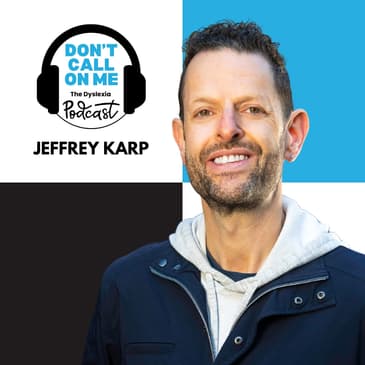
In this moving episode of Don't Call On Me - The Dyslexia Podcast, Megan and Eryn sit down with Dr. Jeffrey Karp, PhD. to explore a pivotal moment that changed the course of his life. As a young child struggling in school, unable to read, recall, or conform to classroom norms, Jeffrey felt lost, anxious, and misunderstood. But during a summer in special education, a single question opened a door: "How did you think about that?" That moment sparked a journey of self-awareness, process-oriented thinking, and ultimately, empowerment. Join us as Jeffrey shares how that question led him to develop tools for navigating learning differences and redefining success.
Dr. Karp is a passionate mentor and biomedical engineering professor at Harvard Medical School and MIT, a Distinguished Chair at Brigham and Women's Hospital, and a fellow of the National Academy of Inventors. This episode is a powerful reminder of how the right question at the right time can change everything.
-
Book a consultation with Megan to discuss CALT therapy.
-
Book a consultation with Eryn to discuss advocacy services.
With Love and Gratitude,
Megan, Eryn & The Don't Call On Me Team
[00:00:00] The school system I was in didn't want to do anything. My mom kept this massive file on me and she went to the education board herself when I was going into the seventh grade and she demanded that they take a look at my file for potential identification with learning differences. And they did and they got like halfway through. My mom had this massive file of everything, you know, all the labels I got, like lazy and not good enough, like all these things.
[00:00:27] And they identified me as having communications disability is what they said, right? So dyslexia. And then I had ADHD as well. And so it's kind of all mixed in there. But that's when things really changed for me is when I got that. I mean, that identification was huge for me. It was really a pivotal moment. This is Megan, owner of Dyslexia On Demand. And I'm Erin, owner of Advocate to Educate. And we are the Don't Call On Me Podcast.
[00:00:57] We are here to talk about dyslexia, to remove the stigma, to hear what families really go through, and to share their stories. In both of our businesses and personal experiences on a daily basis, we listen to people telling their stories. Many have heartbreak, many have struggle, but most all have a silver lining, even eventually. It's all about the stories.
[00:01:23] The more we share, the more we realize we aren't alone and we are a community. No, a tribe standing together. Today's episode is sponsored by Advocate to Educate. We help parents navigate through the confusing maze of special education in public schools in California.
[00:01:45] We support families starting as early as preschool through 12th grade, creating individual education plans to support the specific needs of your unique and amazing child. To learn more, go to our website, advocate2educate.com. Today's episode is sponsored by Dyslexia On Demand.
[00:02:06] Dyslexia On Demand uses only the highest trained dyslexia therapists, and it's all one-on-one and individualized to your child's needs. The best part is that it doesn't matter where you're located because it's all virtual. Visit us at dyslexiaondemand.com to learn more. All right, listeners, welcome back to the Don't Call On Me podcast. Today we are so excited to have Dr. Jeff Karp with us.
[00:02:35] I have heard him on another podcast and was pretty much blown away by his story. He is the author of a book titled Lit, Life Ignition Tools. He has used a lot of his journey through dyslexia to kind of reframe his thinking and to share a lot of those strategies with listeners. So welcome, Dr. Karp, today for being here. Thank you so much. So great to meet both of you.
[00:03:03] And yeah, I think there's so many people struggling out there. And I just think, yeah, we need to do everything we can to support them and love that you're doing this. So thank you for that. You know, some people enjoy like a nice breakfast in bed. We enjoy talking about dyslexia. So tell us a little bit about where your journey with dyslexia started around the age that you were identified as having dyslexia or just a learning challenge.
[00:03:29] And then a little bit fast forward to today in terms of the success that you've had. So let's back way up to those early moments and tell us a little bit about that experience. We'll have to go back to when I was, you know, seven years old, eight years old. In the second grade, that's when things really started to hit hard because nothing was sinking in. I'd sit at the back of the classroom and just be completely feeling demoralized.
[00:03:58] My mom would try phonics. I couldn't sound out words. She'd try cue cards and flashcards and just nothing was working. Nothing. And, you know, I kind of looked around the room and it seemed like everybody was getting it and I just wasn't getting anything. And it seemed foreign to me. I felt like just completely out of place. At the end of the year, the teacher pulled my parents aside and said that he wanted his name was Mr. Stedwell. I remember what he looked like.
[00:04:26] He pulled my parents aside and said he wanted me to repeat the second grade. And my parents negotiated with him that if I spent the summer catching up with tutors, that I'd be able to move on. And so he agreed to that. And all my classmates went on vacation. And here I am in summer school. And I go in every day and, you know, they do games. And, you know, it was pretty fun. They made it a really kind of nice experience. But there was one day in particular when I went in and they asked me a question that no one had ever asked me.
[00:04:55] And that actually changed everything for me. Like it was a light bulb moment. The tutor read a passage to me and asked me questions as they typically did. And I gave answers very quickly, very unsure of what I was giving. But I just sort of gave it. And, you know, they were supportive. So I kind of felt comfortable. But then on this particular day, the tutor paused after I gave my answer and asked, how did you think about that?
[00:05:19] And that question sort of blew my mind in a way because I was very impulsive. I just said what was ever on my mind. And it kind of made me start to think about thinking. I didn't really realize that was possible before. I just sort of thought you just do whatever, you know, sort of comes to you.
[00:05:38] And that changed everything because it had helped me to really tap into processes and realize it was almost like if you kind of use a computer analogy, like I was a computer where I had the hardware, but I didn't have software that worked for me. And I had to program it myself. So I couldn't read when I was younger. The only thing I could read was joke books and fact books.
[00:06:01] Like I felt this pressure to read beyond those books, but it just didn't work. And nobody understood why. And they felt like, oh, it was a problem with me trying. It was always like, oh, you're not trying hard enough. And I started to really get in these cycles of self-shame, like what's wrong with me? Why can't I do this? And my parents kind of over time realized that that's the only thing I could really read was joke books and fact books. And so they were very supportive in just buying me those kinds of books.
[00:06:31] Later on, it kind of moved to like choose your own adventure type books. But even those were a bit challenging for me because I feel like what would happen for me is I would read like a sentence or two, but my mind would wander. And so I just have to keep coming back and nothing was sinking in. And so there were like all this stuff was going on.
[00:06:53] Recently, I've sort of kind of created this almost like a mantra for myself that my goal is not to finish any book in particular or even anything that I watch. It's just for me to engage in something and have my mind like be engaged. Right. That's a pretty good purpose, I think. Right.
[00:07:11] And so I don't know that there's all these pressures, I think, because of how we've scaled things in society, like how we've created the education system and tried to like, you know, by doing it, we're sort of catering to a very select, like a sort of group of people. And then anyone outside of that just gets lost in the cracks, you know, the goal is like we want to just unleash our curiosity, like we want to like find things that interest us and then like double down on that and keep going.
[00:07:41] And for me, it was just like I was up against this system that just didn't work. And it was a really, really, it was super challenging for me. And the school system I was in didn't want to do anything. My mom kept this massive file on me and she went to the education board herself in when I was going into the seventh grade and she demanded that they take a look at my file for potential identification with learning differences. And they did. And they got like halfway through.
[00:08:10] My mom had this massive file of everything, you know, all the labels I got, like lazy and not good enough, like all these things. And they identified me as having that communications disability is what they said, right? So dyslexia. And then I had ADHD as well. And so it's kind of all mixed in there. But that's when things really changed for me is when I got that. I mean, that identification was huge for me. It was really a pivotal moment.
[00:08:38] Can I bring up something that you just said about, you know, the goal doesn't need to be to finish a book, to read a whole book. I was reading a book last night, which doesn't happen often, but I opened to a random page and I said to myself, well, I don't need to start from the beginning. Like my husband reads books start to finish. And I'm like, I don't even understand that. Honestly, that's way too much. So I was just reading a couple paragraphs and I put the book down.
[00:09:06] And just those couple paragraphs that I read were so monumental. And the information in those paragraphs were enough for me to sit and think and have a whole conversation with my husband. And I was thinking to myself, man, like, had I read the whole book? I don't even know where I would have started.
[00:09:30] And I just really want to reiterate what you're saying because there is such an emphasis with our kiddos to finish a book. And the reality is that is, and this just dawned on me right now. Who cares if they finish the book? Let them open the book and read a portion and talk about that. And that, you know, I've been hard on my son recently because he keeps wanting to jump from book to book.
[00:09:59] And he's getting bored of Diary of a Wimpy Kid. And I'm like, no, we just got to finish it. And I'm recognizing, like, that's me. That's my own stuff. Like, who cares? Let's switch it up. It doesn't matter. So I just wanted to loop that back around for others listening that the end goal is not finishing. The end or the goal is to take in information and think on it and ponder and pique our interest. And that's enough in itself.
[00:10:29] Well, and it can bring you down a rabbit hole of something that is more interesting, you know? So to get, to glean enough information from it. I like to think of these things as, like, algorithms. There's so many algorithms in society of things, like, need to be a certain way. Like, even the way that we grade children. To me, it takes the emphasis off of where we really should have the emphasis, which is everybody has their own creative expressions.
[00:10:57] They have their own ways that they experience the world. To me, it's all about finding, like, using the powers of our observation to engage the world and find what excites us and to, you know, and stimulates us and connects us. And to just keep following that path along the way. And when you have these rules in the system, like, you need to finish the book, you actually shut down people's curiosity. You shut down their powers of observation.
[00:11:27] You shut down their engagement and their ability to connect with others. And you especially shut down the people who are neurodiverse, who are on the periphery because they have hyper-focus and hyper-arousal and, like, rejection sensitivity. And, like, you know, like, it's all these things. In many ways, I think people who are dyslexic have other learning differences, ADHD.
[00:11:49] It's almost just, like, it creates a wall around those people so they can't even interact or be present or engage in society in meaningful ways. And shame. A lot of shame. It's like, oh, you didn't finish your reading for the night? My and Megan's children, and I don't know if you have children, but our children are in school right now. And this is the environment that they're in.
[00:12:16] And, of course, we do our best to advocate, but at the same time, they're still going to these schools. And we make the best of it because it is what it is. And, you know, but at the same time, when we think about how under-identified our kiddos are in the community and in our schools, you realize how many kids are stuck in that box going to school every day.
[00:12:46] And maybe the parents are, because we're living this world of a rat race, we're going, going, going. And, you know, maybe they're not able to catch it the way that maybe our parents were back in the day. There was a lot more households where one parent was home to see what was going on. It sounded like your mom was a gem. Yeah. And I already love her. I'm just kidding. Kisses to her.
[00:13:12] Hugs and kisses to her because, thank God, she really held you, held a space for you. And, by the way, just on that one point, just something really quickly. Like, I feel like there's so many moms and dads out there who want to help and support, but they can't because of various reasons, right? Like, there's, like, some people, they can't be present at home because they need to support their family because they've been disenfranchised in society or, like, you know, there's this generational thing, right?
[00:13:41] So, to me, we need a revolution and it's possible. We can all make this happen, you know? Like, we can bring about a revolution. And I think also with what's happening with AI and the potential to do, like, personalized education, you know, we have to be careful about how we approach it. But I really feel like we now have these tools that are coming online, which I think can address many of these challenges. But we need to sort of all having the conversations and make sure that we're getting the word out there
[00:14:11] and that we're sharing these challenges, but then also being solutionary, you know, in the sense of, like, talking about how we might bring this change to bear. Because I think it's not only possible, like, we can make it happen in a short period of time, but it's going to take, like, a revolution. And a lot of times I feel like we're actually closer to that, like, we're on the cusp of that because there's so much awareness now of the failures in the school system.
[00:14:38] Not that we haven't already known about a lot of these things, but I think it's in the ears of lots of parents who are speaking out and trying to create change within the system. Nothing happens fast when it comes to the educational system. So I think that, like, you know, enough of a spark is being lit. I don't think it's going to be a quick domino.
[00:15:02] But I think that that's one of the most pivotal pieces that we needed was the parents pushing back. And so I think that is happening. And similar to what your mom did, and so I want to kind of circle back to that. So when you did finally receive that diagnosis or that explanation prior, you had mentioned that there was a lot of shame. And, you know, as you're looking into that mirror and questioning yourself, did that change things for you, Jeff? Yeah, no, it changed everything.
[00:15:32] Because what it did is it flipped me from being there's something wrong with me, right? That is so unknown and something wrong that I can change, right? Like, that's what it was. Like, I felt like there's something wrong with you, and you're the one responsible for it, right? And what it did is it allowed me to see it through a different lens, which was, no, no, no, you're not responsible for it. This is actually a thing. You're wired differently.
[00:16:02] And because we recognize you're wired differently, you're going to get extra time to write your exams and to do your assignments. You're going to be able to do it in a room where you'll be alone in an environment that's more conducive to thinking, you know, in a more focused manner. And I actually got time and a half or double time, not only in the seventh grade and eighth grade, but all through high school, through my undergrad, and even in grad school when I was taking, you know, classes.
[00:16:29] And I also, I ran up against a number of professors who didn't want to give me those accommodations. And so I ended up kind of, you know, my mom was my big supporter, big advocate early on, but then it had to transition to me over time. But there was also empowerment in that process. And I think there was sort of confidence building. And the other thing to me that has been so critical, and, you know, I've gone around kind of speaking about the book,
[00:16:57] Lit Life Ignition Tools over the last year or so, came out in April of 24. And I get a lot of parents come up to me, and also children actually, who are dyslexic, have ADHD, other forms of learning differences. And the struggles they describe are just, they're just like heartbreaking, you know? And it reminded me of one other thing that my mom did when I was younger, which is, and I think it was like the fourth or fifth grade in my school,
[00:17:25] they had speech competitions. I was terrible at memorizing. I mean, I was terrible at everything, really. But at the time, not that I didn't have the potential to get better, but I just wasn't, you know, I just, everything, nothing came easy to me. I always had to work like two to three times harder than everybody else. And I still feel like I actually do. But my mom would write the speeches for me, and then she would help me memorize. And it was very frustrating for me. But then what she did is she said, okay, well, why don't we just memorize one word?
[00:17:54] And then I did that. And then she said, okay, let's move to two. Because the truth is, if you can do one word, you can do two. And then you can do a sentence, you can do a paragraph, you can get to a page, and then you can get to two pages. Like, you can go on. And it's sort of like breaking it down like that. And it was painful, like for me to memorize, but she was there and supporting and coaching. And then she would coach me in how to say it, the rhythm of the words. And what happened was, I started doing well in the speech competition. I actually became the kid to beat.
[00:18:24] Like, I started winning. I started taking home trophies. It was the one thing that I was gaining confidence in. And I kind of feel like that actually had a huge impact on my life. And I almost feel like every child, every person needs to have just one thing, and it doesn't matter what it is. Just one thing where they have some agency, they can build some self-efficacy where they can say, I did it. I put in some effort, and I saw some results.
[00:18:54] I could make some incremental improvements. Because then you start thinking about how you can apply that to everything. That, to me, was so key. So there was this one parent that came up to me after one of my talks, and she was kind of saying, like, her son is in high school. She's really concerned about going to college because he's really struggling. I started asking some questions. I said, well, what does he like to do? He's like, I don't, you know, there's a few interests. And I sort of kept asking different questions around that.
[00:19:22] And she said, well, he's really interested in the stock market. And he talks about it all the time. And I said, okay, bingo. Like, what if you were able to find somebody, like a stockbroker, someone inspirational, and maybe they could become a mentor, you know, to him. And at the end of the day, this is my personal belief, but it doesn't matter if he goes to college or not. I mean, there's so many opportunities. Like, most people actually in the United States do not have a college degree.
[00:19:49] To me, it was sort of like that, you know, it's like, how do we, you know, as parents, help our children identify that one thing? And it could be a sport. It could be, you know, acting. It could be anything where the child can gain confidence because that there's like a multiplier effect there throughout their entire lives. I'm glad that that is something that the three of us are providing to others. And I love hearing it from somebody else too.
[00:20:17] You know, sometimes when you give advice to others based on your own experience, and then you're like, well, this is just my experience, but it feels so powerful. So it's great. We've never met. So it's really even more powerful to hear you say the same thing. I'll say that those that are also in a lot of intervention, they are going to tutoring after school, even though they've been at school all day, and maybe they can't do the sport.
[00:20:42] I always tell parents, like, figure out a way if it's the sport they love. Don't drop that because it's the one thing not only do they look forward to, but we forget about bonding with coaches and tutors and mentors. You know, it takes one mentor or one coach to make a kid feel connected and special and loved
[00:21:08] and that their little bits of confidence grows when a coach believes in you. Whether it's a sport or not, whether it's playing poker or for my kid, it's Pokemon cards. It's literally like collecting Pokemon cards and going to Pokemon card conferences and negotiating himself to buy, like the price to buy.
[00:21:35] And of course, because he's seven and adorable, they're always giving him good deals, right? And that is something he's proud of because it's something also that is fun for him. Those are not phonetically easy to read. So I'm putting myself in his position thinking, oh yeah, no, that's like, that's too intimidating because looking through the book, like, how can he get through it? But he loves it. He absolutely loves it.
[00:22:00] Because of his love for it, he can move right past what might be challenging. And what the core of all of it is, is confidence. And what I say over and over is to me, that's one of the key qualities that causes success, is just having that confidence, faking that confidence, whatever. And I do think that for our kids with dyslexia, so often they do feel really beat down.
[00:22:27] And so that is why we need to help to foster that confidence. If anything, you know, they're going to need to have enough confidence to advocate for themselves in those later years. So in high school, in college, and so on. So all those pieces are so important. So Jeff, we often ask, you know, what's the best advice that you can give others with dyslexia?
[00:22:50] And I think that you kind of rattled off prior, inadvertently, so many amazing pieces of advice for those who have dyslexia, children who have dyslexia, anyone who needs to hear this. But do you have one piece of advice in particular that you would, you know, just kind of reemphasize? Yeah, absolutely. One thing that's just, you know, front and center in my mind is how all of us, every single one of us
[00:23:19] has this incredible biology that's working for us. And in that biology is this amazing power of observation, this ability to use our senses, all of our senses to experience the world. And I think that this society that we live in today dulls our senses. It really tries to shut down the way that we experience things.
[00:23:47] It tries to control the way that we experience things. It atomizes our attention. It cubes our time. It just has this way of flattening our imagination and flattening our curiosity. And these are all things that we have that we can tap into individually, that we don't need external interactions to do that. Like we all have it within.
[00:24:13] It's like when I go outside, for example, and walk the dogs, I'll cycle through my senses. So I'll actually say sight, and I'll look at the texture of the bark on the trees, and I'll look up at the clouds, and I'll look for different shapes in the clouds. And then I'll say hearing, and I'll listen for the rustling of the wind and the leaves, and I'll listen for the birds. And then I'll say touch, and I'll feel it close against my skin, and I'll feel my heels hit the ground.
[00:24:41] What I'm doing actually is resensitizing my senses. I'm resensitizing my aliveness. And to me, it's sort of like when you start to recognize this very powerful biology that we all have access to, this biology that allows us to experience the world in these incredible ways, it brings you this sense of wonder and awe, and it activates your curiosity, and it makes you come alive. And nobody can take that away from you. Nobody.
[00:25:08] And so to me, that's sort of my one piece of advice is to spend time pausing and engaging with that because it is just such a powerful source of connection and cultivation of your curiosity. And so to me, when you start to connect with that, I think it gives you, it's this lens that allows you to disconnect from these narrow institutionalized sort of structures that sort
[00:25:36] of tell us that we're not doing it right, that we're not acting the right way, that we're not fitting in and that we need to fit this mold. And I think when you change the lens to thinking about this biology and the grander scheme of everything, I think it allows us to navigate life where we can actually break through from these structures and really have that agency and that self-empowerment that allows us to navigate
[00:26:06] the world in deeper and more connected ways. I love that, that grounding. It's like taking the opportunity to step back and realize that your purpose for being here is so much larger than making an A on that spelling test. When we ask this question, nobody's ever given that advice. So brilliant. First question, are you describing what people call mindfulness?
[00:26:33] Because I know that there's a lot of mindfulness that is attempting to be brought to schools. In my local district where we live now, is it done well? I don't know. That's a whole new thing. But I'm just curious, the connection to mindfulness. And also there tends to be this idea of when we ask what's the best advice you can give, it's like, well, do structured literacy and get into mental health therapy to make sure that... And I'm guilty.
[00:27:01] I'm number one guilty of giving those in the sense of trying to support the child to gain those literacy skills and make sure that their self-esteem is still intact because I feel that the trauma of this experience is just not talked about enough.
[00:27:18] That being said, I've never heard anybody say just a tool that can be so helpful is to just stop and notice and do the things that you're describing. Because most kids these days can't stop. They're going. Their motor is just going, going, going, going. So that in itself is a skill. Yeah. And we're cultivating that too, right? In society, we're cultivating the busyness.
[00:27:46] And I think AI is actually deepening that as well, right? Because now you can do more in a shorter period of time. It's not like you're going to do the same amount of work with less time. You're still going to work the same amount of time, but now you're going to achieve a lot more in that work. And so that means that you're actually doing more. It's like a lot more for your brain to process as well. And our brains need time to sync up. There's a lot that goes into our subconscious mind.
[00:28:12] And if we don't pause, we don't allow these sort of thoughts to swirl in our minds and sort of bounce between the conscious and subconscious mind. And then be able to be intentional with the information that we're receiving. For me, in between meetings, I like to create some time because then if I don't, I might miss some really key opportunities. And the other thing about mindfulness, I've written an article on mindfulness.
[00:28:36] I haven't published it yet, but the title of the article is Quit Getting Mindfulness, Live It Instead. If you look at the history of mindfulness, it wasn't something that was to be gotten. It was not something to be acquired. It's something that we already have, that we're born with. It's a way of being. And in today's society, we look at mindfulness as like an antidote, like as it's a fix. It's going to fix our anxiety. It's going to fix our depression.
[00:29:06] It's going to fix our loneliness. And I think that to me, if we look at like go back in time and also look at indigenous ways of being and knowing, it's actually, it's part of who we are. Correct me if I'm wrong, but the way I took it in is that we're seeing life through this lens of how we know it. And when we take these little moments to pause, to breathe and connect, to check in with our senses,
[00:29:35] it gives us and cultivates that space for us to almost think outside of the box where we might only be thinking, okay, well, my child has to go to this school. These are my only options. And, you know, it's this or nothing. And with that, we are kind of continuing the perpetual cycle of thinking small and thinking rigid,
[00:30:00] opposed to when we are more connected, we're capable of that idea wheel being closer to our ability to actually put it into fruition. Yeah, yeah, exactly. Like it's like we constantly get cues that help to guide us, right? And it's like intuition and we can cultivate that intuition over time by just being open to it. For me, like with ADHD, I constantly interrupt.
[00:30:27] But if I'm open to the cues, I can sense people's sort of experiences and I can be like, okay, I want to change that. Like, okay, and then I can find a process to try to pause. And the more that I create pauses in my day, the more I'm able to pause in conversations. And then I can start to open things up. Again, it kind of comes back to we have all these pulls on us, this definition of normal,
[00:30:51] but it often conflicts with if we were to pause, what we would consider best for our child is likely different than what society is telling us is best for our child. And that's the challenge. That's the interception. And that's where I think we can really intercept the habit so that we can truly figure out what is best. We need to sort of, I think, look at our lives as how do we figure out the guideposts that we want to use to direct our lives?
[00:31:18] Because if you don't do that, you just get pulled along in other people's, you know, towards other people's interests. And that, I think, creates a lot of problems for our children, especially. I am looking at your website right now, and you've done some extraordinary things. And you've spoken in front of many, many crowds.
[00:31:37] I want to ask you, if you had to describe the education system that you want to and that you feel would be most beneficial for neurodivergent kiddos or all kiddos. But, you know, kids don't get to choose what they want to learn. If they have a higher interest in one area or the other, they still have to be exposed to all of it.
[00:32:07] I'm just curious, what would that school look like? I think part of it is there needs to be an evolution component where there's the actual process of engaging children changes over time based on the insights that are gained. So there's like experiments that are being conducted, essentially, right? If you look at the way the education system works now, it's very outdated. It hasn't changed much, right? That, to me, would be a big element is that it would actually evolve.
[00:32:34] Like the content would evolve and how we bring the content about. And as we better understand how people learn and how there's diversity in learning, there would also be this evolution of the whole process. So you could imagine you could go into school and it's really, you know, part of it is like assessing where the child's at and where their interests are.
[00:32:57] And then you start to present the material in a way that captivates those interests. In all of this, there could also be this sense of like, what are all the possibilities of potential career paths? And you could start to get a feel for as that child was evolving. You could have a sense for like, okay, here's the ones that at this moment might end up being the most conducive to that child.
[00:33:25] And I think another part of this, to me, this is actually really important, is that we also would have a deep understanding of what are the current problems that we face in society, the biggest societal problems. And we would try to guide the children to develop skills to address the current problems that we face. Maybe we should be trying to present the problems of today to the problem solvers of tomorrow.
[00:33:52] You bring about education in a very purposeful, intentional way that empowers the students based on what their interests are. But then you guide them towards being contributors to society to help address the problems that really matter at this moment. I think you need to run for president. I'm so excited with everything that you've done to see what happens in the next 20 years, you know, with all this information.
[00:34:22] If my son didn't have to worry about non-preferred tasks that he's stressed out about doing on a daily basis at school, and I knew he was going to school and he was living his best life studying what was interesting to him. What a difference that would make. But imagine a classroom that was broken up into groups based on interest and how much easier the teachers would have.
[00:34:52] Maybe they're diagnosed ADHD and they're just, they're the kids that the motors are running, but we're able to channel that energy into what they love rather than pushing down who they are in order to make them sit still to shove material down their throat. I mean, basically, right? The natural consequence of teaching to their interest.
[00:35:22] It would change everything. Imagine children now, you know, go out and they start collecting water samples in a stream, and then they get to see and the scientists analyze what's in there, and then that gets contributed to the scientific literature, and the children are now part of that, right? Like, it's sort of like there's so many things where we can bring kids out and sort of engage them in the process where what they're doing is not just academic,
[00:35:51] but actually functionally helping move things forward, where they feel part of something important. I feel like it's so challenging with parenting to know what to do, and you can also get into these cycles of shame. We've tried to be a little bit more experimental with it. I think that's a good mindset to have is to be experimental because you never let an experiment go on forever. The goal of an experiment is to learn and gain insights
[00:36:18] and then update and sort of run another better experiment or more informed experiment. I don't have a way of guiding other than saying to make a choice, but don't make it permanent. I think the biggest thing above everything is trying to keep the open communication line. By doing that, I really feel strongly that the one way to do that is you actually have to do the work yourself on yourself, and I think when you do that, it flows to the children. But if we don't work on those things,
[00:36:47] then essentially we're just carrying the generational trauma and all those things down to our kids. It's up to us to break those cycles. I think the best thing that we could do for our kids is actually work on ourselves. And they see that. They'll see that. They notice, like you said, the child who was listening to the podcast. You have to also realize that kids have very powerful observation skills, and they will see what you're doing. They might not say anything. They might not react to it,
[00:37:14] but they are observing even when they don't appear to be observing. All right. Well, so thank you so much, Dr. Karp, for spending the time to speak to us today and give us so many amazing insights. Please go and check out his book, Lit Life Ignition Tools. It's definitely something that I'm going to spend a lot more time with and really try to incorporate a lot of these tactics into my world and model them, like we were saying,
[00:37:42] for our kids and for a lot of the decisions that, you know, I'm having to make on an active basis with my own children. I think it's going to definitely be extremely impactful for myself and I think anyone who reads this. So if you're interested in the book, we will go ahead and put links to it in the show notes. So thank you so much again for taking the time. We've really, you've had so many great and unique insights. I also want to say thank you. This has been different than our traditional path.
[00:38:12] It's opening my eyes to new, like just opening up additional doors of thinking and bringing up some areas that I can't wait for Megan and I to digest the information and then talk more about. So thank you. Yeah. Thank you both so much. Yeah. Again, for, for inviting me onto your show and, and for giving me this opportunity and for really your, the questions that have like totally activated my mind in all kinds of ways. And yeah.
[00:38:42] And I, I, and my heart goes out to your listeners, you know, those who are dyslexic or have children who are dyslexic or struggling with other types of neurodiversity. And, and I just feel like, you know, there really is, there's so much reason to be hopeful. And we just, we all have so much potential that, and we're only tapping into a tiny fraction of it. And, and I think again, it, to me, it's just like these little rituals, these tools,
[00:39:09] these, these practices that just, you know, take a few seconds and they have this auto catalytic effect. And that's something if, if anyone's interested, I have this newsletter where I'm sharing the rituals that I'm practicing and I'm encouraging others to share theirs and I'm practicing theirs and sort of, you know, writing back about that. So if you're interested, you can sign up for that too. Awesome. Thanks for joining us on Don't Call On Me. If you're loving what you're hearing, follow us on social media
[00:39:39] and let's keep the conversation going. Take care and we'll catch you next time.