With Love and Gratitude,
Megan, Eryn & The Don't Call On Me Team
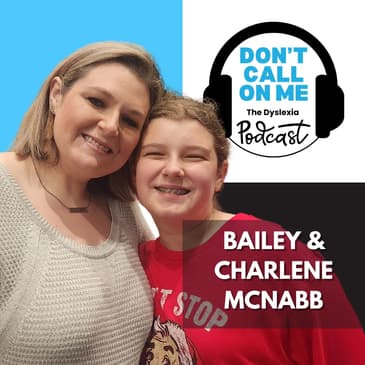
[00:00:00] So welcome back listeners. We are so happy today to be joined by Charlene and Bailey. We have a mother daughter combination and we're really excited to hear your story. So please go ahead and tell everybody who you are and a little bit about yourselves.
[00:00:21] Hi, my name is Bailey and I have dyslexia.
[00:00:25] Awesome. And Bailey, how old are you?
[00:00:27] I'm 11 turning 12 in August.
[00:00:31] Awesome.
[00:00:32] August what?
[00:00:33] 29th.
[00:00:35] Okay, mine's the 16th. I get excited whenever there's an August birthday. Okay, anyways. And what grade are you going into?
[00:00:44] That's grade.
[00:00:46] Okay, very cool. Okay, Charlene, tell us about your family.
[00:00:51] And what I myself my husband Curtis Bailey is our oldest at 11 and she has a little sister who's eight and a little brother who's one.
[00:01:01] Okay, and I would like to ask you since you have other you have other kids in the family.
[00:01:08] What, what characteristics does Bailey have or did Bailey present when she was younger that showed signs of potential dyslexia that you noticed?
[00:01:23] Um, well, and she was always very smart. She was in a daycare. She did pre K and she worked hard. She always liked doing certain things, but she is a super perfectionist.
[00:01:37] And as she slowly got older, if things weren't done exactly like 100% and she got it right the first time she's just like I'm done.
[00:01:49] And she liked learning like the ABCs and stuff that as she got older into kindergarten, reading and putting the words together slowly were just not her favorite and she went from I love school I want to go to school to I hate school.
[00:02:05] I don't want to be here. I don't want to have to do this.
[00:02:08] There's too much going on.
[00:02:10] So she would just shut down and talk.
[00:02:13] That was her big deal is talking with other people because she didn't get it.
[00:02:17] She didn't understand.
[00:02:19] Yeah, yeah.
[00:02:20] And did she did you notice that coping skill arise and she had and Bailey definitely we're going to ask you this too.
[00:02:31] I'm curious so from mom's perspective, did you notice that she noticed something was different or that she wasn't picking up on on things related to language and the precursors to reading and writing.
[00:02:49] Did she start to notice that as well.
[00:02:53] And I think she just noticed that it was just more difficult.
[00:02:57] She saw her friends like getting stuff and it seemed like the more she saw them doing stuff like the more frustrated she got because she wasn't doing it 100% like they were.
[00:03:09] And I think I think that's what she noticed.
[00:03:14] And so like when she didn't get it, she would just shut down and she's just I don't want to do this.
[00:03:19] I can't.
[00:03:21] So Bailey, I know that like a lot of times I personally don't remember a whole bunch from my childhood, but I do remember little kind of flashes, isolated memories and feelings.
[00:03:35] Does that what your mom say?
[00:03:37] Did that resonate with you at all?
[00:03:39] Do you remember like ever feeling frustrated?
[00:03:45] Yeah.
[00:03:46] Yeah, I remember a lot of it.
[00:03:48] And it just I just I started feeling jealous because I have a best friend.
[00:03:54] Her name's Jalen.
[00:03:55] And she and I'm still friends with her now.
[00:03:58] She was in a different class, but I could still see her getting her stuff done and doing her stuff and not having a problem.
[00:04:08] And I felt jealous because I couldn't do it straight away.
[00:04:11] Yeah.
[00:04:12] Yeah.
[00:04:13] I have a notebook full of F's because of my dyslexia.
[00:04:17] Right.
[00:04:18] Well, so tell us what led us.
[00:04:20] Yeah.
[00:04:20] Like we totally identify with that situation, completely empathize with it.
[00:04:27] So tell us a little bit about your journey.
[00:04:31] And I know that's a little bit different for both of you.
[00:04:34] I know a little bit of your backstory already, but I want everyone to hear it from you guys.
[00:04:40] You know, tell us some details about kind of how we got to where we are today in terms of when we got pursued, getting an identification of dyslexia.
[00:04:52] You know, any kind of emotions that like were tied to that, you know, and so I'm going to let if it's OK, I'm going to let Charlene start from like mom's perspective and what happened.
[00:05:06] And then I 100 we 100 percent want to hear your side to Bailey.
[00:05:11] OK, so.
[00:05:13] So my thing was like I I knew she was having trouble and it was just a struggle for her.
[00:05:21] And she I just thought it was she's a talker.
[00:05:26] I was a talker.
[00:05:27] I grew up being a big talker.
[00:05:28] And so I just thought it was.
[00:05:31] It's just it came from me.
[00:05:33] It was like she was a talker and I rubbed off on her somehow.
[00:05:36] And like she's just getting in trouble for talking all the time and she's not focusing on her stuff because she wants to play and interact with her friends.
[00:05:44] And I knew she was having trouble through kindergarten and it got into first grade and she hated first grade.
[00:05:50] And I hated that she hated it because it was just like I'm taking her somewhere that she just doesn't want to be at.
[00:05:56] She didn't get it.
[00:05:58] She couldn't understand.
[00:05:59] It was just driving her crazy.
[00:06:01] And so I was like, I don't know what to do.
[00:06:03] And there was a lot of other contributing factors at that school that were happening that we needed to address.
[00:06:12] And my friend, LaSondra, she taught in Garland ISD and she actually taught second grade.
[00:06:21] And Garland ISD is an open district.
[00:06:24] So you can pick whatever school you want to go to.
[00:06:26] If you get in, you can go there.
[00:06:29] And she knew that Bailey was having trouble and she knew that we needed another home school.
[00:06:37] And she was like, why don't you bring her to my school?
[00:06:40] I can even try to see if I can get her in my class.
[00:06:43] And so I was like, yeah, that'd be great just to try to get her somewhere else because we needed to be somewhere else with everything.
[00:06:50] And then see a week into her being there.
[00:06:54] She's like, hey, hey.
[00:06:57] She's like, I don't want you to get upset or anything.
[00:07:00] But have you ever considered maybe her being dyslexic?
[00:07:04] And I was like, I've never crossed my mind.
[00:07:08] I've never dealt with dyslexia until her.
[00:07:11] And so I was like, no, I haven't.
[00:07:14] And she's like, I see her struggle and I see a lot of stuff going on with her.
[00:07:20] And I feel like maybe she could use some help.
[00:07:24] And I'd really like to get our dyslexia therapist and the diagnostician in to kind of test with her and go over what might be happening to see it, even if it's not that, figure out what's going on with her.
[00:07:39] And so I was all for it.
[00:07:43] And I signed it.
[00:07:45] And within a couple of weeks, Miss Feger had met with her.
[00:07:49] She had met with the diagnostician and they had done different tests on her.
[00:07:54] And we had our meeting.
[00:07:57] Had it.
[00:07:58] Had it.
[00:07:59] Just like kind of say a little something here.
[00:08:03] And first of all, just like comments on how it's such a funny small world because I went to high school with Lissandra.
[00:08:11] But those little people who make that huge difference because and teachers, teachers are should always be that like first line of defense.
[00:08:25] Our problem is that teachers actually, as a whole, don't learn a lot of things in college, but especially about dyslexia.
[00:08:36] And I know because I graduated high school with Lissandra that she studied education the same time I did.
[00:08:43] And I can promise you not one thing was mentioned about dyslexia.
[00:08:47] And point being that because of the education that she had and the ability to recognize that Bailey had like characteristics of a child who is struggling with dyslexia, that changed your life, Bailey.
[00:09:05] Like right there.
[00:09:05] And I just wish that more teachers had this level of knowledge and education to be that because you guys don't know.
[00:09:16] I mean, both Erin and I work in the fields and how many kids we are talking to who had to struggle until maybe high school.
[00:09:27] And did you know that 80% of kids leave school undiagnosed and so who are dyslexic?
[00:09:34] And so the point is like just amazing kudos to that teacher.
[00:09:40] And I know that was great because and that was my biggest thing.
[00:09:46] It was kind of a relief a little bit for me just because I was first grade was horrible.
[00:09:53] Like I felt horrible that she was just having this really hard time and she was excited to go there because she knew Lissandra.
[00:10:00] So she's like, I know her from because we go to church with her.
[00:10:03] She's like, I know her from church.
[00:10:05] You know, she felt better that she would be with somebody that she knew.
[00:10:11] And but we still had that underlying issue.
[00:10:15] And then I felt like this her poor because I even went to class with her.
[00:10:19] I told her I'm like, she keeps calling me telling me you're talking all the time.
[00:10:23] I'm going to go to class.
[00:10:24] And she called me and she was having a rough day.
[00:10:27] And so I talked to my boss and they were like, go.
[00:10:29] And so she came back from PE and I'm in her room.
[00:10:32] And she was like, her and all these kids were like, there's a parent in the room.
[00:10:38] And I sat by her.
[00:10:40] And even with her being quiet, they did math.
[00:10:44] And I just saw her face.
[00:10:46] Like she was like, I could tell it's like she couldn't get it.
[00:10:51] Like she didn't understand.
[00:10:53] And the poor teacher, there were so many kids in her class to that year.
[00:10:57] She spent the whole time like redirecting students back to what they were trying to focus on that.
[00:11:04] I don't think she was even able to focus on what individually kids needed.
[00:11:12] And so I think that was another big thing too, is that she didn't have that.
[00:11:19] And as soon as she got to be around Lissandra and Lissandra knew her struggle, she just saw her and she was.
[00:11:25] And like, that's, I agree.
[00:11:26] Completely kudos to her.
[00:11:27] Because it's like, that's something that even me now, now knowing and seeing her, her, I see evidence of it in my brother.
[00:11:38] I see evidence of, and he never got diagnosed.
[00:11:41] Like even her dad, I think maybe struggled with it a little bit because he talks about having trouble reading.
[00:11:46] Totally.
[00:11:47] But he's never been diagnosed.
[00:11:48] He just learned how to cope.
[00:11:50] Yeah, and we don't know what we don't know, right?
[00:11:52] And that's the same message to teachers, right?
[00:11:56] Like I believe in my core, every, not every, I can't say that like confidently, but most all, people who move into that field have that care and concern and desire, but they don't know what they don't know.
[00:12:11] Same as you as a parent.
[00:12:13] Like if you don't know that, what to look for, you don't know the right questions to ask of the right people, right?
[00:12:20] And so, yeah, I mean, and that, you know how common it is, Charlene, to like get a diagnosis of your child and then start looking back and going, oh, oh.
[00:12:31] You know, I talked to so many parents who are like, I found out I was dyslexic.
[00:12:35] But I just didn't know it was any different because you don't know when you're dyslexic that other people's brains operate differently.
[00:12:44] So like the struggle is all you've ever known.
[00:12:47] So what do you do?
[00:12:48] You just question your intelligence, right?
[00:12:50] And so.
[00:12:51] And I want to bring something up about this wonderful teacher that was willing to say something, even though technically forget the lack of education for just a second.
[00:13:04] A lot of reasons why or a lot of times the teachers are afraid of retaliation and they don't want to say anything because as soon as they say, you know, unfortunately, there's a lot of and Bailey like all.
[00:13:18] I want you to understand this, too.
[00:13:20] There's a lot of principals that all principals have bosses.
[00:13:25] OK, the principal, while they seem like the boss of the school, they actually have a boss.
[00:13:29] And to make it very simple for you to understand, I'm sure you know that when somebody has to do dyslexia therapy with you, they get paid.
[00:13:41] Right.
[00:13:41] But since not every student needs it across the board, unfortunately, our school systems don't love to pay for therapy, which is insane.
[00:13:54] And I don't it's not fair.
[00:13:56] Yes.
[00:13:57] I like the face you're making because you're spot on.
[00:14:00] It is not fair.
[00:14:01] Scream it.
[00:14:02] It's not fair.
[00:14:04] It's not fair.
[00:14:06] Right.
[00:14:07] There you go.
[00:14:08] And imagine imagine, Bailey, looking at your teacher and they look at you and they say, well, I don't know how to teach you how to read.
[00:14:17] Like what?
[00:14:18] Of course you do.
[00:14:18] You're my teacher.
[00:14:19] Right.
[00:14:20] But these teachers don't they don't learn it.
[00:14:23] And now we're starting to see changes that they the teachers are learning in credentialing school to teach all kids.
[00:14:32] But it's not it's going to take a long time to actually soak in and become what they are equipped to do.
[00:14:40] That all being said, the teachers are afraid that they'll get in trouble if they say, hey, my student really needs extra help, which is.
[00:14:50] You know, honestly, as three parents on this screen and looking at Bailey, like I want to cry because I can't that the reality of that being our school system is horrifying.
[00:15:03] And Bailey, you deserve.
[00:15:07] You deserve.
[00:15:07] Everything in the world, you deserve to be taught by somebody who understands how your brain works.
[00:15:13] And, you know, it's not a mystery.
[00:15:17] We there is so much science that tells us exactly how kids with dyslexia need to learn to read, write and spell.
[00:15:26] And our system is so behind.
[00:15:28] And I mean that by our school system that unfortunately, there are a lot of kids that don't have access to the brave teacher that was able to talk to your mom and say, you know what?
[00:15:42] I don't care if I get in trouble or whatever.
[00:15:45] This means more to me about that.
[00:15:49] This child gets what they need.
[00:15:51] So there are so many aspects of it drives me nuts.
[00:15:55] And there's lots of schools, Bailey and Charlene, because you guys are so lucky to be in an area that does have that dyslexia teacher.
[00:16:05] Right.
[00:16:05] Who specifically she's a couch.
[00:16:07] She studied how to do all of that.
[00:16:09] But most schools out there don't have that.
[00:16:13] So even if there was that educated teacher who brings it up, what Aaron is also saying is that they're scared to actually suggest to you to get testing.
[00:16:26] Because what happens is once that child is identified, then the principal is going to be like, oh, you're responsible because now what?
[00:16:36] We're not equipped to teach that child how her brain learns to read.
[00:16:43] And so then they just they kind of keep it hush hush.
[00:16:46] Or we're not going to like push them to identify because the dyslexia teacher is already full.
[00:16:53] And if I had to add another kid to her roster, I'd need to hire another one.
[00:16:58] You know, so there's like reasons.
[00:16:59] And it's sad.
[00:17:01] But even schools are run like businesses.
[00:17:03] But anyway, Bailey, tell us, like, let's go back to like your mom talked to us about the identification process and how lucky you were.
[00:17:14] But what about you?
[00:17:15] Like in terms of the feelings that you had before and then how they changed or maybe didn't change once you did get identified?
[00:17:27] So like whenever I would walk into my first grade classroom, I would feel like I had pressure on my shoulders.
[00:17:35] And then whenever I went to Liberty Grove with Miss Crocker, I walked in and she said, you can have help.
[00:17:45] That's what it felt like.
[00:17:47] Oh, and and on the inside, how did that feel?
[00:17:50] Did it change your feelings of nervousness about school?
[00:17:56] Yes.
[00:17:57] It made me feel like it made me feel like I had a weight off my shoulders.
[00:18:02] Yeah.
[00:18:03] Yeah, totally.
[00:18:04] Wow.
[00:18:05] And like, wow.
[00:18:07] Somebody who understood.
[00:18:08] It made me feel like I had people that understood me around me.
[00:18:15] That's really powerful, right?
[00:18:17] Especially as a kid, because so often kids don't feel like they have a voice and or someone to listen.
[00:18:27] Yeah.
[00:18:27] Mm hmm.
[00:18:29] Yeah.
[00:18:29] I think one of the real big things, too, that I remember that happened during all the testing is that Miss Steger, who became her dyslexia therapist or teacher, she was like, I have dyslexia, too, when we did our first meeting.
[00:18:45] And I think that, I don't know.
[00:18:47] I just remember, Bailey, I remember your face.
[00:18:49] You felt kind of like happy because you had somebody that had it.
[00:18:55] That was that knew kind of what you were going to be dealing with.
[00:18:59] And she's like, I've got my master's.
[00:19:01] I did all this stuff.
[00:19:02] You could do it, too.
[00:19:04] So I think it brought me relief for sure, because it's like she has somebody that knows.
[00:19:09] So it's not because I don't know.
[00:19:12] So somebody that she can relate to and that she gets to use done stuff.
[00:19:17] Is that how you felt, Bailey?
[00:19:19] Yeah.
[00:19:21] Those are always my favorite combinations of there's so much social emotional work to be done on a child with dyslexia.
[00:19:29] So when your dyslexia teacher or your count also has walked a mile in your shoes, right, they can connect like they have this ability to really speak to the child's like feelings like and, you know, I just think it's a really special combination.
[00:19:48] Bailey, I want to know what makes your dyslexia therapist like what makes you feel so comfortable?
[00:19:55] Why is it that you feel more comfortable?
[00:19:57] We can we can tell you why or I can tell you why it makes me feel comfortable.
[00:20:02] But I want to know for you, what is it that you think she understands more than maybe a teacher who doesn't have dyslexia?
[00:20:10] It just it made me feel like I had people that know how I feel and that people and that I could make more friends and that I could do something good.
[00:20:22] I actually mastered my fourth grade reading star because of her and how much she helped me.
[00:20:28] And she made me feel so like lucky.
[00:20:32] Yeah. And when you said that that she knows how you feel, how did you feel?
[00:20:39] Did you feel maybe not like I want we're going back to when it kind of you first got support from her?
[00:20:47] How were you feeling?
[00:20:48] I felt nervous to meet her because I didn't know what she was going to be like.
[00:20:53] I didn't know if she had dyslexia just like me.
[00:20:56] And whenever I found out she did have dyslexia, I was like, she gets how I feel and how I felt was I just felt like I had nobody and nobody knew how I felt and nobody could be there.
[00:21:13] And you felt like you couldn't talk about.
[00:21:16] Is it that you felt sad?
[00:21:18] Is that you felt lonely?
[00:21:20] You felt I mean, I felt really stupid.
[00:21:22] That's I mean, to just just use the word that I would use at your age.
[00:21:28] You felt stupid and I felt like nobody understood.
[00:21:32] I just felt like I didn't have it in me to be smart.
[00:21:36] Like I was like how my mom told you I I was really good and like before kindergarten and stuff.
[00:21:45] And then it got to that and it made me feel like I couldn't do anything at all.
[00:21:49] So, Charlene, like hearing her say that my mama heart just like I started actually my eyes started welling up with tears because hearing your daughter say that is the last thing we ever want for our children in general.
[00:22:07] Like, is that I did was that just completely crushing for you to you probably already knew she felt like that.
[00:22:14] But just knowing that as a mama.
[00:22:17] Yeah.
[00:22:18] Yeah.
[00:22:18] It brought tears to my eyes.
[00:22:20] Yeah.
[00:22:21] Yeah.
[00:22:21] It it was really hard because I knew that she was struggling and I knew that she was when she was little.
[00:22:30] Like like I said, when she like she said, even like pre-K and stuff, she was she was jamming.
[00:22:35] Like they moved her up in like the three year old classes because she was she knew A's and like she knew A's Apple and like all the stuff and she was getting it.
[00:22:45] And then it's like, yeah, just just watching her.
[00:22:50] It was hard because she went from I'm excited.
[00:22:52] I want to go to just I hate this.
[00:22:55] I don't want to go.
[00:22:56] You can't make me.
[00:22:56] I'm not reading.
[00:22:57] Like because they wanted us, you know, to read a book with them at night to help them learn and see and read and follow along.
[00:23:04] And she just hated that.
[00:23:06] She's like, I don't want to.
[00:23:08] I don't want to do this.
[00:23:09] I'm going to watch my show.
[00:23:10] And it was just like pulling teeth.
[00:23:12] And it was so hard.
[00:23:13] And she just it hurt my it did.
[00:23:16] It hurt.
[00:23:16] It hurt my heart because I didn't know what to do.
[00:23:19] I didn't know like how it went from excited to just hating it and like how I can help her do better.
[00:23:27] Yeah.
[00:23:29] I got tired of I couldn't I couldn't do it.
[00:23:34] I felt like I couldn't do it.
[00:23:36] And I would fall asleep without eating dinner on my homework sometimes trying to figure out what it was.
[00:23:43] And what you don't realize is that your brain was working, I would say, like 600 times harder than all the kids around you for you to end up feeling that way still.
[00:23:54] Right.
[00:23:55] And that's why you're so tired.
[00:23:57] I mean, and and defeated.
[00:23:59] Right.
[00:24:00] Like when we keep like failing over and over, it is natural for us to just become defeated.
[00:24:07] And a lot of people just throw their hands up.
[00:24:10] That's a natural reaction.
[00:24:13] Bailey, imagine being in a pool swimming and like having to hold like bags of rocks.
[00:24:19] Yeah.
[00:24:20] Like that ain't fair.
[00:24:22] Right.
[00:24:22] And you're like at us.
[00:24:23] Like imagine being in a swim lesson and you're learning how to tread water.
[00:24:27] You know what treading water is?
[00:24:28] Yeah, I was actually in swimming lessons.
[00:24:30] We won't get into that.
[00:24:31] OK.
[00:24:32] OK.
[00:24:34] So imagine like literally that is how much harder your body.
[00:24:39] Imagine like me giving you a backpack of rocks and being like, OK, now we're all going to get in the pool and learn how to tread water.
[00:24:46] But Bailey, you're going to carry the rocks, too.
[00:24:50] Like that is how much harder you had to work.
[00:24:55] And that's not fair that it just it's not fair.
[00:24:59] And you mentioned being jealous of others that were able to, you know, pick up reading easily.
[00:25:06] And my best friend also, she to this day, she she writes like she's a writer for a living.
[00:25:13] She gets paid to write and she'd come over with her books.
[00:25:17] Like I question, I'm like, how did we stay best friends?
[00:25:20] Like we were definitely meant to be best friends because she'd come over and want to read.
[00:25:23] Like, what is that?
[00:25:24] I'd hide her books.
[00:25:25] And that's how we remained best friends.
[00:25:28] But I really I really understand what that's like.
[00:25:34] And so I want you to explain, if you can, a little bit more about what that jealousy was like for you looking at your peers, being capable of doing something that seemed easy to them.
[00:25:49] It just felt like I couldn't do anything and everybody else could do it.
[00:25:56] And I felt like I was just being left behind in the marathon.
[00:26:02] Yeah.
[00:26:03] Yeah.
[00:26:03] And I couldn't do it.
[00:26:05] It just felt hard.
[00:26:07] My friend, she would get A's and B's and meanwhile I was getting C's and D's and sometimes F's.
[00:26:17] Mm-hmm.
[00:26:18] And my mom would try to help me, which made me feel better.
[00:26:24] Right.
[00:26:25] Yeah.
[00:26:25] It makes school not feel like a safe place, too.
[00:26:28] When you're trying so hard and feeling defeated on a regular basis, like, of course, school doesn't seem like that welcoming place that you want.
[00:26:39] And look, first grade is supposed to be like the happiest fun.
[00:26:45] Yeah.
[00:26:46] Yeah.
[00:26:47] Time, you know.
[00:26:48] So.
[00:26:50] And I just got to say really quickly that I love your analogy, Aaron, and I tend to steal analogies.
[00:26:56] It's all yours.
[00:26:57] Um, but.
[00:26:58] It's all yours.
[00:26:59] Of the being in the pool with the rocks.
[00:27:02] Right.
[00:27:02] And so I just want to say to all the listeners, anyone who.
[00:27:08] I hear a lot of times parents saying, I'm so worried.
[00:27:12] I think accommodations are like, um, easy way out kind of attitude.
[00:27:20] Right.
[00:27:21] But that's, that's a comment of somebody who doesn't understand what dyslexia is.
[00:27:26] Mm-hmm.
[00:27:26] And, uh, accommodations, all they do is help, like, Bailey now gets to drop the bag of rocks.
[00:27:35] And so she can be swimming in the pool like everybody else and have a fair chance of getting
[00:27:41] to the finish line.
[00:27:42] So, um, I think that's just such a great visualization for anyone who feels any teacher, any who forgets
[00:27:49] accommodations or any parent who's worried it's a crutch.
[00:27:53] That's the word I'm looking for.
[00:27:54] I've heard that so many times.
[00:27:57] Um, so anyway, for what it's worth, but, um, all right.
[00:28:01] So I want to hear now, I know that you have done, you started with Miss Steger, um, who shout out
[00:28:08] to Miss Steger because I know her also and she's amazing.
[00:28:11] Um, so you started with Miss Steger and you were doing the take flight program at school.
[00:28:17] I would presume since you started that in second grade that you finished.
[00:28:22] Is that correct?
[00:28:23] Yes.
[00:28:24] I finished in fourth grade actually.
[00:28:26] Yeah.
[00:28:26] All right.
[00:28:27] So you finished in fourth grade and tell me about your experience since you've done
[00:28:32] dyslexia therapy, since you've completed the take flight program, do you feel like it is a game
[00:28:38] changer or, or maybe you don't tell, tell us about that experience.
[00:28:44] Yes, it did change at the beginning of my fifth grade year.
[00:28:48] I felt better about myself and then I got handed a calculator.
[00:28:53] And now that I'm in sixth grade, I'm having to relearn all that math.
[00:28:59] Yeah.
[00:29:01] And I, I, I now I feel like I can do anything.
[00:29:07] That's awesome.
[00:29:08] That's awesome.
[00:29:09] And, and, and that is a huge important thing for kids with dyslexia.
[00:29:13] Yeah.
[00:29:14] Wait, wait.
[00:29:15] Yeah, yeah, yeah.
[00:29:15] So tell me with, when you said you got handed a calculator, um, and you had to relearn it,
[00:29:21] what do you mean that cause you were so focused on learning to read and write that you didn't
[00:29:25] do, do math or.
[00:29:26] Because of my accommodations, I kind of, I got, I got a little accommodation where I had
[00:29:33] to get a calculator.
[00:29:35] Fifth grade all year.
[00:29:37] I lost my math.
[00:29:39] Most of my math abilities besides addition and subtraction.
[00:29:42] Okay.
[00:29:43] I see.
[00:29:44] Okay.
[00:29:45] Okay.
[00:29:46] All right.
[00:29:47] And so now when you relearned that, like once you went back and relearned it, now you
[00:29:53] feel like now you've got it all.
[00:29:55] You've got your, you're good.
[00:29:57] Okay.
[00:29:58] Okay.
[00:29:58] That's incredible.
[00:29:59] Now can I ask, do you enjoy reading?
[00:30:02] Um, yes.
[00:30:03] I like reading.
[00:30:04] I just need new books though.
[00:30:06] Cause my books are for like second graders.
[00:30:09] Okay.
[00:30:10] This is a, this is a P.
[00:30:13] I'm working on the Narnia book right now.
[00:30:16] Oh, nice.
[00:30:17] I was going to say, I hear this is a PS to Charlene.
[00:30:21] Like, yes.
[00:30:22] Go buy me some books, mom.
[00:30:24] Uh huh.
[00:30:26] Do listeners want to send Bailey, uh, some books?
[00:30:31] Anybody, anybody?
[00:30:33] Um, Bailey, we don't have listeners yet, but when we get them, um, cause we haven't even
[00:30:39] posted this yet, but when we do, um, we'll be, we'll, we'll happily just put this on repeat.
[00:30:46] So they hear that you want more books.
[00:30:48] Um, okay.
[00:30:49] So you enjoy reading.
[00:30:50] Do you enjoy writing?
[00:30:52] Um, no, I can't write.
[00:30:55] I still can't write my fives the correct way.
[00:30:58] Uh, but.
[00:31:00] Who needs to do that?
[00:31:01] You're going to type them anyways.
[00:31:03] I write.
[00:31:03] Totally.
[00:31:04] She knows what she's writing.
[00:31:06] I write like a crazy person and nobody understands it, but Ms.
[00:31:10] LaSondra, she could just take up my paper and understand what I was saying.
[00:31:15] I was like, my mom can't even, can barely even read that.
[00:31:19] How can you?
[00:31:20] And she was like, I learned.
[00:31:22] I learned.
[00:31:24] So how about your teachers up to this point?
[00:31:28] Do you feel, I mean, because Ms.
[00:31:30] Crocker did not, it's Crocker now, right?
[00:31:34] Cause I just, of course I, I know her name.
[00:31:36] I call her, I call her Ms.
[00:31:38] Crocker all the time.
[00:31:40] Yeah.
[00:31:40] Ms.
[00:31:41] Uh, Ms.
[00:31:41] Watley Crocker.
[00:31:42] Uh, but Ms.
[00:31:43] Crocker didn't move with you all the way up to seventh grade.
[00:31:47] So how has your experience been with other teachers?
[00:31:51] So whenever I moved into third grade, I had two teachers, Ms.
[00:31:55] Saiga and Ms.
[00:31:57] Mayberry.
[00:31:58] Ms.
[00:31:58] Mayberry was our reading and writing teacher.
[00:32:03] I feel like, but I feel like Ms.
[00:32:05] Saiga helped me with more of my writing and reading.
[00:32:07] That's how I learned how to write my threes back, uh, the correct way.
[00:32:12] And she helped me learn how to tie my shoe.
[00:32:14] She helped me learn how to write my threes and fives the correct way.
[00:32:18] And I still can't write my fives the correct way.
[00:32:21] And, uh, she just helped me in a whole bunch of different ways.
[00:32:25] And Ms.
[00:32:25] Mayberry, she was still really nice.
[00:32:27] And I still, I love her.
[00:32:29] She's so nice.
[00:32:29] I love her kids.
[00:32:31] They're so sweet.
[00:32:33] And then.
[00:32:33] It sounds like they made a really big impression in your life.
[00:32:38] Like you're going to know them forever.
[00:32:40] Yeah.
[00:32:40] And then whenever I moved up into fourth grade, one of my other friends, because I used to
[00:32:47] stay off to school with Ms. Crocker, um, her friend from second grade, Ms. Swiser, she moved
[00:32:55] up with us and she came up to fourth grade and she was my math teacher.
[00:33:02] And then Ms. Bishop was our reading teacher.
[00:33:06] Ms. Bishop was really nice.
[00:33:08] She would take time and actually bring us to her table to help.
[00:33:13] Like give us, she would give us rewards if we did the, if we glued all the things in
[00:33:18] the books and stuff.
[00:33:20] And she would bring her dog up there and for our rewards on like Fridays and stuff.
[00:33:26] And then she got guinea pigs.
[00:33:30] And yeah, and she still has them now.
[00:33:33] Yeah.
[00:33:34] And then.
[00:33:36] They're a little crazy.
[00:33:37] And then we went to fifth grade, which was when I was handing the calculator.
[00:33:43] I had a teacher named Mr. Jeff.
[00:33:45] I had three teachers.
[00:33:47] I can't remember one, but she was really nice.
[00:33:51] She was our science teacher, but she got replaced because she had to go to the doctors and stuff
[00:33:58] with our friend, Ms. Marquez.
[00:34:00] She's super nice.
[00:34:01] Her daughter, Elia.
[00:34:03] She was also one of my, she's also one of my friends who also has dyslexia, who was in
[00:34:07] the same class as me.
[00:34:10] And so I had Mr. Jeffrey.
[00:34:13] He had handed me calculators.
[00:34:14] He was like our reading and writing teacher.
[00:34:17] Yes.
[00:34:18] And our history teacher.
[00:34:19] He would hand me calculators for some of the math before we started switching classes.
[00:34:25] And then I had Ms. Lewis, aka Ms. I don't know her.
[00:34:30] I don't know her pre-major name.
[00:34:33] Um, and so she had, she, she was, she was really, she wasn't my teacher.
[00:34:44] Yeah.
[00:34:44] I didn't really like her that much, but she still kind of helped me every now and then.
[00:34:50] And then Mr. Jeffrey just, and then eventually I got the hang of math again in sixth grade.
[00:34:59] So it sounds like you've had a trail of amazing teachers.
[00:35:03] And so this is clearly a shout out to Garland ISD.
[00:35:08] Um, uh, anybody who's looking for a great place or maybe it's just the elementary school
[00:35:13] specifically, cause not everybody is always so fortunate, but your transition to middle
[00:35:17] school went okay.
[00:35:18] Oh, mom has got something to say.
[00:35:20] Yes.
[00:35:21] I'm going to say it.
[00:35:22] I, um, I actually started working for Garland ISD because of a lot of my stuff.
[00:35:30] And I know that they, um, they had a big step in trying to do their special education.
[00:35:37] And I, that's the thing that I think was interesting and nice.
[00:35:41] Like I got nothing but support every year.
[00:35:45] Um, even moving her from elementary to junior high, I was really nervous.
[00:35:50] I was like, I was like, she's going to struggle all these things.
[00:35:54] I was, I was super nervous.
[00:35:56] And like, I contacted, like she was struggling.
[00:35:59] She did struggle.
[00:36:00] Fifth grade to sixth grade is a big thing.
[00:36:02] Went from like, Oh yeah.
[00:36:03] Going around into each other's classes in the same hallway to like actually walking in
[00:36:07] these giant hallways and switching like seven classes.
[00:36:10] Right.
[00:36:11] Bailey.
[00:36:11] Eight.
[00:36:13] Eight.
[00:36:14] Eight classes.
[00:36:14] They have so many classes and they have to be in charge of that.
[00:36:17] And I was so nervous and I knew she was kind of struggling.
[00:36:20] And I, I contacted her counselor and they, the dyslexia teacher and everybody got on board
[00:36:28] and we made changes to her accommodations.
[00:36:31] They were very quick about us getting and doing it.
[00:36:34] And so I, I, I went to the sixth grade orientation night with her and we met the dyslexia teacher,
[00:36:41] even though she didn't have to go anymore.
[00:36:43] She still knew that she had her class and available to her.
[00:36:47] And so that's, that was one thing that I have to say that they've done really well is just
[00:36:51] to make sure that anytime that you have questions or anything like Ms.
[00:36:56] Steger was always open.
[00:36:57] She's like, please email me.
[00:36:58] And I got to shout out to Ms.
[00:37:00] Steger.
[00:37:01] I have to say, I know y'all said y'all know her, but this lady, Bailey was in COVID year.
[00:37:07] Her second grade year when, right after she got tested that year in spring break was when
[00:37:11] COVID happened.
[00:37:12] She shipped us to her stuff.
[00:37:15] Yeah.
[00:37:16] Yeah.
[00:37:17] She went to all of her students' houses and dropped off packets for them to continue to
[00:37:23] do their dyslexia stuff on their zoom calls.
[00:37:26] Wow.
[00:37:27] What an angel.
[00:37:28] What an angel.
[00:37:29] She amazing.
[00:37:31] And they had their time that they all got on and they did it.
[00:37:34] And that's why, like, I was worried about them not finishing it on time or being able
[00:37:39] to continue, but all of the kids that I know that Bailey was with, they, they passed and
[00:37:44] they finished in fourth grade.
[00:37:45] Yep.
[00:37:46] She was amazing.
[00:37:47] And shout out.
[00:37:48] Sorry, but I got to plug it.
[00:37:51] Terry works at Dyslexia On Demand and that's how I know her.
[00:37:54] And so I'm really close to her.
[00:37:56] So it just goes to show like, well, it's also just the heart.
[00:38:01] I think that like, as therapists, when we become therapists, like you guys are our babies and
[00:38:07] your success is extraordinarily important to us.
[00:38:10] You are not just a face or a name or a number.
[00:38:13] Like it's, we care like deeply.
[00:38:17] Or you don't go into that profession.
[00:38:19] You don't work as hard as you do to earn those letters behind your name and to have the credentialing
[00:38:25] that you do and all of that to just like go through the motions or think you're going to
[00:38:30] make a bunch of money because neither one of those is true, right?
[00:38:32] It's no one goes into it because of that.
[00:38:35] It's because they love and care for all of their students.
[00:38:39] And so I, I just am so happy that you had that experience and that opportunity and that
[00:38:46] it really was such a game changer for you and that you're, and actually I kind of want
[00:38:52] to move into the next question if that's okay.
[00:38:54] I don't know if there's anything else about the journey you want to share.
[00:38:58] Cause it sounds like, like it's a win.
[00:39:01] And I love that we're getting to kind of encapsulate the story.
[00:39:06] But what I was going to say, and I don't want to take your words away from you, Bailey at
[00:39:11] any shape or form, but because you were able to go through that starting in second grade,
[00:39:18] like, you know what a gift that is.
[00:39:19] It's like amazing that you're able to do that and change the trajectory of how you see
[00:39:25] yourself.
[00:39:27] So young.
[00:39:28] And that it's not like you went on into seventh grade, eighth grade, and then finally had the
[00:39:35] answer after, you know, your first grade experience happening every year until you're in seventh
[00:39:42] grade.
[00:39:42] Right.
[00:39:43] But that is the gift I think so often is that we take that away from you.
[00:39:49] Right.
[00:39:50] Like now that doesn't have to be your story.
[00:39:53] So what I want to ask you, Bailey, is what I'm going to talk about something called an
[00:40:00] inner voice.
[00:40:00] Do you know what I'm talking about?
[00:40:03] So you're in.
[00:40:04] Wait, I want to try this.
[00:40:06] I want to.
[00:40:07] Okay, you do it.
[00:40:07] You do it.
[00:40:08] I want to prompt you, Bailey.
[00:40:09] Okay.
[00:40:09] So let's say you are, let's say your teacher is absent.
[00:40:16] Like you're the teachers that you love and support and there's a substitute.
[00:40:19] And for whatever reason, they like give you this book and you know that this reading material
[00:40:26] is too hard.
[00:40:27] You know, you already know.
[00:40:28] You're like, oh my God, the words are so small.
[00:40:30] Oh my God, how many words are on this page?
[00:40:32] Like, whoa.
[00:40:33] Okay.
[00:40:34] And old panic sets in like the kind of panic maybe used to feel when you were younger and
[00:40:39] you didn't have the support before take flight.
[00:40:43] Right.
[00:40:44] What does that inner voice say to you when you're like, they hand you the book and they're
[00:40:50] like, okay, now we're going to call on you all to read out loud.
[00:40:53] What, what's that?
[00:40:54] What?
[00:40:55] Yeah.
[00:40:55] What does your voice say to you?
[00:40:57] I wish I was not here right now.
[00:41:00] I wish I could read.
[00:41:03] Mm-hmm.
[00:41:04] Okay.
[00:41:05] So that is the inner voice that we're talking about.
[00:41:08] It's the inner voice that I find when I talk about an inner voice with kids who aren't dyslexic.
[00:41:15] I don't find that they can find it as easily.
[00:41:19] I think we, I've heard multiple things about that inner dialogue and that certain brain,
[00:41:26] certain types of brains and learners don't have it, which I, I don't know.
[00:41:30] I don't know if I believe that, but I know that when I talk to kids with dyslexia, they can
[00:41:34] always answer that question.
[00:41:36] That inner dialogue or that inner voice can really beat us up.
[00:41:40] And I'm sure Bailey, does it, it still comes up from time to time.
[00:41:46] Like I know I created that horrible situation that may happen in a classroom.
[00:41:51] That was like worst case scenario.
[00:41:54] Right.
[00:41:54] Yeah.
[00:41:55] But still as somebody who has dyslexia, even though I'm an adult and I have a business and
[00:42:01] I am a mother and all of that, sometimes when I get an email that has something attached to it and
[00:42:08] it's really long, I'm like, oh my God, it's going to take me forever to read that.
[00:42:11] And I get down on myself because I think I'm going to have to work so much harder than other
[00:42:16] people would have to work.
[00:42:17] And it, it sometimes makes me feel frustrated.
[00:42:20] Do you still have those moments of frustration?
[00:42:24] I do.
[00:42:25] But Mystique actually showed us this cool website that it's, it helped, it's like,
[00:42:30] you can take it and highlight it and I'll read it to you.
[00:42:33] And that's what I always did.
[00:42:36] But sometimes it'll have a few mess ups and I'd be like, read it.
[00:42:41] Yeah.
[00:42:42] Yeah.
[00:42:43] Oh, well.
[00:42:44] And does, I was going to say like, what is your, does your brain still tell you sometimes
[00:42:49] or that inner voice tell you like, this is going to be too hard.
[00:42:52] I can't do it.
[00:42:55] Yes.
[00:42:56] Yeah.
[00:42:57] Yeah.
[00:42:57] The, the reason why I brought it up is because you've gotten some wonderful intervention.
[00:43:04] You have these teachers that are incredible and love you for who you are and have taken
[00:43:08] such good care of you.
[00:43:10] And what we want the listeners to hear is that you can have all of that.
[00:43:14] But with dyslexia comes this inner dialogue that sometimes doesn't go away.
[00:43:20] Um, and a lot of times we tell, I tell my family is, you know, make sure that you get, um, some
[00:43:28] coaching or some support with that because we, I don't want you to be an adult and still
[00:43:35] have that in our dialogue.
[00:43:37] Um, because you are so smart and so hardworking, just hearing your story that you deserve that
[00:43:47] inner voice to say, yeah, Bailey, you got it girl.
[00:43:51] Like that's what we want the voice to say.
[00:43:53] Right.
[00:43:54] And it takes time to change that.
[00:43:56] Um, it, uh, it definitely does.
[00:43:58] Um, so I just wanted to throw that in there.
[00:44:01] Totally natural.
[00:44:03] Like Bailey, because you had a hard experience in first grade and it could have even started
[00:44:11] in kinder, but then the tide changed, your brain is still going to hold on to that thought
[00:44:21] of what, how those feelings from first grade.
[00:44:25] And I'm sure you've heard the word trauma before it is trauma, regardless of whether or not,
[00:44:31] like it doesn't have to be, um, something.
[00:44:35] And I won't even mention some of the things, but like you got in a massive car wreck or something
[00:44:39] like that.
[00:44:40] Right.
[00:44:41] It can be something small, like a feeling that I had over and over.
[00:44:46] Um, that is still trauma and kids.
[00:44:49] It really impacts how you see yourself.
[00:44:52] And I promise you that your mom has an inner voice, that Ms. Erin has an inner voice.
[00:44:57] I know I do.
[00:44:59] And very unfortunately they tend to be negative unless we train them to stop doing that.
[00:45:05] So realize that when you hear that voice, it is not true.
[00:45:10] First of all, right?
[00:45:12] Like some of the things that you hear, I'm not going to discount your experience in any
[00:45:17] way.
[00:45:17] Cause you may actually still be like, but Megan, I still feel some of this stuff like
[00:45:22] for real.
[00:45:23] And you might, um, but starting to rewrite your script that you're telling yourself is
[00:45:30] really important.
[00:45:31] Cause if not, you're going to be 48.
[00:45:34] Like I am, um, still telling yourself that same message and what we want for you.
[00:45:41] Cause we see what just an absolute brilliant joy.
[00:45:44] You are that you, um, cut, cut that, like stomp him out, like name him.
[00:45:50] What I used to always tell my students is like, let's draw my inner voice.
[00:45:55] Like, let's put like, let's give him a name and let's draw him.
[00:45:59] And then when he happens, we can like even physically like punch him.
[00:46:04] Like, because we don't need that guy in our heads.
[00:46:09] No, we do not.
[00:46:11] No, absolutely not.
[00:46:13] Um, I was wondering Charlene, how does it feel to have us talk to Bailey?
[00:46:20] Because we don't, we just, I mean, I, we, I just met you guys what within the last two
[00:46:27] hours, right?
[00:46:28] Do you feel like we're speaking her language as far as, um, uh, I mean, obviously you're
[00:46:36] her mother, you want the best for her, but how does it feel hearing us talk to her like
[00:46:41] this and, and really understanding what she goes through?
[00:46:46] Um, I, I appreciate it because I want her to see like, that's been my biggest thing is
[00:46:53] Miss Seeger always made sure to in their classroom.
[00:46:57] I knew to make sure she put that there's a lot of people out there that have dyslexia.
[00:47:01] You're not alone and you can still do amazing things.
[00:47:05] I think it's nice to hear because she's going into seventh grade and she, yeah, still has
[00:47:13] that inner voice fighting with her on things.
[00:47:15] I know daily because she's preteen and there's all kinds of stuff going on in life just in
[00:47:21] general at that age.
[00:47:22] And then she has that on top of it.
[00:47:24] I think it's nice for her to have like a general conversation where she's not talk to you like
[00:47:30] a little kid, but as somebody else who suffers from the same stuff, but y'all are both like
[00:47:37] have business.
[00:47:38] We've done this.
[00:47:39] We've, we've been there.
[00:47:40] So we know, so I, I, I like hearing it and I like knowing that she has people that she
[00:47:46] can see that have it and that she doesn't have to like hold back because she can do it.
[00:47:53] And she, she's been given that gift of the training of take flight.
[00:47:57] And she was given that ability to learn stuff and learn how to get through it to where she
[00:48:02] can see that she, she can do lots of things.
[00:48:05] She doesn't have to put herself in a corner and continue to listen to that negative inner
[00:48:10] voice that she can't do things because she can.
[00:48:14] And I know she can.
[00:48:15] Yeah, she can.
[00:48:16] Yeah.
[00:48:16] And it always just lands different when it's coming from somebody who's not mom.
[00:48:20] And we, as all being women on this, on this screen, every one of us knows what I'm talking
[00:48:27] about for, there's just something about it.
[00:48:29] It's just how it is.
[00:48:31] Um, so yeah.
[00:48:34] But what is the best advice you can give others with dyslexia?
[00:48:40] I think that's a really important one for both Bailey and Charlene.
[00:48:44] So Bailey, why don't you start there?
[00:48:49] Like, don't push yourself down.
[00:48:51] You can still do it.
[00:48:53] Just find help.
[00:48:55] Mm-hmm.
[00:48:56] And you'll have it better off from there on.
[00:49:01] Yeah.
[00:49:01] A hundred percent.
[00:49:03] And what about you, Charlene?
[00:49:05] To any parent who is just starting their journey or maybe, you know, maybe they're still fighting.
[00:49:11] Tell us what your advice would be.
[00:49:13] Um, I think to like, um, just finding the right place that they, it's hard.
[00:49:21] It's hard to hear that something's wrong with your kid and you're like, but it's not, it's
[00:49:28] lots of people have it.
[00:49:29] So I think going out and like doing the own research yourself and finding the information
[00:49:34] that lots of people have it, people get through it every day and they've learned how to cope
[00:49:40] with different skills that they've been taught or they've even taught themselves.
[00:49:45] And I think not getting hung up on it and that it's something that's bad.
[00:49:50] Cause I know just in interactions that I've had, there's a lot of people that get parents
[00:49:56] that I've met that get hung up on the fact that it could, it's something bad.
[00:50:01] And, oh my gosh, how do we fix this bad thing in their life?
[00:50:06] And it's an understanding that it doesn't ever go away.
[00:50:10] It's always going to be there.
[00:50:12] Um, there's always going to be a struggle, but it's okay.
[00:50:16] And that you can help them by doing the best you can as a parent, by, like I said, finding
[00:50:23] information, just being there and encouraging them.
[00:50:28] Um, I, I try to encourage her every day.
[00:50:31] Like, uh, she's in band now.
[00:50:33] She plays band.
[00:50:34] She reads musical notes on a sheet.
[00:50:36] You guys like that's not the biggest thing.
[00:50:39] Like she's playing trumpet.
[00:50:41] Awesome.
[00:50:42] Um, yeah, it's like still in band.
[00:50:45] It affects.
[00:50:46] Yeah.
[00:50:47] Yeah.
[00:50:47] Of course.
[00:50:49] And you're so brave to do that.
[00:50:51] Oh my God, I would never, ever.
[00:50:54] So, I mean, go just rock this world.
[00:50:59] Like, honestly, that is so freaking cool.
[00:51:02] Yep.
[00:51:03] So cool.
[00:51:04] So cool.
[00:51:04] And Charlene, I got to tell you, that's really valiant advice to parents because just like
[00:51:10] you said, it's how could it be bad?
[00:51:12] I'm looking at both Aaron and Bailey and saying, how could that be bad?
[00:51:17] Right.
[00:51:17] And, and I know what you're talking about because there are so many parents that I talk to who
[00:51:22] just are so scared.
[00:51:24] They're like, it's a death sentence and crying.
[00:51:27] And, and I understand you can handle the emotions, but to put it in perspective that where it's
[00:51:35] going to be okay.
[00:51:36] Okay.
[00:51:36] And that 20% of our population have this challenge and there are answers.
[00:51:42] And just because, and the reason that they're crying and upset and feel like that is because
[00:51:48] they don't want that, the struggle for their child.
[00:51:52] And we understand where that's coming from.
[00:51:54] So it's not to say that is wrong, but when you can offer that light on the other side
[00:51:59] to parents, I think it's really powerful.
[00:52:02] Um, and that's a lot of why we're doing this is so that people can hear this and embrace
[00:52:09] the experience, right?
[00:52:11] It's a journey through.
[00:52:12] That was all, that was some of the, that was like one of the names that we were kind of
[00:52:16] like toying with Aaron and I, um, because it's, it's a journey and it's a lifelong journey,
[00:52:22] just like you said.
[00:52:24] Yeah.
[00:52:25] And there's only one way through, you just got to get through it.
[00:52:28] And one thing Bailey, as you get older, I mean, going into seventh grade, you're, you
[00:52:34] already learned how to work hard.
[00:52:36] And that is, you know, when people say that, um, you know, like what's the most important
[00:52:47] thing I can teach my child, um, or when adults are talking about it, if you have, um, a child
[00:52:54] that doesn't want to work hard, it's really difficult.
[00:52:58] It's really difficult, but you have learned what it means to work hard.
[00:53:02] And so that's a gift that while when I was your age, I didn't think it was a gift, but
[00:53:08] now knowing that I know how to work hard, it is absolutely a gift.
[00:53:13] And we get to learn it younger where others have to learn it later in life.
[00:53:18] So you're going to be able to do whatever it is you want to do because you already know
[00:53:23] how to get there.
[00:53:24] That internal drive is going to take you miles and miles and miles.
[00:53:30] When I say, I tell, when I give advice to my kids, uh, or like, you know, what are the
[00:53:34] three things that you have to have anyone to be successful and has nothing to do with how
[00:53:40] smart you are.
[00:53:42] It is, you've got to be a hard worker.
[00:53:45] You have to have a pause, know how to have a positive attitude and you have to find confidence.
[00:53:52] And when you don't have confidence, you fake it.
[00:53:54] And those three things are the, to me, the equation for success in life.
[00:54:00] And people are missing, a lot of people are missing those three things.
[00:54:04] And I think that you are clearly on your way to, to, you know, running with it.
[00:54:10] So, all right, last question really quick.
[00:54:13] But if you could craft your life again, would you still choose for dyslexia to be part of
[00:54:19] it?
[00:54:19] And we want honest answers because we get both.
[00:54:22] Yes and no.
[00:54:22] It doesn't have to be positive power time.
[00:54:26] I would still include it because I made so many new friends along the way and met so
[00:54:32] many amazing people.
[00:54:34] And I wouldn't be, I don't know if I would be here today if, if I didn't have it.
[00:54:39] Yeah.
[00:54:40] We definitely wouldn't be on this podcast.
[00:54:42] Yeah.
[00:54:44] I don't even know if I would have met Miss Crocker.
[00:54:47] Right.
[00:54:48] Yeah.
[00:54:48] And it's just taken you, you never know how your life is going to unfold and like what
[00:54:53] twists bring you to new twists.
[00:54:55] And so it's such a positive attitude.
[00:54:58] See, back to it.
[00:54:59] We love it.
[00:54:59] Well, we've loved having you guys here today.
[00:55:02] You've been, this has been wonderful.
[00:55:04] Um, I think I loved, I've loved hearing both of your perspectives.
[00:55:08] I don't simultaneously.
[00:55:10] Um, and Bailey, you're very articulate for, I have a seventh grader and, um, or going to
[00:55:17] exactly your age.
[00:55:18] Um, and I don't know that he would have performed as beautifully.
[00:55:23] I love my son, but like you were very confident and articulate.
[00:55:26] Um, and I mean, I'm proud of you.
[00:55:29] I know your mom is proud of you.
[00:55:30] Thank you.