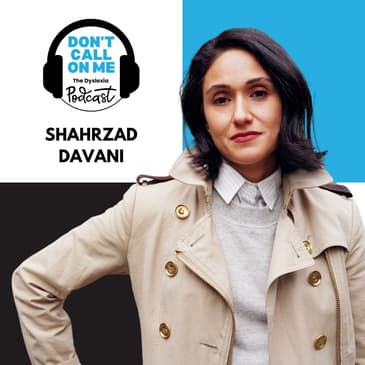
In this episode of the Don't Call On Me, The Dyslexia Podcast, Megan and Eryn sit down with Shahrzad Davani, a director, producer, and creative force behind hit projects like Abbott Elementary, St. Denis Medical, and How to Die Alone. With experience spanning directing, producing, and writing, Shahrzad has played a key role in shaping compelling narratives across film and television. Tune in as she shares insights into the entertainment industry, her creative journey, and the power of storytelling to inspire and connect audiences.
-
Book a consultation with Megan to discuss CALT therapy.
-
Book a consultation with Eryn to discuss advocacy services.
With Love and Gratitude,
Megan, Eryn & The Don't Call On Me Team
[00:00:00] I Am Who I Am Because Of Both Dyslexia and ADHD. And I think more dyslexia, like I said, you know, from like the basic things of like being able to see things nonlinear and like understand things in a kind of abstract way, but also the skill sets that I acquired out of it, like being a leader and being more verbal, all of these things wouldn't have resulted if it wasn't for the disadvantage of the other side. So there's not a really anything I would trade. It's a real, it's a better payoff in my opinion.
[00:00:30] This is Megan, owner of Dyslexia On Demand. And I'm Erin, owner of Advocate to Educate. And we are the Dont Call On Me Podcast. We are here to talk about dyslexia, to remove the stigma, to hear what families really go through, and to share their stories. In both of our businesses and personal experiences on a daily basis, we listen to people telling their stories.
[00:00:57] Many of heartbreak, many of struggle, but most all have a silver lining, even eventually. It's all about the stories. The more we share, the more we realize we aren't alone and we are a community. No, a tribe standing together. Today's episode is sponsored by Advocate to Educate.
[00:01:23] We help parents navigate through the confusing maze of special education in public schools in California. We support families starting as early as preschool through 12th grade, creating individual education plans to support the specific needs of your unique and amazing child. To learn more, go to our website, advocate2educate.com. Today's episode is sponsored by Dyslexia On Demand.
[00:01:52] Dyslexia On Demand uses only the highest trained dyslexia therapists, and it's all one-on-one and individualized to your child's needs. The best part is that it doesn't matter where you're located because it's all virtual. Visit us at dyslexiaondemand.com to learn more. Welcome back listeners to the Don't Call On Me podcast. We have a wonderful guest today with a wonderful name.
[00:02:19] And we started off before we hit record, I had asked this lovely lady, how do we pronounce your name? Because the dyslexic in me didn't want to butcher it. So I want you to tell us the history of having a complicated name, because as we'll give it away, this lovely lady also is dyslexic. So there's a story behind it. So why don't you share with us? Tell us about your name and tell us who you are and where you live.
[00:02:47] My name is Shahrazad Devani. I live in Los Angeles. My name is Persian, Iranian, and Orangian. Later discovered that my dominant dyslexic trick is phonological, right? I have a really hard time with phonics. And so my name itself can be a struggle. And actually growing up, I just opted out of using it and went with Sherry because it was simpler. And I think that my name is a storyteller, like about five years ago was really like, because I do love my namesake. It feels really connected to me.
[00:03:17] Like the, you know, Shahrazad is a storyteller and I'm a storyteller. So I really pushed through that. And I've kind of just forgiven that like everyone will say it differently and create their own nicknames, like Shah or Shah and it's fine. But as long as it like the origin is Shahrazad, I'm quite all right with it. Okay, so and Shah and I have some mutual friends. And so that's how we connected to have her on our podcast. So welcome.
[00:03:45] Thank you so much in advance for sharing your story. A lot of what Megan and I have tried to do is share our story. So the younger listeners can really hear from those of us that are not too old to be, you know, like their grandma telling them it's okay, you'll be successful eventually like that younger generation. Although we have interviewed older people, but still to like, let them know that there's a place for them in the world.
[00:04:12] And this just because they might be getting dyslexia therapy, maybe they haven't even had any treatment yet. Maybe they're young adults that have never had treatment or older people that have always been kind of hiding behind this as a disability that just gets in the way of their everyday.
[00:04:33] And so we want them to hear from those of us that are out there and public about it and willing to share the what it was like. And we want to hear all different experiences. Okay, so tell us kind of the beginning experience of school for you and what that looked like. So, yes, I was born and raised in the States. My parents are immigrants from Iran.
[00:05:00] And it was actually a real struggle, I think, because, you know, English was their second language. So I was learning most of my English through television in the home. And I would say like verbally, I was always fine, but it was the written that was a struggle. And this kind of coincides in that, like, I was diagnosed with leukemia early on. So like from like two to like, I think I went on full remission at 10.
[00:05:26] So these are like these like really like formative school years and I would miss a lot of school. So I think they like were confusing my lagging with like absentee. So like tutors and stuff. So I think there was a lot of delay in understanding that there was like a learning disability as they would call it back then. And I ended up having to do second grade repeat it, which was really hard because you always just like you feel like you're being left behind and your friends are moving forward. And I hated being the oldest kid in class.
[00:05:56] And so then I repeated the second grade and I was just always having a struggle when it came to spelling, especially. I could not get the simplest of words. And it was just that kind of thing where your parents were yelling at you at the dinner table on a Thursday night before the spelling test. Like, why can't you get this? And you're like, I just don't know. And eventually they just would. The result was to put me in like LD as they would call it back then, the learning disabled class, which was like truly the most embarrassing thing.
[00:06:24] Like, and then you'd have to like sit in like this weird hour class with like five other kids who are struggling for different. It's just like very embarrassing. And I had to do that through like seventh grade. So, you know, I would do it, but I don't really. And no shade to the teachers because they were all really great, but it didn't really help me in any way. It was just became like an anxiety that I had.
[00:06:48] Then I just went through the rest of from like eighth grade to high school without the help, but also without being diagnosed officially with dyslexia. Like, I think the title of your podcast is very accurate in that like, God, those days where you had to each read a paragraph from the book was like the most like stress inducing thing.
[00:07:08] And, but in turn, like the other things I was really great at were like when you got to do like presentations or like my presentations were always the funniest and like the biggest because like I'm really good verbally. So I would make up for it in that way. And I also became a really good leader because I would just, every time we do group projects, I'd be like, okay, so I'm going to do this and you do it. Like I'm writing, not do the thing I wanted to do by being bossy.
[00:07:36] And that like ultimately has served me for the rest of my life. So like, I'm grateful for the things that came out of that. But like, I also, so I just didn't like school. The teachers all liked me and I was popular, but I didn't enjoy school that much. So days before my first day of freshman year, I went to my guidance counselor who was like really just doing it so he could be the assistant football coach.
[00:08:00] He was like, correct me if I'm wrong, but like, if I look at what's required to graduate from high school, the only thing I need four years of is English. Everything else is three years. And he was like, correct. So I was like, so tell me, like, if I just take one summer school of English and do everything else, like starting now, I can do this in three years. And he was like, yeah. And so I was like, okay, then that's what I'm doing. And he was like, okay. Wow. And so like we rearranged, like took away electives I didn't need.
[00:08:27] And like I did the three years of every requirement, went to one summer school and did it in three years. So like I was clever to get around the things that I didn't want to do. And I think it's really funny because like even the summer school, there was the county summer school, which was like 10 hours a day and like ruling. But there was also the like one you could pay for, for like the trouble kids, which was like two hours and like not hard at all. So I was like, I'll do that. Yeah. And like the beauty of having immigrant parents is like they don't question what you're doing. Like they're just like, okay, sure.
[00:08:56] We'll sign the slip. So I'd go to like some like office building to do summer school with all the kids who got kicked out of school. So I was always finding the way around my thing to the point where like maybe up until 10 years ago, I had like a reoccurring dream that somewhere in my history, they like, like, oh, you've never actually finished this thing. Yes, I've had those dreams. I've had that too about college. Yes. It changes. Sometimes it's like as early as elementary, sometimes it's college. And then they're like, you have to go back to get your degree.
[00:09:26] And I would always end the dream with like, well, I mean, at this point, who cares? Like I want this part. But it's like always the resolve, like there's the anxiety and then there's like, so I think finally I've stopped having the dream. So I graduated in three years. I even my senior year, I took a class that gave me credits for working. So like I would leave at 1030 in the morning. Like I was really like not present in school in that way. But I graduated with like, like average grades. I would.
[00:09:54] And then like most Persians, I did two years of community college because it's cheaper and then transfer to a good university. And it was really important to my mom that I get a college degree just because she hadn't and nobody else in my family had. So it was like really this like one thing she asked. And when it came to transfer from community college, I had gotten into GW at that time. So because my grades were better in college, like I excelled a little bit better in college.
[00:10:22] And I also got into George Mason, which was like the local, like, you know, city college with like better tuition. And she was like, listen, you can go either place. But like because you really seem to not know what you want to do. Like I wasn't sure I didn't have like a real goal. She was like, if you're doing this for me, like you can go to George Mason. I'll pay for it because I can afford that. And then you can graduate and not have debt and like do whatever you want. So I took that option.
[00:10:46] And then it was there that my first, I don't know, literature class, the teacher in the first essay was like, have you ever been tested for dyslexia? Wow. And I was like, I don't know what you're talking about. No. And so she's like, I think you're dyslexic. And I think I'm grateful that I was still going to school at a time where we're still writing. It wasn't all like types. So she saw it in my like physical writing. The way I was making mistakes was very specific.
[00:11:14] And I'm really grateful to her because like she was like a young professor and like she really went out of her way to be like, this is like something that like, and it really did change like how I saw myself and everything from that point forward. And like in the same breath, I had a professor, like I was so excited to take a film studies class. Like I ultimately am a filmmaker now. And I was always passionate about film. So I was like, so excited to take like a film one-on-one class. And I was the best class, like student in like class.
[00:11:43] So I would raise my hand and like so smart and have like all these great discussions. And then the first essay we had to write about, I think it was actually like about do the right thing. And when I got the grade back, he was, he had written on top, like, I don't know how you got into college with this writing. And so I never went back and I flunked out of it because I was so embarrassed by it.
[00:12:06] And so it was like, you know, in the same place, like one teacher professor was like really trying to find the answer and the other was just like shaming me. And also in that experience, I might, first of all, like the fact that you negotiated your way through with parents who, and my husband is also, his parents are immigrants from Turkey. And he came here as a baby.
[00:12:31] So like he would always share with me how like his parents weren't the ones that he was going to, to like for advice about college, like, which is so different than my parents. He would just be like, no, I'm, I'm going, doing this. Or like after school, it was like they were working and it was, they, they didn't have a lot of say. They didn't know any better and they had to work whatever. Right.
[00:12:54] So getting through that shows that your determination of you, you had this quote thing, right? It wasn't even a diagnosis, but it came out in your writing, which you had to do. And I'm sure this is, like you said, it's not like we had AI at this time. So there, but you figured out a way, which I feel like is a very common story using your verbal strengths.
[00:13:19] And I'm sure that that teacher in college heard you speak in class and heard how bright you were in your ability to communicate. And then when you turned in that paper, I don't know if you can relate to this, but as a dyslexic, I would always write words that were much smaller in nature. Instead of saying fabulous, I would say good because I could spell good.
[00:13:42] So there's that difference of like, wait, you speak so eloquently and you're using words that obviously you sound like you're ready for college. But then I'm looking at this paper and there's a disconnect there because my guess is she knew you could have higher level discussions than what you were producing. And then the other person, and I wonder, like, did they know anybody ever who was dyslexic? Because that's such a common situation.
[00:14:09] So for his response to be that of like, how'd you even get into school? Clearly he knows nothing about the creatives that were in that class. And that's what's so appalling because the whole creative world in itself takes guts to get into because it's, and I went to Brooks. That's actually how we know our common friends. I didn't go to film school.
[00:14:37] I went to photography school, but we had mutual friends and we're shining in those schools. That's, those are our places. But for that teacher to be teaching that class, I have to say is really like disgusting that he didn't have the knowledge to know that while dyslexia is 20% of our population in that class, there was probably more like 50%. So it's, it's, it's awful to hear, but that didn't stop you.
[00:15:06] So clearly, because, you know, you might, you stopped, dropped out of that class. Yeah. And then, and then what happened? You know, and like to, you know, to speak to the, like, it's like my parents did their best, but like they just didn't know. Of course. In some ways, I kind of liked being in charge of my own, like, I didn't really want to like negotiate with them. I liked that they didn't really care about my report card. I didn't do poorly.
[00:15:33] I did well, but I think when I did succeed at things, it was for my own gratification, which is something that has carried on throughout my life versus like for someone else's approval. So in some ways it was like a real gift to be like, oh, I just like the way this feels. So I'm going to keep being good at things because I like the way it feels. And then if something doesn't feel good, I'm not going to do it.
[00:15:54] So it was definitely like, I will run away from that part of the challenge, which now I'm in my later life have learned that like, that is like, we all have to like start somewhere. So once I was diagnosed, it didn't really like super change anything like at that point, like other than it was like an understanding. And like, as you were speaking, I realized, I was like, how did I get through those first two years? And I was like, oh, right. Because like I cheated a lot.
[00:16:21] Like I had like who had already graduated college and he'd give me his papers. So we broke up and I didn't have that. So like I was like finding my way through. I cheated a lot too. And I've shared on this podcast, like honestly. Yeah. I think it was a survival skill and I like got through the language requirements, both in high school and college, because I said I spoke and wrote Farsi fluently, which is not true.
[00:16:50] I mean, I can speak and understand it, but I can't read and write. But I found a teacher who like was willing to write it and like say I could. And so like who's going to dispute it? So like I was always finding those things and like I skipped every Friday of my high school career because I hated school because I mastered how to replicate the checkout passes. And I realized that if you just go to first period, they don't call your parents and then you just show the checkout passes on Monday.
[00:17:17] And I always think I was like, if I applied all this energy for getting out of doing things, I might have been better at it. But like, I don't know. Y'all had bigger balls than I ever did. That time I am like blown away. But you know what? It didn't. I have to say that. I don't know if it was balls, but I think it was survival. And it was like, well, what else am I going to do? I'm not going to read the book. That's for sure.
[00:17:44] I was going to ask you, what were you because you mentioned spelling, which was actually very similar to me spelling even to this day. Forget it. Reading. I didn't read a book until high school. So I wasn't a big reader at all. I'm somewhere in the middle with reading. Like if it can spark enough of my attention, I can finish it. But it is a struggle. And so like I was really big into storytelling early on.
[00:18:10] And I would always write these really funny stories that in like second and third grade that like the class would always be like excited for. But then again, it was like when they got bogged down in the grammar and the spelling, it like pulled me back from it. And I do wonder sometimes like I've only returned to writing literally this year. Like as like maybe I should write a script. But like I've really avoided it my whole life because it's just too – and it's a struggle. It's hard. It's not enjoyable.
[00:18:37] And I think reading what I realized – and I don't know if this applies to – so like I try to explain this to people with like having a phonics dyslexia. It's like I don't actually read. I just have memorized a plethora of words my whole life. So I know what the word element looks like and I know these but I'm never reading it. So new words are always the struggle because I can't sound them out. Like I don't understand why this sound is connected to this like letter.
[00:19:06] And I have the hardest time with words and that's when like even when computers came into play, I still had mistakes is because like the word three and tree are not different to me. They're still the same letters. I don't understand why one has an H or one doesn't. And so like the spell check wouldn't find that mistake because it is technically spelled right. But in a word where I'd be like the three sisters are going to the store, it'd be like the tree sisters and it wouldn't pick up on that.
[00:19:34] If I have to see words in context of a sentence to like figure it out. And reading what they were saying, like the reason you stop reading is like once you hit a word that you no longer recognize, your brain starts to like go somewhere else. And like that's why you like reread a sentence a hundred times. So like it was like stop and like look up the word so that you're staying engaged. And like that helps to an extent. But it's a lot of work. It's so much work. When my mom used to be like, oh, you don't know this word? Look it up.
[00:20:03] I definitely don't read the way I should. Like I would love to read more. I think I've only started doing some audio books this year. And it's not great because I don't always like, but if I can do both at the same time, then I'm like, oh, now I'm taking it in. And like I'm one of those people when I do take in information, it's like there and it's like state. So it's like a superpower. So it's like, and like I have to read scripts all the time. Like that was like, how do you get through that? So like what would take somebody like two hours would take me four hours.
[00:20:34] But here's the flip side is that if I read that script once, I've memorized every aspect of it. It's like I really do take it in. And I think that's what made me such a great, I was a first AD for a long time and now I'm a director. But what was so good at it was that like, I really remember, I like really knew the script inside and out. Similar to what you're saying, I really have to read it myself to really take it in. And if I were and because now there's so much technology.
[00:21:02] So I think that as our brains are learning how to cope with this later in life, when we find the things that interest us, that we want to read, we figure it out. It's kind of like when kids, when we were talking about kids that are ADHD and can't focus to save their life, but their parents are like, but they can play video games for three hours. And you're like, well, because they love it. That's why. So, and they're addicting, but that's a whole nother thing.
[00:21:30] Because reading is addicting for some people, not for me. I also have ADHD, which I learned later. Okay. I think there is like a good percentage of people with dyslexia who also have ADHD. Yeah, that would be a very high percentage. They're like, not necessarily everyone with ADHD has dyslexia, but almost everybody with dyslexia has ADHD. And so like, yeah, it all goes hand in hand. It's like, I'm not receiving dopamine from this struggle, so I'm going to stop doing it. And scripts are not fun to read.
[00:22:00] The formats are not designed in a way that like it's enjoyable, even if I love the process. And I am what, I think because of my ADHD, my dyslexia, I'm one of those people where it's like, I know I can't put it off. Because if I do, like it will become really daunting. So like, and I trick my brain, I've always done this actually, where I'm like, okay, just read 20 pages and then like come back to it. And so then I'll read the 20 pages. Okay, well, I can keep going.
[00:22:24] And so like, I keep like telling myself these little like achievable goals that like once I reach it, I set another one. So that's something I've just always done to myself that helps me get through that. Like, oh, you just have to get to this point and then like, you'll be fine. I like the pressure of crunch time. I think that I don't know. I don't know how it's not a good thing. I don't like to admit it. But there's something about like, okay, it's one o'clock. I got to get the kids at three.
[00:22:52] So now you really have two hours. So hit the floor running. And then I always have to like after the kids go to bed, I have to finish everything. But because I never finish it. But you know, it's a it's it's an interesting cycle to be in. I do love how everyone operates so differently. But I want to go back a bit to elementary school, your entire K through 12.
[00:23:17] And because you were not diagnosed at that point, but obviously the school recognized that there was some struggle or they wouldn't have been pulling you out. But throughout that entire time, you clearly are and were extremely intelligent, extremely motivated, too. But we didn't have an answer to why the struggle was happening.
[00:23:42] So I want to talk a little bit or hear a little bit about how you felt internally, how you saw yourself. Was it just that you saw school as being negative? Is it that you internalized that at all? You know, tell me a little bit about that. I definitely did. And like, if anything, overcompensated in the places I excelled so that I didn't feel stupid. Like I said, like that word for the longest time had such weight.
[00:24:10] And I realize it now that it no longer does because I am certain that I am not. But it really took, you know, into my 30s to like really let go of that. Even if a friend like in a joke was like, oh, you're so stupid. Like it really hurt. It's a bad feeling, obviously. And I remember in the classes, like the LD classes, like they're like here are famous people who had learning disabilities.
[00:24:36] And like Hans Christian Andersen was always the one that like stood out like as to me because I had loved The Little Mermaid, the original because I'm like a little emo kid. And I was like, I like that she like killed herself for love. And like life is sacrifice. And so those things did really help like push you through because you're like, well, if they could do it, like I can do it.
[00:24:59] But yeah, I think you're in that like fight or flight survival mode at that point where you're not like you're just like, how do I get through today without an embarrassment? Like and then move on from it, you know. And fortunately, like I said, like I'm like a personality hire almost. I was like I made up for it and like I was funny or like, you know, the teachers always really enjoyed me. So I didn't feel like an outcast in other ways that I could make up for it.
[00:25:27] Yeah, because you definitely chose the road of motivation because I mean, even just listening to the lengths that you went through to figure out the way around it. I'm actually very impressed because so many kids take the opposite in terms of how they choose to see themselves. We're just going to not go to school. We're not going to bust our hump to figure out how to get out. So I'm very impressed with your motivation.
[00:25:54] And you obviously could see in yourself other sources of strength that really pushed you through. So then when you it was suggested to you that you might have dyslexia, where did you go to find out the diagnosis? Or was it, you know, do we ever get a clinical diagnosis? Like did somebody, did you get tested? Like fully tested? At Mason, but like I don't remember anything. There was like no resolve to it.
[00:26:23] It was just like, okay, this is what you are. And, you know, having immigrant parents are like, no, you don't. Like that's not it. You're just not applying. You're like. Yes, of course. Like that, like notion. And I only recently heard in another. And when I say read somewhere or heard, it's usually TikTok because that's usually where it but like that. We're the same. And I, right.
[00:26:53] TikTok was made for our brains. Yes. Yes. That like reading is not a natural component of our, in our brains. Like we have to force it to, but it has nothing to do with like our actual like makeup. So like, it is a made up thing. And I've like learned to be that way now when people are like, oh, that's not the right. That's not a real word or something. I'm like, they're all made up. Who cares? Like none of this is real. Like it's just made up language.
[00:27:18] Like, so why are we getting so caught up in like how one word means something and something doesn't like. So then the one thing my mom did that was hilarious in retrospect is that she had somehow heard that Tom Cruise had dyslexia and that he got it like solved through Scientology. Oh goodness. Not knowing Scientology at all was like, well, let's go and see. And so we went to like the Scientology Center in DC and they're like, yeah, no, we can totally fix her like dyslexia.
[00:27:48] And we're like, okay. And so like, we like signed up for like the first round of courses to like solve my dyslexia at my, and we sat there and like, but we like immediately realized like, this is not. This is one of the best stories I have heard in a long time. And I'm fully using that telling other people. And like, I remember we were in class and at this point I was, you know, in my 20 or like, yeah, it was probably my early twenties.
[00:28:12] And one of the first classes is like, well, when you come across friends or family who don't agree with the things you're doing, like in life and like choices you're making, you should cut them out. And I was like, oh, this is like, they're trying to like prep me for cult behavior, cut out the people who don't agree. And I was like, and my mom and I were like, okay, we're, we're, this is. Yeah. Yeah. But they still like email, like they still find you and like send you postcards. Like they never let go once you're in the system. So like, this is for the world.
[00:28:40] Like if it ever comes out that I was a Scientologist, I was not a Scientologist. I went, get dyslexic training. But it also is, if anyone ever wrongs you and you want to secretly get back at them, put the, put their name on Scientologist email list, mailing list. So they will find you forever. Oh my gosh. Okay. So I want to, cause it sounds like you fought this voice in your head that told you you were
[00:29:08] stupid, which is that word. When we're interviewing young kids, same thing. It's the, I think I'm stupid or I thought I was stupid. Now in your professional life, do you share on set? Like, does it come up like, Hey, I'm dyslexic. Like, so I'm not the one that's going to write this list or whatever. Like, okay, put it this way. We all have something, whether we're dyslexic or not. It's that inner voice that tells us we suck and all the things.
[00:29:35] And as somebody who I've done a lot of therapy to work on that and work on that inner voice and no matter what you do to help yourself to kind of push through that. I'm curious if, and how that little voice pops up day to day now, because I can say for me, it pops up. It still pops up for me. So I'm just curious how it shows up today as you're in charge of a lot of people.
[00:30:04] And so how does that voice pop up from time to time? And, and what do you do to cope with it? It's actually really fascinating because it has shifted a lot in the last couple of years. So I was a first AD for like 17 years. For our listeners, will you explain what that is? So first AD on set is in charge of everything. They're like the equivalent of like a project manager.
[00:30:29] So like you communicate to every department, you schedule it, you make sure the train is always moving is a really high responsibility, but it's technically not a creative role. Like you, the director is the creative and you are facilitating all of that creative mind. So for a long time, I was like this, you know, it does really work for my personality in that like I take charge and I can be the right brain to the left brain or whatever, vice versa. When in reality, I was actually the creative.
[00:30:58] I think I just, I didn't think it belonged to me, but that's another story. And so the things that also helped me as a filmmaker and an AD was like, I can think nonlinear, like nobody's business. And I think that is a dyslexic thing where I can see things in all different ways and it doesn't matter. And that made me really good at scheduling and editing and all of like seeing stories unfold in that way. But I skipped a step in that I didn't become a second AD, which usually you're like a second than a first.
[00:31:27] Second AD is all like the writing, like sending the emails, like doing the call sheets. And I purposely found a way around that. So I didn't have to do that job because I hated it. Like it was torture. So I made sure to find it. I somehow found a job where like I had someone who did all that and I didn't have to do it. And yes, there's always going to be occasionally someone who would like email you back who didn't know you and be like, this is spelled wrong. And like, yeah, it's embarrassing. Or you say something and you're like, I'm dyslexic.
[00:31:54] And then I think the thing that always bothered me was like, I'm like, oh yeah, I'm really dyslexic. So that happens. And they're like, yeah, me too. And you're like, everyone's like, yeah, me too. And you're like, yeah, are you like, I mean, they're like, yeah, I always like mix up letters. And you're like, okay, sure. Like nine out of 10 times they're not really dyslexic. And I'm not to like discredit people's thing, but you're like, it's got, it was such a casual thing to like say like, oh, I always like flop like numbers. And you're like. That's what I was just about to say.
[00:32:24] Yeah. They're always say that. And you're like, oh, I have no issue with numbers. I don't know why that's like a thing. Or like, do you write backwards? Or like, he's like, you know, like, no, I am genuinely dyslexic. Dyslexic. So like, that was always annoying to have to like kind of prove it. And then I did a, I guess a show called Abbott Elementary and that's about schools. Like everybody knew I was like, cause I was there. And I remember at one point the writers were like, do you mind coming to like the writer's room and talking about it? Cause we want to do an episode on it.
[00:32:54] And it was like really nice to like actually be heard and like communicate that to a group of people. And they were like, we really never understood that. And they actually wrote a really beautiful episode about it. They never used dyslexic specifically, but it is like the idea. And like, I think the kid even has immigrant parents and like how that like there's a resistance and they really took that to like tell an honest story about it. And I thought that was really beautiful.
[00:33:18] But as I got to direct and like, I came into that role and I was really good at it. Like, I think I was never as good an AD as I was a director. And like now when I make mistakes, cause we all are going to make mistakes. I'm the first to be like, I can't be good at everything guys. Like there'd be too much for you to handle if I was like good at everything. Yeah. Does not define me anymore because I have so many things that are good that do define me. And that's really clear.
[00:33:47] And I don't think it's up for debate anymore that I have really like let go of that. Like, even when you were saying this morning, you're like, don't stress. Don't worry. I was like, I stopped stressing about things like that. I, I'm not going to be the first or last person who doesn't get on this program easily. I'm not, you know, I'm so aware that we're all like doing that all the time, but it's like no longer a weight on me. And I will say that I've, I have said this to a lot of friends that like, I actually am
[00:34:16] really grateful that I was never naturally great at anything. Like I was smart, but not like, it wasn't effortless. So I think what happens is if you are just like really naturally good at something and then that you get to that first thing that you're not good at, you give up. You're like, oh, like, well, I don't have the talent. So it's not the point. And I think being kind of like mediocre underneath like underlying average and some things and
[00:34:42] pushing to the point where you get good is like, oh, you really learn that anything is possible in that way. And I think that's like helped me persevere in this career because I didn't start as like an amazing filmmaker. I always felt behind everybody else in that, like, I didn't go to film school and I didn't, I'm not like a intellectual film nerd, but like those things are achievable and you just have to put in the time. And I think the hard part to hear that is that, yes, it does take time. Like it's a really long road.
[00:35:12] I'm 45. Like it took a long time to get to this place. Yeah. But the only way to get there is with experience. There is no other shortcut. Like you must carry all of that experience and with you to be like, all right, I am confident in what I know. You're not going to be that out of the gate. You're not going to be that at 10. You're not going to be that at 20. Like it just comes with time. And it just, I always say that the three keys to life are going to be having a great attitude,
[00:35:41] working really hard and being confident. Even if you're not confident, pretending like you're confident. And you put all those three things together beautifully. So that's to me, just the story of how it works and how it fits for anyone. Because I also was pretty mediocre at everything. And that's okay. Right now, specifically in our schools, we're going through a shift and the shift is moving
[00:36:09] towards more of this, using the science of reading to teach kids, no matter whether they're dyslexic or not, but going step-by-step, getting back to phonics and all those things, but it's going to take a while. And it seems like the universities have to change their credentialing program. That's like key, which it's starting to happen. States need new legislature and new laws in effect and all of this.
[00:36:36] Now with our current potential president, God knows what's going to happen to the Department of Ed. That's a disaster, complete disaster. But either way, no matter what happens, kids are going to still need to learn to read, write, and spell. Well, now that I'm in my 40s, how old am I? I'm 42, 41. Oh my God, I forgot. Literally for 42. I'm 42. I'm 42. I don't care anymore. Just like you're saying, whatever. It doesn't define me. I don't care.
[00:37:05] I'm very open about it because it is what it is. You're right. I love that. You can't be good at everything. And who cares? I'm not going to fret on something that's like, my brain's not as plastic as it was or malleable as it was before. So let's just go with it. That's how I hope dyslexics today will present themselves and be honest. Yes, I'm dyslexic. Big deal. All right, moving on. Let's get to why I'm really here at this job because I'm not the editor here. I'm not the one writing copy right now.
[00:37:35] So there's no need to pick on my email misspelling. I'm like, no. I want to ask you what advice you would give parents going through this with their child. And also, let's say it's somebody in second grade who is noticing like that they can't keep up. What pieces of advice would you give those two individuals?
[00:38:00] I feel like something that I maybe, and I'm not an educator and you guys are, I'm very far removed. I don't have children. But I always struggle is that I think school was just always giving you information and you're supposed to just absorb information like facts. I don't know if that's really the skill set that's important as much as learning how you learn. Like, that's the key. Like, how do you as a person absorb information? And once you figure that out, like the world is your oyster.
[00:38:29] Like, you really can do anything. I learned I was a haptic learner. Like, you know, I need to have some kind of engagement with it. Like, whether it's like building something as I hear, like there has to be a connection physically to the act. Or like, if I read something, having a conversation about it immediately, it will come, like it will stick. But just reading is not going to work where some people are, you know, very visual or audio and like that is how they learn.
[00:38:55] But once you figure that out, I think like it really does change the game because it's the puzzle piece that is all missing. But who, and I understand like what teacher has time to figure out how each individual child absorbs information. And it is a mystery until you figure it out. But it does feel like a big key to the process ultimately. Yeah, absolutely. And it's not just on the teachers. I mean, the parents can support their kids in doing that too.
[00:39:22] It's not that, you know, you have to go and be identified as having special needs and assessed. I think it's really important that all kids figure out how they learn best, right? Oh, no, no. Yeah. Everybody. I think once you figure that out, it's like all of a sudden understanding a foreign language. You're like, oh, that's all I have to do. Like we do have to trick our brains into taking in information all the time. I think that's to believe otherwise is like naive. Like, oh, you just like get information and like you have it.
[00:39:51] No, like you have to figure out how you absorb it. And once you do, and that's for everybody, has nothing to do with having dyslexia or not. And, you know, I've always like said that I'm not good at facts or names, but I'm really good at concepts. Give me a theory or a concept and it will stick with me like wholeheartedly. But I won't remember what year something happened or the name of that president. That's fine to me.
[00:40:16] Like as long as I understand like the essence of the thing, like there's Google for, you know, dates and names. Right. All the specifics. Yeah. So I have a question and I feel like I might know the answer being the field that you're in, et cetera. But the concept of the gift of dyslexia, are you familiar with that concept?
[00:40:36] So how do you feel about that, about that idea of the fact that, you know, along with dyslexia comes so many strengths that really help to outweigh the negatives? I mean, I've always felt I wouldn't trade it because I think I am who I am because of both dyslexia and ADHD.
[00:40:58] And I think more dyslexia, like I said, you know, from like the basic things of like being able to see things nonlinear and like understand things in a kind of abstract way. But also the skill sets that I acquired out of it, like being a leader and being more verbal, all of these things wouldn't have resulted if it wasn't for the disadvantage of the other side. So there's not really anything I would trade. It's a real it's a better payoff, in my opinion. Yeah. In the long run. Right.
[00:41:27] And I think that a lot of times that's the perspective that we are trying to share with anyone who's listening to this, but especially the younger population. Those who are, you know, dyslexia is a journey, we always say. And depending on where you are in the journey, your viewpoint on the positive aspects probably are different. And they probably have been for you, too, on, you know, throughout your journey.
[00:41:56] But trying to share that overall, the majority, like pretty much every single person that we have interviewed up to this point, minus one who was earlier in the journey, has said, actually, I wouldn't trade it.
[00:42:11] Because it has lent me so many positive strengths out of, you know, the entire experience that I have learned about myself, others, you know, and have really contributed to my overall success. And I want to close with this.
[00:42:29] I think something that you brought up about hard work and how when you're not born with this natural skill set to do whatever it may be, it's really not about whether like life in general is not about being born with things coming easy because that you don't learn anything. When things come easy, it's just, OK, they come easy. Great. You don't even feel good about what you're doing.
[00:42:56] But when you have to work really hard and you get that feeling of like I I worked really hard and it and the outcome doesn't have to be an A. The I mean, I remember working really hard at certain things and like it would still be I'd end up with like getting a B and I was like or or a C plus. That's great. At the end of the day, just like Megan brought up the journey.
[00:43:23] If if you're in this right now and you're in the stage of you're like climbing up the mountain with that bag of rocks, you're exactly where you're supposed to be. And it's supposed to feel hard and it will pay off. Thank you so much. Yeah, we are so lucky to have you here. And we want to we want to keep in touch and see all the wonderful things you produce.
[00:43:52] And just thank you so much for being so honest and vulnerable. Thank you, guys. Thanks for having me. It was a pleasure. You're welcome. Thank you for listening to today's episode of Don't Call On Me. If you felt a connection to the stories we shared, we encourage you to engage with us online through our social media platforms and YouTube. Contribute your own experiences at Don't Call On Me dot com and help us spread the word about dyslexia.
[00:44:20] Your involvement is critical as we build and support our community. Tune in next time for more empowering stories.